Digitalowl
- Home
- Why Beginners Should Build Small Projects Before Learning Everything
- What to Power First During a 72-Hour Blackout
Recent posts
-
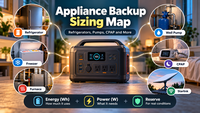
Appliance Backup Sizing Index: Refrigerators, Pumps, CPAP and More
A battery backup system that can run a refrigerator overnight may not be suitable for a well pump. A power station that supports a CPAP machine for twelve hours might provide much shorter runtime for a furnace blower. And a battery with enough stored energy may still lack the electrical output needed to start a motor. Backup battery sizing begins with the appliance, not the battery specification. …
- fridge
- home
- +5
-
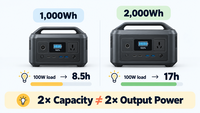
1,000Wh vs 2,000Wh Power Station: What Changes in Real Use?
A 2,000Wh portable power station stores approximately twice as much energy as a 1,000Wh model. But twice the battery capacity does not automatically mean twice the output power, faster charging or better performance in every situation. The most significant difference is how long the station can support connected equipment. A larger battery may keep a refrigerator running longer, provide more reser…
- batteries
- electricity
- +4
-
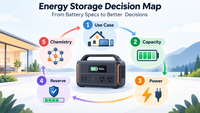
Decision Tools for Energy Storage: Turning Battery Specs Into Better Choices
A portable power station may advertise 2,000Wh of battery capacity, 2,400W continuous output, 4,000 charge cycles and multiple charging options. Every specification provides useful information, but none independently tells you whether the system is suitable for a particular application. The real challenge is not finding more battery specifications. It is turning technical measurements into practic…
- battery
- energy
- +5
-
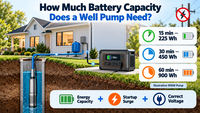
How Much Battery Capacity Does a Well Pump Need?
A well pump can provide essential household water during a power outage, but running it from a battery requires more than matching the pump's wattage to a portable power station. Well pumps can demand substantial startup power even when their total daily energy consumption is relatively modest. The battery capacity you need depends on the pump's actual electrical input, operating time, water cons…
- battery
- energy
- +5
-
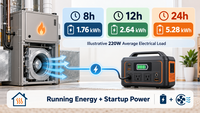
How Much Battery Capacity Does a Furnace Blower Need?
A gas furnace can produce heat using natural gas or propane, but its blower motor, control board and ignition components still need electricity. During a power outage, a battery backup system may keep the heating system operating even when the utility grid is unavailable. The battery capacity required depends on the furnace's electrical consumption, blower operating time, startup power and desire…
- battery
- energy
- +3
-
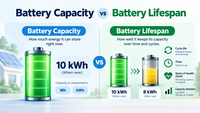
Battery Capacity vs Battery Lifespan: What’s the Difference?
Battery capacity and battery lifespan are closely related, but they are not the same thing. Capacity tells you how much energy a battery can store or deliver now. Lifespan tells you how that performance changes over time. A battery can have a large capacity and still be old. It can also have a relatively small capacity and still be in excellent health. For the broad battery-capacity framework: htt…
- batteries
- blackout
- +4
-
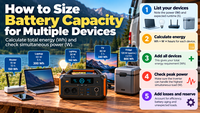
How to Size Battery Capacity for Multiple Devices
Sizing a battery for one device is relatively simple. Sizing for several devices is harder because you must answer two different questions at the same time: how much power might the devices need simultaneously, and how much energy will they consume over the full operating period? Those are not the same calculation. A system can have enough battery capacity in Wh but still fail because the inverter…
- batteries
- content
- +5
-
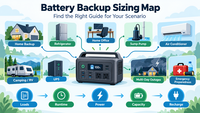
Battery Backup Sizing Map: Find the Right Guide for Your Scenario
Battery backup sizing becomes confusing when every scenario is treated as the same problem. A refrigerator, home office, air conditioner, RV and multi-day outage all require different assumptions. The easiest approach is to begin with the load and outage scenario, then move to the appropriate sizing method. This guide acts as a map across the main battery-backup use cases. Start With Three Questio…
- batteries
- blackout
- +4
-
Battery Capacity for Multi-Day Outages
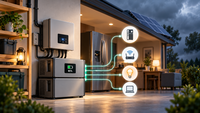
Sizing a battery for a few hours of backup is relatively simple. Multi-day outages are harder because energy use accumulates, weather can affect solar recharging, and essential loads may change from one day to the next. A useful starting point is: daily energy use × number of days = base storage requirement Then adjust for: solar or generator recharging; conversion losses; reserve capacity; exp…
- batteries
- blackout
- +3
-
Battery Capacity for Camping and RV Use
Battery sizing for camping or RV use is not really about choosing between a 1 kWh, 2 kWh or 4 kWh power station. The useful starting point is simpler: How much energy will you use during one day away from the grid? A weekend setup with LED lights, phones and a small fridge may need relatively little stored energy. Add laptops, cooking appliances, water pumps or air conditioning, and the requiremen…

- blackout
- electricity
- +4
-
How Much Battery Capacity Does an Air Conditioner Need?
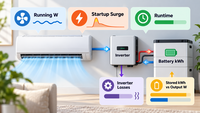
Air conditioning can be one of the most demanding loads in a home-backup system. Unlike a router or laptop, an air conditioner may draw hundreds or even thousands of watts while operating. Many models also use a compressor that can create a short startup surge significantly above normal running power. That means AC backup requires answering two different questions: Can the inverter start and run t…
- batteries
- electricity
- +3
-
How Much Battery Capacity Does a Home Office Need?
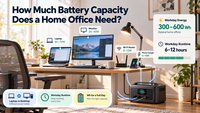
A home office looks simple from a backup-power perspective. A laptop, monitor, router and phone charger seem like small loads compared with appliances such as air conditioners or heaters. But home-office battery sizing still depends on one thing many people underestimate: how long all of those devices need to stay powered together. A 60 W laptop running for one hour is a small energy load. The sam…
- batteries
- electricity
- +4
-
Portable Power Station Capacity Explained
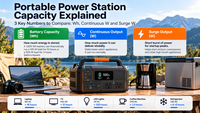
Portable power stations are often compared by one large number on the product page. Sometimes it is 500 Wh, 1,024 Wh or 2,048 Wh. That number matters, but it does not tell you everything the power station can do. To understand whether a portable power station fits a real use case, you need to separate three specifications: Battery capacity in Wh → Continuous output in W → Surge output in W Capacit…
- batteries
- electricity
- +4
-
Battery Charging and Solar Recharging: From Input Watts to Stored Energy
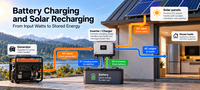
Battery capacity tells you how much energy a battery can store. Charging tells you how quickly — and under what conditions — that stored energy can be replaced. Those two sides of the system are closely connected, but they are not the same thing. A large battery can charge slowly. A smaller battery can charge quickly. A powerful solar array may still be limited by the battery system's input electr…
- batteries
- portable-power-stations
- +2
-
What Are Solar Input Limits?
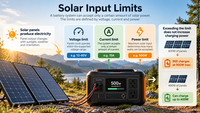
Adding more solar panels seems like the obvious way to charge a battery faster. Sometimes it works. Sometimes it does almost nothing. The difference often comes down to solar input limits — the electrical boundaries that determine how much solar power a battery system, charge controller or portable power station can actually accept. These limits are usually defined by three numbers: maximum input …
- batteries
- electricity
- +3
-
How Solar Recharging Changes Battery Capacity Needs
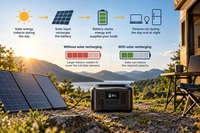
Battery sizing is often treated as a simple question: how much energy will your devices consume before the battery can be charged again? Solar changes that calculation. If a battery can receive meaningful energy during the same period in which loads are running, it does not necessarily need to store the entire day’s energy demand in advance. Part of that demand can be supplied by energy collected …
- batteries
- electricity
- +3