Battery Capacity for Multi-Day Outages

Sizing a battery for a few hours of backup is relatively simple. Multi-day outages are harder because energy use accumulates, weather can affect solar recharging, and essential loads may change from one day to the next.
A useful starting point is:
daily energy use × number of days = base storage requirement
Then adjust for:
solar or generator recharging;
conversion losses;
reserve capacity;
expandable storage.
For the broader battery-capacity framework:
https://medium.com/@volodymyrzh/battery-capacity-explained-mah-wh-amp-hours-decoded-1dc676be5a38
Start With Daily Energy, Not Battery Size
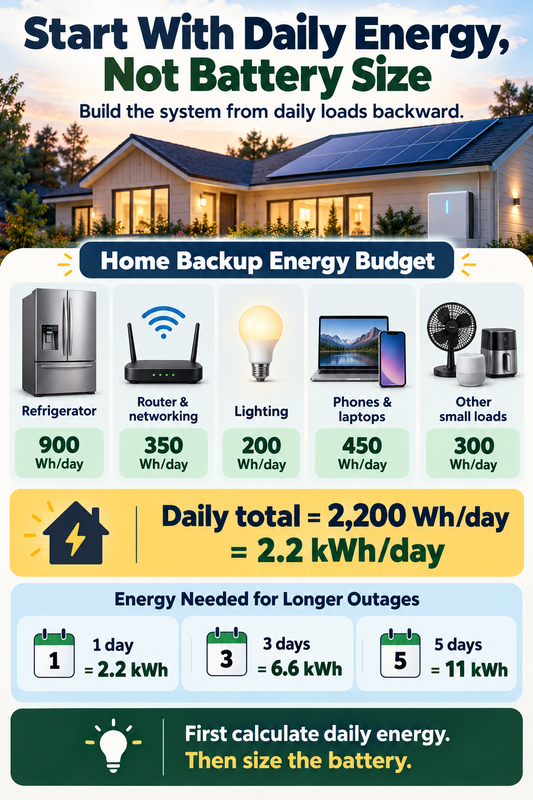
A multi-day backup system should be built from the load budget backwards.
Suppose your essential loads are:
Refrigerator: 900 Wh/day
Router and networking: 350 Wh/day
Lighting: 200 Wh/day
Phones and laptops: 450 Wh/day
Other small loads: 300 Wh/day
Daily total:
2,200 Wh = 2.2 kWh/day
For one day:
2.2 kWh
For three days:
6.6 kWh
For five days:
11 kWh
before losses, reserve and recharging.
This is why even moderate household loads can require large batteries when the outage lasts several days.
The broader home-backup sizing process is covered here:
https://digitalowl.fika.bar/how-much-battery-capacity-do-you-need-for-home-backup-01M41CTYZGP56F26YBTXNACTW5
Separate Essential Loads From Optional Loads
Multi-day backup becomes easier when loads are divided into priorities.
Tier 1 — essential
refrigeration;
communication;
basic lighting;
critical networking;
necessary pumps or controls.
Tier 2 — useful
laptops;
televisions;
additional lighting;
small kitchen appliances.
Tier 3 — high-energy optional
air conditioning;
electric heating;
large cooking appliances;
workshop equipment;
other high-power devices.
The goal is not necessarily to power the entire home normally for several days. Reducing daily energy use can have a larger effect than simply adding more battery capacity.
Small Daily Savings Multiply
Suppose essential backup normally requires:
3 kWh/day
Over four days:
3 × 4 = 12 kWh
Reduce consumption by only:
500 Wh/day
The new daily requirement becomes:
2.5 kWh
Over four days:
2.5 × 4 = 10 kWh
That saves:
2 kWh of stored energy
This is one of the key differences between short and long outages: every daily saving is multiplied by duration.
Solar Recharging Changes the Calculation
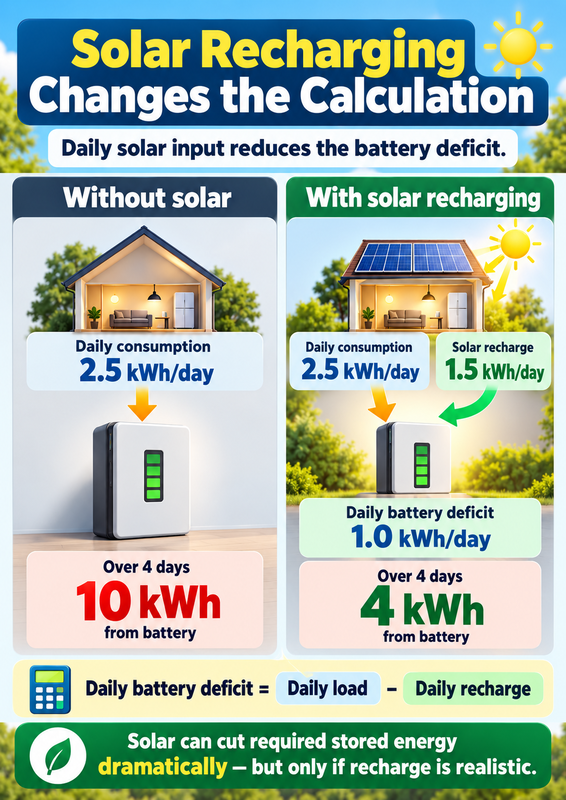
A multi-day outage does not always mean the battery must store every Wh required for the entire period.
Suppose:
Daily consumption = 2.5 kWh
Solar recharge = 1.5 kWh/day
Daily battery deficit:
2.5 − 1.5 = 1.0 kWh/day
Over four days:
4 kWh
of net stored energy is consumed instead of the full:
10 kWh
required with no recharging.
More on this relationship:
https://digitalowl.fika.bar/how-solar-recharging-changes-battery-capacity-needs-01M3PGEW71ED2G597CTNXN0BG3
But Solar Is Not Guaranteed
Multi-day outages can overlap with poor weather.
Suppose daily consumption remains:
2.5 kWh
On a good solar day:
2.0 kWh generated → 0.5 kWh deficit
On a cloudy day:
0.6 kWh generated → 1.9 kWh deficit
On a very poor day:
0.2 kWh generated → 2.3 kWh deficit
A system sized around ideal solar conditions can therefore fail when resilience matters most.
At minimum, model:
expected recharge;
poor-weather recharge.
Example: Three-Day Outage Without Solar
Assume essential loads use:
2 kWh/day
For three days:
2 × 3 = 6 kWh
Now allow about 15% for losses and reserve:
6 × 1.15 = 6.9 kWh
A practical target could therefore be around:
7 kWh
depending on battery chemistry, inverter efficiency and reserve strategy.
Example: Three-Day Outage With Solar
Use the same:
2 kWh/day
Suppose solar provides:
1.2 kWh/day
Daily deficit:
2.0 − 1.2 = 0.8 kWh
Over three days:
0.8 × 3 = 2.4 kWh
The stored-energy requirement falls sharply, but only if solar production actually occurs. A resilient system may still need several additional kWh of reserve for poor weather.
Runtime Is Not Always Perfectly Linear
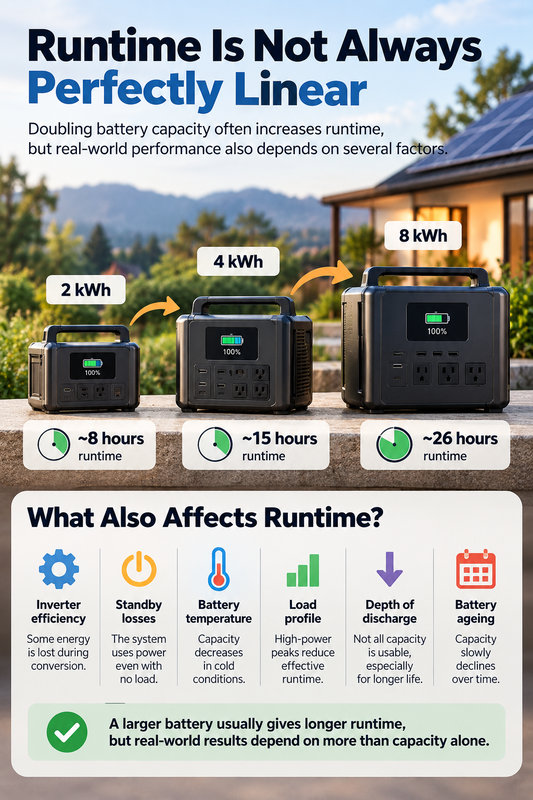
Doubling battery capacity often approximately doubles runtime in a simplified model, but actual performance can also depend on:
inverter efficiency;
standby losses;
battery temperature;
load profile;
depth-of-discharge limits;
battery ageing.
The energy-budget method remains useful, but reserve matters.
Expandable Batteries Can Change the Strategy
Instead of buying maximum storage immediately, some systems support expansion batteries.
For example:
4 kWh → 8 kWh → 12 kWh
as needs increase.
More on expandable capacity:
https://digitalowl.fika.bar/what-is-expandable-battery-capacity-01M3AN3GFYFR9MDEEQESPCNH27
Expansion can be useful when:
loads increase;
expected outages become longer;
solar capacity grows;
household energy use changes.
Compatibility and manufacturer limits still matter.
Stored Energy and Recharge Capacity Work Together
Multi-day resilience should not be judged by battery capacity alone.
Consider:
System A
10 kWh battery
0.5 kWh/day recharge
System B
6 kWh battery
2 kWh/day recharge
Depending on consumption and weather, System B could remain useful longer despite having the smaller battery.
Long-duration resilience depends on both:
stored energy + replenishment
Multi-Day Sizing Is Similar to Renewable-Energy Storage
The same logic appears in larger renewable-energy systems:
estimate load → estimate generation → calculate deficit → size storage → add reserve
A household outage scenario is smaller in scale, but the underlying storage problem is similar.
A broader explanation is available here:
https://www.linkedin.com/pulse/how-calculate-battery-storage-renewable-energy-systems-zhyliaev-5ovlf/
The important point is that storage should be sized from the relationship between demand and replenishment, not from an isolated battery number.
Generator Charging Can Reduce Battery Reserve
Solar is not the only way to replenish stored energy.
A backup system might use a generator and size the battery for only one or two days of autonomy before recharging.
This can reduce required battery capacity, but it adds dependence on:
fuel availability;
generator reliability;
charging power;
practical charging frequency.
The right balance depends on the resilience strategy.
Build Several Scenarios Instead of One
A single calculation can create false confidence.
Model at least three consumption cases:
Normal conservation: 2.0 kWh/day
Heavy use: 3.0 kWh/day
Emergency conservation: 1.2 kWh/day
Then test each against:
good solar;
poor solar;
no solar.
That gives a useful range instead of one fragile estimate.
A Practical Multi-Day Battery Sizing Workflow
List essential loads. Separate essentials from comfort and optional loads.
Calculate daily Wh or kWh. Use realistic operating time.
Choose the autonomy period. Decide whether the system should cover two, three, five or more days.
Calculate base energy.
Daily energy × days = base storage needEstimate daily recharging. Include solar or generator input separately.
Model poor-recharge conditions. Do not size only for perfect weather.
Account for losses and reserve. Nominal capacity should exceed the exact calculated demand.
Consider expansion. Modular storage can allow the system to grow later.
A Useful Simplified Formula
For planning:
Required stored energy ≈ (daily load − daily recharge) × days
Then increase the result for:
losses + reserve
Example:
Daily load = 2.5 kWh
Daily recharge = 1.0 kWh
Duration = 4 days
Net deficit:
2.5 − 1.0 = 1.5 kWh/day
Over four days:
1.5 × 4 = 6 kWh
After losses and reserve, the practical target may move above:
7 kWh
depending on the system.
Multi-Day Backup Is About the Energy Deficit
The central question is not:
“How many kWh of battery do I need?”
A better question is:
“How much energy will I consume each day, and how much can I realistically replace?”
For short outages, stored battery energy dominates. For multi-day outages, the relationship between consumption, recharging and reserve becomes much more important.
Start with the daily energy budget, multiply it across the outage period, subtract realistic replenishment, and then add losses and reserve. That gives a much more resilient battery target than simply choosing the largest battery available.
Comments
No comments yet. Be the first to comment!