How Much Battery Capacity Does a Furnace Blower Need?
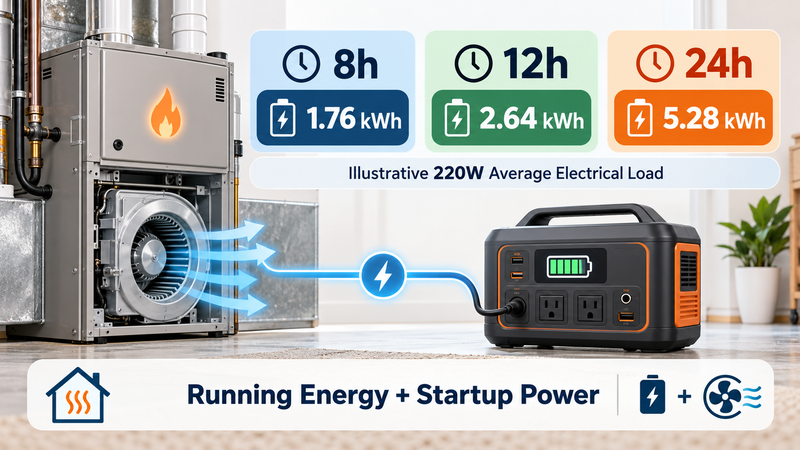
A gas furnace can produce heat using natural gas or propane, but its blower motor, control board and ignition components still need electricity. During a power outage, a battery backup system may keep the heating system operating even when the utility grid is unavailable.
The battery capacity required depends on the furnace's electrical consumption, blower operating time, startup power and desired backup duration. A blower rated at 500 W does not necessarily consume 500 W continuously because the heating system may operate in cycles.
For many gas furnaces, a battery backup calculation starts with the blower and supporting electronics rather than the thermal output of the furnace. However, an electric resistance furnace or heat pump can have substantially different electrical requirements.
How Much Electricity Does a Furnace Blower Use?
A furnace blower distributes heated air through the home's ductwork. Its electrical consumption depends on motor design, airflow demand, operating speed and system condition.
Traditional permanent split capacitor (PSC) motors and modern electronically commutated motors (ECMs) may have different consumption patterns.
For illustration, consider several hypothetical running-power levels:
150 W: a relatively low-power blower operating under suitable conditions.
300 W: a moderate electrical load.
500 W: a higher-power blower.
700 W: a more demanding blower or operating configuration.
These values are examples, not verified specifications for a particular furnace. Actual power should be measured or obtained from manufacturer documentation.
The furnace may also consume electricity through ignition systems, controllers, inducer fans and other components.
Consequently, blower wattage alone may underestimate the electrical power required by the complete heating system.
Why Running Watts and Starting Watts Are Different
A blower motor may briefly require more power when starting than during normal operation.
This creates two separate requirements for a battery backup system.
Running watts describe the power needed while the equipment operates normally.
Starting watts describe the potentially higher short-duration demand associated with motor startup.
Suppose a hypothetical blower uses 400 W during operation but requires an 850 W starting surge.
A battery system with a 500 W continuous output rating might support the blower's normal consumption yet fail to start it if the surge capability is insufficient.
The exact starting requirement depends on the motor and furnace design. Variable-speed motors may behave differently from conventional motors.
For a detailed explanation, see Starting Watts vs Running Watts:
https://digitalowl.fika.bar/starting-watts-vs-running-watts-01M2K3FNMK1HM1FQDAYVFRT1PM
Practical rule: use watt-hours to calculate required energy, but verify continuous and startup watts before selecting an inverter or power station.
How Furnace Blower Duty Cycle Affects Battery Runtime
A gas furnace typically operates in heating cycles. Its blower may switch on when heat is required and stop after the heating cycle ends.
This means its electrical consumption is not necessarily continuous.
Duty cycle describes the percentage of time the equipment operates during a defined period.
The simplified formula is:
Duty Cycle (%) = Running Time ÷ Total Time × 100
For example, if a blower operates for 20 minutes during each hour:
20 ÷ 60 × 100 ≈ 33% duty cycle.
If it runs for 30 minutes per hour, its duty cycle is 50%.
However, actual blower operation depends on thermostat settings, outdoor temperature, building insulation, furnace controls and whether the fan is configured for continuous circulation.
For battery planning, a duty cycle estimated during mild weather may not represent a cold night with substantial heating demand.
Example: A 400 W Furnace Blower Running Half the Time
Consider a hypothetical gas furnace with these electrical requirements:
Blower operating power: 400 W.
Blower duty cycle: 50%.
Additional average furnace electronics consumption: 20 W.
Backup period: 8 hours.
The blower's average power contribution is:
400 W × 0.50 = 200 W.
Adding the assumed average electronics consumption:
200 W + 20 W = 220 W.
The estimated eight-hour electrical energy requirement becomes:
220 W × 8 h = 1,760 Wh.
This is the energy required by the furnace under the stated assumptions, before additional battery-system losses and reserve.
For a twelve-hour outage:
220 W × 12 h = 2,640 Wh.
For a full twenty-four hours:
220 W × 24 h = 5,280 Wh.
The difference between eight and twenty-four hours is substantial. Backup duration is therefore as important as blower power when choosing battery capacity.
Battery Capacity Needed for 8, 12 and 24 Hours
Using the same hypothetical 220 W average furnace demand:
8-hour outage
Average power: 220 W.
Energy requirement: 1,760 Wh.
Equivalent: 1.76 kWh.
12-hour outage
Average power: 220 W.
Energy requirement: 2,640 Wh.
Equivalent: 2.64 kWh.
24-hour outage
Average power: 220 W.
Energy requirement: 5,280 Wh.
Equivalent: 5.28 kWh.
These values represent appliance-level energy demand, not the nominal battery capacity required.
A battery system must also account for inverter efficiency, usable battery capacity and operating reserve.
If the furnace operates more frequently during colder weather, the energy requirement may increase.
How to Include Inverter Losses and Battery Reserve
A portable power station or home backup battery may convert stored DC electricity into AC electricity for the furnace.
This conversion involves losses.
A simplified battery sizing formula is:
Required Nominal Capacity (Wh) = Appliance Energy (Wh) ÷ Delivery Factor × Reserve Factor
Suppose the furnace requires 1,760 Wh for eight hours.
Assume:
Illustrative battery-to-load delivery factor: 85%.
Additional planning margin: 20%.
The calculation becomes:
1,760 ÷ 0.85 × 1.20 ≈ 2,485 Wh.
Under those assumptions, the eight-hour scenario calls for approximately 2.5 kWh of nominal battery capacity.
Using the same assumptions:
8 hours: approximately 2.5 kWh.
12 hours: approximately 3.7 kWh.
24 hours: approximately 7.5 kWh.
These are planning examples rather than universal furnace backup recommendations. The 85% delivery factor and 20% margin must be adjusted to reflect the actual system.
The broader methodology is covered in How Much Battery Capacity Do You Need for Home Backup?
The most reliable result comes from measured furnace energy demand and manufacturer-verified battery specifications.
Why a Smaller Furnace May Need Less Battery Capacity
Not every heating system needs a large battery.
Imagine a more efficient hypothetical furnace with:
Blower running power: 150 W.
Duty cycle: 40%.
Additional average electronics consumption: 10 W.
Average electrical demand:
(150 × 0.40) + 10 = 70 W.
For eight hours:
70 W × 8 h = 560 Wh.
Using the same illustrative delivery factor and planning margin:
560 ÷ 0.85 × 1.20 ≈ 791 Wh.
Under these conditions, the nominal planning target is approximately 800 Wh.
Compare that with the previous 400 W blower example, which required approximately 2.5 kWh under its assumptions.
The difference demonstrates why generic recommendations based only on the word "furnace" can be misleading.
Actual electrical demand matters more than the heating system's thermal capacity rating.
Gas Furnace vs Electric Furnace: A Critical Difference
Gas furnaces and electric resistance furnaces should not be treated as equivalent battery backup loads.
Gas furnace: fuel provides most of the heat, while electricity powers the blower, ignition, controls and other supporting components.
Electric resistance furnace: electrical energy produces the heat directly. Heating elements may require several kilowatts or more, depending on system design.
Heat pump: electricity drives a refrigeration cycle to transfer heat. Compressor demand, auxiliary heating and defrost operation can substantially affect electrical consumption.
A battery system suitable for the blower of a gas furnace may be completely inadequate for electric resistance heating or a heat pump.
For example, a hypothetical 10 kW electric heating load operating continuously for eight hours would require:
10,000 W × 8 h = 80,000 Wh, or 80 kWh.
That is dramatically higher than the energy requirement of a cycling gas-furnace blower.
Before calculating backup capacity, identify which components require electricity and whether the heating system includes electric heating elements.
Can a Portable Power Station Run a Furnace Blower?
Potentially, but electrical compatibility is essential.
A portable power station must provide sufficient continuous output and startup surge capability. It must also be compatible with the furnace's electrical configuration.
Some furnaces require appropriate grounding, neutral bonding, polarity or other installation conditions for their safety and flame-sensing systems.
A standard portable power station outlet is not automatically suitable for connection to a hardwired heating system.
Never backfeed a household circuit through an ordinary receptacle or use improvised wiring to power a furnace.
A qualified electrician or HVAC professional should determine the appropriate connection method, transfer equipment and compatibility with the furnace and local electrical requirements.
For hardwired systems, the electrical connection can be as important as the battery capacity.
What if the Battery Must Power Other Devices Too?
During an outage, the furnace may not be the only essential load.
A home backup system may also support:
Internet router and modem.
LED lighting.
Refrigerator.
Communication equipment.
Medical devices with appropriate backup requirements.
Each load contributes to the total energy requirement.
Consider the earlier eight-hour furnace example requiring 1,760 Wh.
Add:
Router: 15 W × 8 h = 120 Wh.
Lighting: 20 W × 5 h = 100 Wh.
Refrigerator: assumed 400 Wh over the period.
Combined appliance energy requirement:
1,760 + 120 + 100 + 400 = 2,380 Wh.
With the illustrative 85% delivery factor and 20% planning margin:
2,380 ÷ 0.85 × 1.20 ≈ 3,360 Wh.
This raises the nominal planning target to approximately 3.4 kWh.
The correct approach to combining appliance loads is described in How to Size Battery Capacity for Multiple Devices:
You must also check maximum simultaneous running power and overlapping startup surges.
A Practical Backup-Capacity Decision Framework
Furnace backup sizing is part of a wider household energy-planning problem.
The most useful workflow begins with the electrical loads, not with a particular battery product.
Step 1: Identify the heating system and every electrical component required for operation.
Step 2: Measure or document normal running power and startup requirements.
Step 3: Estimate realistic operating time and duty cycle during the expected outage.
Step 4: Calculate energy consumption in Wh.
Step 5: Add other essential household loads.
Step 6: Account for battery-to-load losses, reserve margin and possible recharging.
Step 7: Verify power station or inverter compatibility and safe installation.
The cross-system decision process is developed further in the LinkedIn article From Energy Loads to Backup Capacity: A Practical Sizing Framework:
This is especially useful when selecting one battery system for several appliances instead of treating the furnace as an isolated load.
How to Measure Furnace Electricity Consumption
A reliable estimate should be based on the actual furnace whenever possible.
Start with the equipment documentation and identify the blower motor, inducer motor and other electrical components.
If the furnace uses a hardwired electrical connection, do not attempt to insert an ordinary plug-in energy meter into the circuit.
A qualified electrician or HVAC professional can help measure consumption safely using suitable equipment.
Useful measurements include:
Power demand during normal blower operation.
Startup demand.
Energy consumption across multiple heating cycles.
Consumption when the blower is inactive.
Behaviour during colder operating conditions.
If you can obtain the total Wh consumed over a representative period, divide by the duration to calculate average electrical power.
For example, a furnace consuming 1,800 Wh over ten hours has an average demand of:
1,800 Wh ÷ 10 h = 180 W.
That measured average can provide a stronger basis for battery sizing than a generic blower wattage estimate.
Common Furnace Battery Backup Mistakes
Mistake 1: Confusing Heat Output With Electrical Power
A gas furnace's heating capacity in BTU/h does not directly describe the electricity needed by its blower and controls.
Mistake 2: Assuming the Blower Runs Continuously
Duty cycle can substantially affect energy consumption. However, conservative planning is appropriate during very cold weather.
Mistake 3: Ignoring Starting Watts
Adequate battery capacity does not guarantee that the inverter can start the blower motor.
Mistake 4: Overlooking Furnace Electrical Compatibility
A power station may have enough watts and watt-hours but still be unsuitable without an approved connection arrangement.
Mistake 5: Forgetting Other Loads
A furnace backup battery may also need to support essential devices during an outage.
Avoiding these mistakes produces more reliable capacity estimates.
Final Furnace Backup Sizing Checklist
Before choosing a battery, confirm:
Heating system type: gas furnace, electric resistance furnace or heat pump?
Electrical running demand: how many watts does the complete required system use?
Startup requirements: can the inverter handle motor starting demand?
Duty cycle: how often will the blower operate during cold conditions?
Backup duration: eight, twelve, twenty-four hours or longer?
Battery energy: how much usable energy will be available?
Additional loads: what other essential devices need backup power?
Electrical compatibility: is the connection method approved and safe?
Recharging: how will the battery be replenished during extended outages?
The most important distinction is between the furnace's actual electrical consumption and the amount of heat it produces.
A gas furnace may require a manageable amount of electricity for its blower and controls, while electric heating systems can demand much larger amounts of power.
Final Takeaway
Furnace blower battery capacity depends on running power, duty cycle, backup duration, conversion losses and reserve energy.
In one illustrative scenario, a gas furnace averaging 220 W requires 1,760 Wh for eight hours before system losses. With an 85% delivery factor and a 20% planning margin, the nominal battery target increases to approximately 2.5 kWh.
A more efficient furnace with lower electrical demand may require much less energy, while an electric resistance furnace or heat pump may need substantially more.
Before buying a battery, measure the actual furnace demand, verify startup power and confirm electrical compatibility.
The practical rule: calculate watt-hours from realistic furnace operation, verify starting watts separately and choose a safe backup connection before relying on the system during an outage.
Comments
No comments yet. Be the first to comment!