Does a Bigger Inverter Drain a Battery Faster?
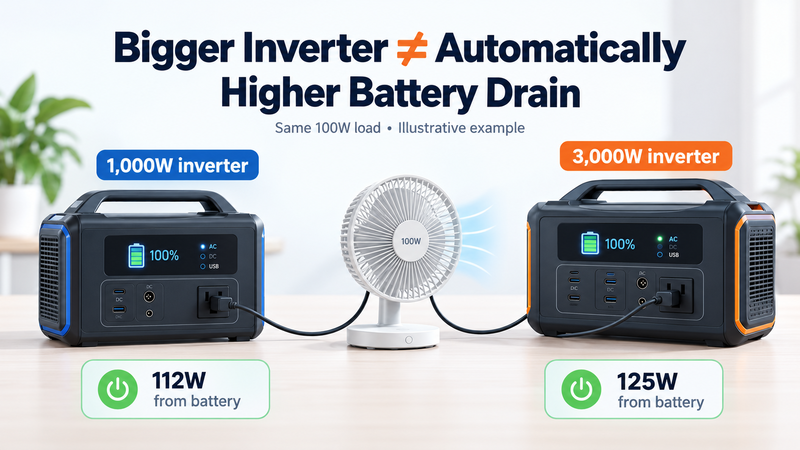
A portable power station with a 3,000W inverter does not automatically drain its battery faster than a station with a 1,000W inverter when both are powering the same 100W appliance. An inverter's rated output describes how much power it can supply, not how much electricity it continuously consumes.
However, a larger inverter may have different idle consumption, conversion efficiency and operating characteristics. Those differences can affect battery runtime, particularly when the connected appliance uses relatively little power.
The practical question is not simply whether a bigger inverter consumes more energy. It is how much power the complete system draws from the battery while supplying the actual load.
What Does Inverter Size Actually Mean?
Inverter size usually refers to the device's rated electrical output, commonly expressed in watts (W).
For example:
A 1,000W inverter may supply up to 1,000W continuously under its specified operating conditions.
A 2,000W inverter may support a higher continuous load.
A 3,000W inverter may operate more demanding appliances or combinations of devices.
These ratings describe output capability, not continuous battery consumption.
A 3,000W inverter powering a compatible 100W lamp does not continuously deliver 3,000W. It supplies approximately the power demanded by the lamp, plus energy required to operate the inverter and compensate for conversion losses.
The rated output still matters because an appliance must remain within the inverter's supported electrical limits.
For a detailed explanation, see What Is Continuous Power Output?
https://digitalowl.fika.bar/what-is-continuous-power-output-01M2JYJBJJHR19Q9ZVAPNTN5GX
The essential distinction: maximum inverter output and actual operating power are two different measurements.
Why Actual Appliance Power Matters More Than Inverter Rating
Suppose two power stations have the same usable battery-energy budget.
Station A uses a 1,000W inverter, while Station B uses a 3,000W inverter.
Both are connected to an identical 200W appliance.
In an ideal system with no conversion losses or internal consumption, both would draw 200W from their batteries.
The larger inverter would not automatically consume three times as much electricity simply because its rated output is three times higher.
Real systems are not perfectly efficient, though.
The battery must provide enough energy for both the connected appliance and the inverter's operating losses.
A simplified relationship is:
Battery Input Power = AC Load Power ÷ Inverter Efficiency
If additional idle or auxiliary consumption has not already been included in that efficiency figure, it must also be considered.
This is where the actual difference between inverter models becomes important.
How Inverter Efficiency Changes Battery Drain
Inverter efficiency describes the relationship between electrical power received from the battery and useful electrical power delivered to the connected load.
A simplified formula is:
Efficiency (%) = AC Output Power ÷ DC Input Power × 100
Consider a 200W AC appliance.
If an inverter operates at 90% efficiency at that load:
200W ÷ 0.90 ≈ 222W battery input.
If another inverter operates at 85% efficiency:
200W ÷ 0.85 ≈ 235W battery input.
The less efficient inverter requires approximately 13W more battery power under these assumptions.
Over ten hours, that difference becomes approximately 130Wh.
These percentages are illustrative, not specifications for particular inverter sizes.
A larger inverter might be more efficient, less efficient or similarly efficient at a given load. Its rated capacity alone does not establish the result.
For the underlying principle, see What Is Inverter Efficiency?
https://app.fika.bar/blog/post/what-is-inverter-efficiency-01M2K65Q757EW3H13TCFP3JFJ7
The important comparison is efficiency at the actual operating load, not merely the inverter's advertised peak efficiency.
Why Bigger Inverters May Have Higher Idle Consumption
An inverter can consume electricity even when no appliance is connected.
Internal control electronics, monitoring circuits and power-conversion components may remain active while the AC output is enabled.
This background consumption is often called idle or no-load power.
Some higher-output inverters have greater idle consumption than smaller models, but this is not a universal rule.
Design quality, circuit topology, operating modes and power-management features can produce substantial differences.
Consider two hypothetical inverters:
Inverter A: 1,000W rating and 5W idle consumption.
Inverter B: 3,000W rating and 15W idle consumption.
If both remain enabled for twelve hours without an external load:
Inverter A: 5W × 12h = 60Wh.
Inverter B: 15W × 12h = 180Wh.
The second system would consume an additional 120Wh under these assumptions.
However, actual products may behave differently, and idle-power specifications should be verified rather than inferred from inverter size.
A detailed explanation is available in Standby Power Consumption:
https://app.fika.bar/blog/post/standby-power-consumption-01M2N3G16AGDKD6RQPH2K3S8NE
Same Load, Different Inverters: A Runtime Example
Consider two hypothetical battery systems, each with 1,000Wh of energy available at the DC input.
Both operate a constant 100W AC appliance.
For this simplified comparison, assume the total measured battery-side power draw already includes conversion losses and inverter operating consumption.
System A — Smaller Inverter
Inverter rating: 1,000W.
AC appliance demand: 100W.
Total battery-side demand: 112W.
Estimated runtime:
1,000Wh ÷ 112W ≈ 8.9 hours.
System B — Larger Inverter
Inverter rating: 3,000W.
AC appliance demand: 100W.
Total battery-side demand: 125W.
Estimated runtime:
1,000Wh ÷ 125W = 8 hours.
In this hypothetical comparison, the larger inverter delivers approximately 54 minutes less runtime.
But the difference comes from its higher assumed battery-side consumption, not from its rated 3,000W output alone.
A well-designed larger inverter with lower losses could potentially perform better than a smaller, less efficient inverter.
Inverter size is not a reliable substitute for actual consumption measurements.
Why Light Loads Can Expose Inverter Inefficiency
Inverter efficiency is not necessarily constant across its entire operating range.
Some inverters perform most efficiently at moderate loads and less efficiently when output power is very low relative to their rated capacity.
This can matter when a high-output inverter is used mainly to power routers, LED lights or small electronic devices.
For example, a 20W appliance represents:
2% of a 1,000W inverter's rated output.
1% of a 2,000W inverter's rated output.
Approximately 0.67% of a 3,000W inverter's rated output.
These percentages describe load relative to rating; they do not directly reveal efficiency.
However, they explain why efficiency curves and low-load consumption measurements are relevant.
If the inverter uses 10W internally while supplying a 20W appliance, the internal demand becomes a substantial proportion of the total energy requirement.
For low-power overnight applications, this can meaningfully reduce battery runtime.
Does a Larger Inverter Drain the Battery Faster at High Loads?
Not necessarily.
At higher loads, a larger inverter may operate closer to an efficient region of its design while a smaller inverter operates near its maximum supported output.
Alternatively, the smaller inverter may still be more efficient because of its design.
The correct comparison depends on verified performance at the same output load.
For example, suppose both inverters supply 800W.
If the smaller inverter operates at 91% efficiency:
800W ÷ 0.91 ≈ 879W input.
If the larger inverter operates at 93% efficiency:
800W ÷ 0.93 ≈ 860W input.
Under those illustrative conditions, the larger inverter would consume less battery energy.
The outcome reverses if their efficiencies reverse.
Therefore, conclusions about battery drain should be based on measured or documented efficiency, not inverter rating alone.
What Happens When No Appliances Are Connected?
An inverter's AC output can remain enabled even when all appliances are disconnected.
Depending on the design, it may continue consuming power to maintain the AC waveform and internal electronics.
This can be particularly relevant during extended outages when a power station remains switched on overnight.
For example, a continuous no-load consumption of 8W requires:
8 hours: 64Wh.
12 hours: 96Wh.
24 hours: 192Wh.
Over several days, these small loads accumulate.
Some systems provide eco modes or automatic output shutdown features that can reduce unnecessary consumption.
However, automatic shutdown may interrupt equipment with very low electrical demand.
Before enabling such features, confirm that they are compatible with the intended application.
Can Using DC Outputs Improve Battery Runtime?
Sometimes.
When an appliance supports a suitable direct-DC connection, it may be possible to avoid operating the AC inverter entirely.
For example, certain routers and electronic devices can operate through manufacturer-compatible regulated DC power supplies.
Using a suitable DC output may eliminate one conversion stage and reduce inverter idle consumption.
However, DC converters also have losses.
The result depends on the power station's architecture, output efficiency and the equipment's electrical requirements.
Never connect devices to incompatible DC voltages, polarities or connectors solely to improve runtime.
Where both AC and DC operation are officially supported, comparing their measured energy consumption can help identify the more efficient setup.
Does a Bigger Inverter Mean a Bigger Battery?
No.
Inverter power and battery capacity are independent specifications.
A power station can combine a high-output inverter with a relatively small battery.
Another product may have lower output power but much greater stored energy.
For example:
Station A
Continuous output: 3,000W.
Battery capacity: 1,000Wh.
Station B
Continuous output: 1,500W.
Battery capacity: 2,000Wh.
Station A may support more demanding instantaneous loads, provided they meet its electrical requirements.
Station B may operate compatible lower-power appliances longer because it stores more energy.
Neither specification alone determines the complete performance of the system.
This is why inverter output, usable energy and efficiency should be evaluated separately.
How to Compare Two Inverters Fairly
When comparing inverter sizes or power stations, use the same operating conditions.
A useful assessment includes:
Same appliance load: compare both systems while supplying equivalent equipment.
Same measurement boundary: measure battery-side input or delivered AC energy consistently.
Same operating duration: use comparable observation periods.
Idle consumption: record no-load draw with AC output enabled.
Efficiency at realistic loads: compare performance at the power levels you actually expect.
Startup requirements: verify whether each inverter can start motor-driven appliances.
Battery capacity: distinguish differences in inverter losses from differences in available stored energy.
Operating modes: account for eco modes, automatic shutdown and other settings.
For portable power stations, manufacturer-published no-load consumption and efficiency information can be useful, but realistic measurements provide additional confidence.
Avoid comparing an inverter's maximum efficiency figure with another product's measured low-load performance. Those values represent different operating conditions.
When Is a Bigger Inverter Worth Choosing?
A higher-output inverter may be appropriate when:
Appliances require greater continuous power.
Motor-driven equipment has demanding starting requirements.
Several devices must operate simultaneously.
Future equipment additions are expected.
Electrical compatibility and installation requirements are satisfied.
However, oversizing an inverter solely for occasional low-power electronics may provide little practical benefit, particularly if the chosen model has relatively high idle consumption.
For a system mainly operating low-power devices overnight, low-load efficiency and no-load draw may matter more than a very high inverter rating.
For systems with substantial simultaneous electrical demand, sufficient continuous and starting power remains essential.
The most suitable inverter is the one that safely supports the required loads while operating efficiently under the intended conditions.
Final Takeaway
A bigger inverter does not automatically drain a battery faster. The connected appliance's power demand usually accounts for most energy consumption, while inverter efficiency and internal operating power determine additional losses.
A higher-output inverter may consume more electricity while idle, but the relationship is not universal. At a given load, a larger inverter can be less efficient, equally efficient or more efficient than a smaller model.
To compare battery runtime accurately, evaluate total battery-side energy consumption under the same operating conditions.
The practical rule is simple: choose enough inverter power for the appliances, then compare efficiency and idle consumption at the loads you will actually use.
All calculations are illustrative. Real consumption and runtime depend on inverter design, battery condition, operating modes and connected equipment.
Comments
No comments yet. Be the first to comment!