Battery Capacity vs Battery Lifespan: What’s the Difference?
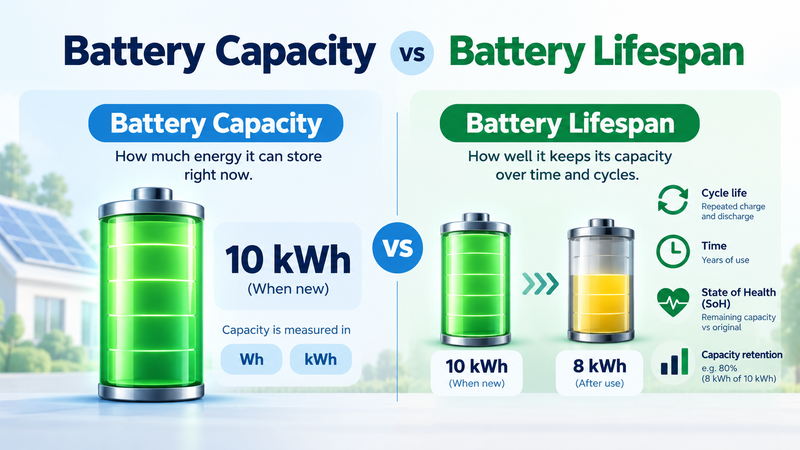
Battery capacity and battery lifespan are closely related, but they are not the same thing.
Capacity tells you how much energy a battery can store or deliver now. Lifespan tells you how that performance changes over time.
A battery can have a large capacity and still be old. It can also have a relatively small capacity and still be in excellent health.
For the broad battery-capacity framework:
https://medium.com/@volodymyrzh/battery-capacity-explained-mah-wh-amp-hours-decoded-1dc676be5a38
Capacity Describes Stored Energy
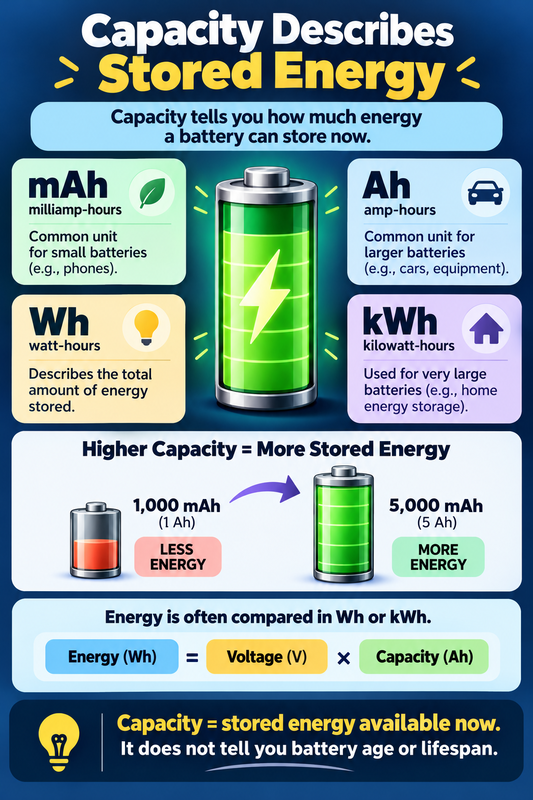
Battery capacity describes how much charge or energy the battery can hold.
Depending on the application, it may be expressed in:
mAh;
Ah;
Wh;
kWh.
For energy comparisons, Wh is especially useful because it includes voltage.
A 1,000 Wh battery and a 2,000 Wh battery differ in total stored energy.
That does not tell you how old either battery is, how many cycles it has completed, or how much of its original capacity remains.
Lifespan Describes Change Over Time
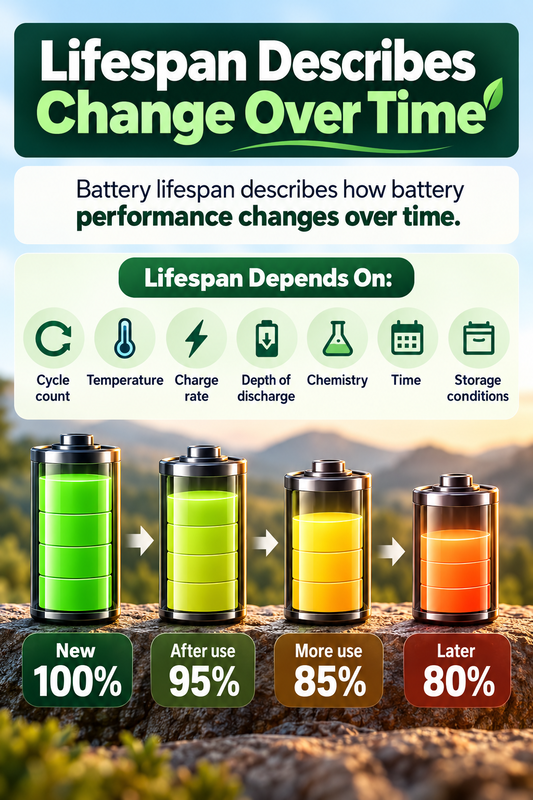
Battery lifespan is a broader concept.
It describes how long a battery remains useful before degradation becomes significant enough that performance no longer meets the intended requirement.
Lifespan can be influenced by:
cycle count;
depth of discharge;
temperature;
charge rate;
storage conditions;
chemistry;
time.
Unlike Wh or Ah, lifespan is not one simple capacity number.
A Large Battery Can Still Be Aged
Imagine a battery that was rated at:
10 kWh when new
After years of use, suppose it can now provide:
8 kWh
It is still a large battery.
But it has lost:
2 kWh of original capacity
and retains:
80% of its original capacity
Another new battery might store only 5 kWh.
The older 8 kWh battery still stores more total energy, but its health relative to its original condition is worse.
This is why present capacity and battery health must be kept separate.
Cycle Life Is One Measure of Longevity
Cycle life describes how many charge-discharge cycles a battery can complete before reaching a defined performance threshold.
For example, a manufacturer may specify that a battery retains a certain percentage of its original capacity after a given number of cycles.
That does not mean the battery suddenly fails on the next cycle.
It means the battery has reached the threshold used for the cycle-life specification.
For the full explanation:
https://digitalowl.fika.bar/what-is-battery-cycle-life-01M2YNVWHAW1CQ4D7CFQ9DSEHH
Cycle Count Alone Does Not Define Lifespan
Two batteries with the same cycle count can have different health.
One may have been:
kept cool;
discharged moderately;
charged gently.
Another may have experienced:high temperatures;
deep cycling;
high charge or discharge rates.
The second battery may degrade faster even if the cycle count is similar.
This is why cycle life should be understood as a controlled specification rather than a universal prediction of exactly how long every battery will last.
State of Health Describes the Battery Relative to New
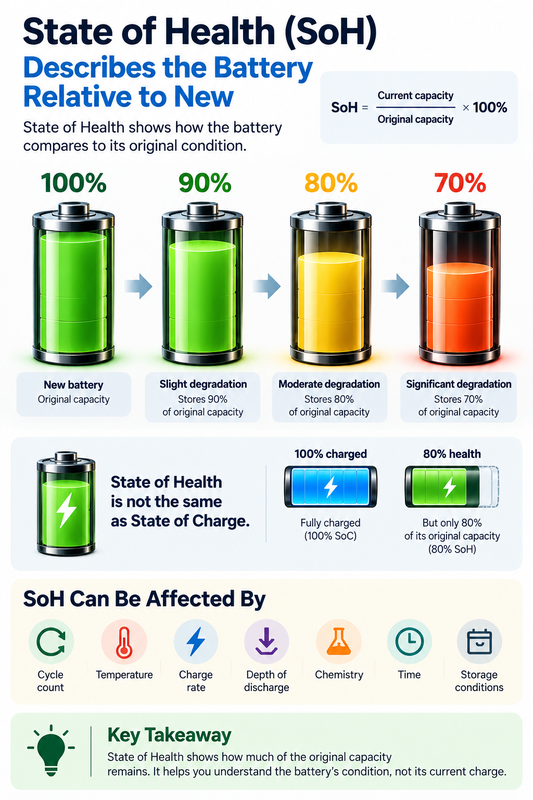
State of Health, or SoH, is used to describe how the battery compares with its original condition.
An SoH estimate may include capacity, internal resistance, power capability or other factors depending on the system.
In simplified capacity-based terms, if a battery originally stored 100 units of energy and now stores 85:
SoH ≈ 85%
But SoH is not the same as State of Charge.
A battery can be:
100% charged
while also having:
80% State of Health
That means it is fully charged relative to its current reduced capacity.
For more detail:
https://digitalowl.fika.bar/what-is-battery-state-of-health-01M2YV5RRYGFSKJYQWQH8RWS0V
Capacity Retention Is a More Specific Metric
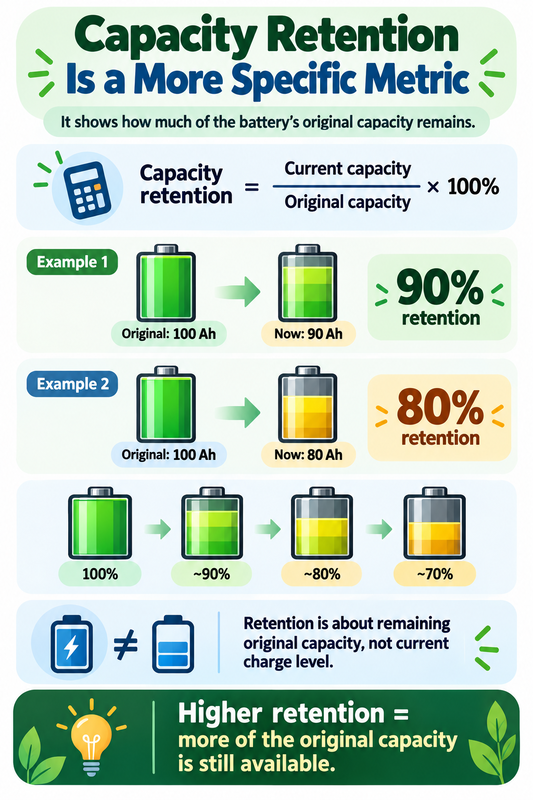
Capacity retention focuses specifically on how much of the original capacity remains.
If a battery starts at:
100 Ah
and later provides:
90 Ah
capacity retention is approximately:
90%
If it later provides:
80 Ah
retention is approximately:
80%
This metric is useful because it makes degradation easier to visualise.
For a dedicated explanation:
https://digitalowl.fika.bar/what-is-capacity-retention-01M2YVXR04YVB9906154JB79PB
80% Capacity Does Not Mean Immediate Failure
An important misunderstanding is that a battery reaching 80% capacity has “failed.”
Usually, that is not what the number means.
A battery that retains 80% of its original capacity may still be perfectly usable.
It simply stores less energy than when new.
For example:
New battery:
5 kWh
At 80% retention:
4 kWh
That battery still stores 4 kWh.
Whether that is sufficient depends on the application.
For a phone, reduced runtime may become annoying.
For a backup system, the remaining energy may still be adequate.
For a critical application, the loss may no longer meet required margins.
The usefulness threshold depends on the job.
Lifespan Is Not Measured in Wh
Wh tells you how much energy is stored.
It does not tell you how long the battery will remain healthy.
A 10 kWh battery is not automatically longer-lived than a 5 kWh battery.
A larger battery may sometimes experience less cycling stress if the same load uses a smaller percentage of its capacity, but lifespan still depends on chemistry, operating conditions and use.
Capacity and longevity should therefore be treated as separate dimensions.
Capacity Can Decline Gradually
Battery degradation is usually gradual rather than a sudden step.
A simplified progression might look like:
100% → 95% → 90% → 85% → 80%
As capacity declines, runtime decreases for the same load.
If a device consumed 500 Wh per hour:
A 5 kWh battery might theoretically support it for around:
10 hours
At 80% retention, available capacity may be closer to:
4 kWh
and theoretical runtime becomes:
8 hours
The load has not changed.
The battery's available energy has.
Aging Can Affect More Than Capacity
Battery aging may also change:
internal resistance;
voltage behaviour;
power capability;
thermal performance;
charging behaviour.
This is another reason lifespan cannot be reduced to one Wh number.
Two batteries with similar retained capacity can still behave differently under high load.
Calendar Aging Matters Too
Batteries can age even when they are not heavily cycled.
Chemical processes continue with time.
Storage temperature and State of Charge can influence how quickly this calendar aging occurs.
A battery used only occasionally can therefore still lose capacity over several years.
This is important for:
emergency backup;
rarely used power stations;
stored batteries;
seasonal systems.
Low cycle count does not automatically mean new-battery performance.
More Capacity Can Sometimes Reduce Cycling Stress
Suppose a household uses:
2 kWh per day
A 2.5 kWh battery may use a large fraction of its capacity every day.
A 10 kWh battery supporting the same load uses a much smaller percentage.
Under some conditions, shallower cycling can help reduce stress.
But that does not mean oversizing always improves lifespan enough to justify the additional cost.
Capacity, expected cycling, chemistry and economics should be evaluated together.
Chemistry Changes the Lifespan Equation
Different battery chemistries can have different:
cycle-life characteristics;
temperature sensitivity;
energy density;
operating-voltage ranges;
charging requirements.
So two batteries with the same:
1,000 Wh
rating can have very different long-term behaviour.
Capacity describes their energy today.
Chemistry and operating conditions help determine how that capacity changes over time.
Compare Present Capacity With Original Capacity
When evaluating an older battery, two questions are useful:
How much energy can it store now?
and
How does that compare with when it was new?
Suppose:
Original capacity:
2,000 Wh
Current measured capacity:
1,600 Wh
Capacity retention:
1,600 ÷ 2,000 × 100 = 80%
The battery still has 1.6 kWh of usable storage before other system losses are considered.
But its historical degradation is also clear.
Battery Health Metrics Work Together
Cycle life, State of Health and capacity retention answer different parts of the same question.
Cycle life describes repeated-use durability.
State of Health estimates the battery's condition relative to its original state.
Capacity retention describes how much original capacity remains.
Together, these metrics provide a more useful picture than capacity alone.
A broader view of battery health metrics as transparent, reusable energy data is here:
https://www.linkedin.com/pulse/battery-health-metrics-linkable-energy-data-volodymyr-zhyliaev-i3nif/
Capacity Matters for Today; Lifespan Matters for Tomorrow
When buying or evaluating a battery, capacity answers immediate practical questions:
how much energy is stored?
how long can loads operate?
is the battery large enough?
Lifespan answers longer-term questions:how quickly will performance decline?
how many cycles can it tolerate?
how much capacity may remain later?
when might replacement become necessary?
Both matter, but they should not be mixed.
The Practical Rule
Think of capacity and lifespan on two different axes.
Capacity = how much energy the battery can store now.
Lifespan = how well the battery preserves useful performance over time.
A high-capacity battery can be heavily degraded.
A lower-capacity battery can be nearly new.
And an 80% capacity-retention figure does not mean the battery suddenly stops working.
To understand battery condition properly, compare current capacity with original capacity, then look at cycle life, State of Health, retention and operating history together.
Comments
No comments yet. Be the first to comment!