How Solar Recharging Changes Battery Capacity Needs
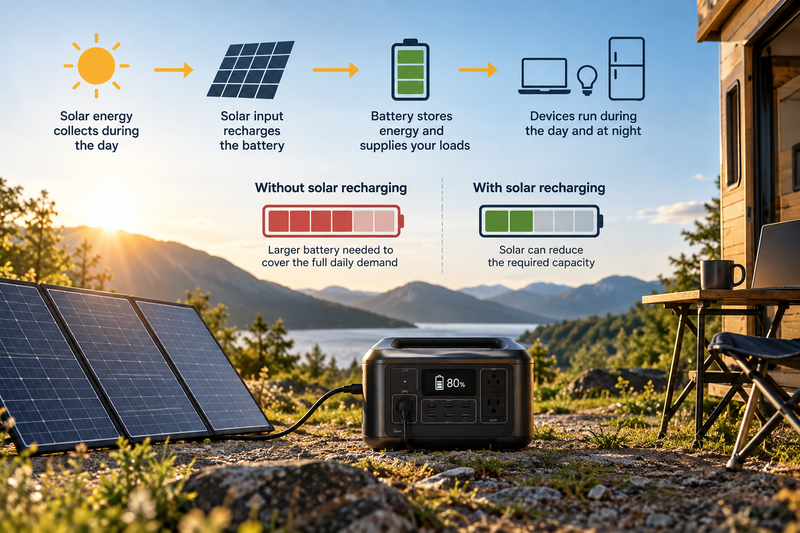
Battery sizing is often treated as a simple question: how much energy will your devices consume before the battery can be charged again?
Solar changes that calculation.
If a battery can receive meaningful energy during the same period in which loads are running, it does not necessarily need to store the entire day’s energy demand in advance. Part of that demand can be supplied by energy collected and stored during the day.
That can reduce the battery capacity required for some systems. But it only works when solar production, charging limits, weather and load timing are considered together.
Battery Capacity and Solar Input Solve Different Problems
Battery capacity tells you how much energy the battery can store.
Solar panels determine how much additional energy may become available while the system is operating.
These two numbers should not be combined as if they were interchangeable. A 1,000Wh battery is still a 1,000Wh battery even if it is connected to hundreds of watts of solar panels.
For a broader explanation of battery energy units and capacity, see:
https://medium.com/@volodymyrzh/battery-capacity-explained-mah-wh-amp-hours-decoded-1dc676be5a38
Solar simply changes how quickly the stored energy may need to be depleted.
Imagine a system that consumes 1,500Wh during a day. Without recharging, the battery would need enough usable capacity to cover roughly that entire requirement, plus appropriate allowances for losses and reserve capacity.
If solar supplies 800Wh during the same period, the battery may only need to provide the remaining energy.
But that does not automatically mean that a 700Wh battery is sufficient.
Timing matters.
Think in Terms of an Energy Balance
A useful simplified model is:
Battery energy used = Load energy − Solar energy actually captured
Suppose a small off-grid setup uses:
laptop: 300Wh
lights: 150Wh
refrigerator: 700Wh
router and electronics: 150Wh
Total daily demand is approximately 1,300Wh.
If the solar system actually delivers 700Wh into the battery and loads during that day, the net battery contribution may fall to roughly 600Wh.
This makes solar recharging extremely important when estimating storage requirements.
However, the word actually matters.
Panel wattage alone does not tell you how much energy will reach the battery.
Panel Watts Are Not Daily Energy
A solar panel rated at 400W does not produce 400Wh every hour from sunrise to sunset.
Watts describe power at a moment in time. Energy collected over time is measured in watt-hours or kilowatt-hours.
This distinction is covered in more detail here:
https://digitalowl.fika.bar/solar-panel-watts-vs-solar-energy-01M3KRYFWQ65C0E305C4EV3RMQ
A 400W array operating under ideal rated conditions for one hour could theoretically produce 400Wh.
Real solar production changes continuously because of sun angle, clouds, shading, temperature, orientation and system losses.
That is why battery sizing should be based on expected daily solar energy rather than simply comparing panel watts with battery watt-hours.
Peak Sun Hours Make the Estimate More Useful
One way to estimate daily solar production is with peak sun hours.
Peak sun hours convert varying solar irradiance during a day into the equivalent number of hours at 1,000W/m².
The concept is explained here:
https://digitalowl.fika.bar/what-are-peak-sun-hours-01M3KVQA7E6RMVJD737AM7AD7Q
For example, a 400W array and four peak sun hours give a simplified theoretical energy figure of:
400W × 4h = 1,600Wh
That does not mean the system will necessarily store 1,600Wh.
Losses and equipment limits still have to be considered.
But it gives a much more useful starting point than saying that a system simply has “400 watts of solar.”
Solar Can Reduce the Required Storage Buffer
Consider two otherwise identical systems.
System A has no solar recharging during use.
System B can recharge during the day.
Both consume 2,000Wh every 24 hours.
System A may need enough battery capacity to cover nearly the entire interval between external charging opportunities.
System B might receive 1,200Wh from solar during a typical day. Its battery therefore has to bridge a much smaller energy deficit.
This is why solar-powered systems can sometimes operate successfully with less storage than an equivalent system that depends entirely on stored energy.
The battery becomes a buffer between production and consumption rather than the only energy source.
Load Timing Can Matter as Much as Total Consumption
Daily totals alone can hide an important detail.
Imagine that your solar panels generate most of their energy between late morning and mid-afternoon.
If your largest loads operate during that same period, solar energy can contribute while those loads are running.
The battery may experience relatively little net discharge.
But if the largest loads operate at night, the situation changes.
Solar energy must first be captured during the day and stored for later use. The battery then needs enough capacity to carry the system through the evening, night and early morning.
Two homes could therefore consume exactly the same number of watt-hours per day but require different battery capacities because their load profiles are different.
A Simple Day-and-Night Example
Suppose a system consumes:
Daytime loads: 900Wh
Night-time loads: 1,100Wh
Total demand:
2,000Wh/day
Now suppose the solar system contributes 1,400Wh during the day.
Some of that solar energy can power the 900Wh daytime load directly or indirectly through the power system.
The remaining solar energy can recharge the battery for use at night.
In this simplified example, approximately 500Wh remains available after daytime consumption.
The battery must still cover roughly:
1,100Wh − 500Wh = 600Wh
This is very different from sizing storage for the full 2,000Wh daily load.
Real systems also require allowances for conversion losses, battery operating limits and uncertainty, but the example shows why solar production changes the storage calculation.
Recharge Time Still Matters
Knowing how much solar energy is theoretically available is not enough.
You also need to know whether the battery can receive that energy fast enough.
A battery with a large capacity but limited charging power may require many hours to recover after a deep discharge.
The basic relationship between energy, charging power and time is explained here:
https://digitalowl.fika.bar/battery-charge-time-formula-01M3F98QE99JV0CY8AEYC2PWAV
For example, adding more panels cannot always reduce recharge time indefinitely.
The battery, charge controller or portable power station may impose its own input-power limit.
This becomes especially important when solar conditions are good for only a limited number of hours.
Solar Input Limits Can Become the Bottleneck
Consider a power station that can accept a maximum of 500W of solar input.
Connecting a theoretical 800W of panels does not mean the battery will charge at 800W.
The system may limit incoming power.
Voltage and current limits may also restrict which panel configurations are compatible.
This is why solar array size and battery capacity cannot be planned independently from the charging system.
A future article in this series will look specifically at solar input limits and why adding more panel wattage does not always increase the amount of charging power a battery can accept.
Weather Changes the Required Safety Margin
Solar-based battery sizing becomes less predictable because sunlight is variable.
A system that works comfortably on a clear summer day may behave very differently during several cloudy days.
If your daily consumption is 1,500Wh and your expected solar production is also around 1,500Wh, the system may appear perfectly balanced on paper.
But there is almost no margin for poor weather, shading or unexpectedly high consumption.
Increasing battery capacity provides additional time between charging opportunities.
Increasing solar capacity can improve recovery when sunlight returns.
The right balance depends on what the system is expected to do.
A recreational setup that can occasionally fall back to grid charging can tolerate more uncertainty than a critical backup or remote off-grid system.
Do Not Subtract Best-Case Solar From Worst-Case Loads
A common sizing mistake looks like this:
Daily load: 2,000Wh
Expected solar: 1,500Wh
Battery required: 500Wh
The arithmetic is correct, but the conclusion may be misleading.
The 1,500Wh figure may represent good solar conditions rather than reliable daily production.
The 2,000Wh load may also occur partly after sunset.
And some of the collected energy will be lost during charging, storage and conversion.
A safer planning process treats solar production as a variable input rather than guaranteed energy.
A Better Solar-and-Battery Sizing Workflow
Start with the load.
Estimate how many watt-hours the system consumes during a realistic day.
Then separate consumption into periods when solar production is likely and periods when the system must rely mainly on stored energy.
Estimate realistic solar production using panel wattage and local peak sun hours rather than daylight duration alone.
Then consider:
solar variability
charging efficiency
inverter and conversion losses
maximum solar input
battery usable capacity
night-time consumption
required reserve
number of low-solar days the system should tolerate
The result is not simply a bigger-or-smaller battery.
It is an energy balance between storage, generation and consumption.
The Key Idea
Solar recharging can reduce the battery capacity a system needs because energy is replenished while the system is operating.
But solar panels do not replace battery capacity on a one-to-one basis.
Battery capacity determines how much energy can be carried through periods when generation is insufficient. Solar determines how much of that energy deficit can potentially be replenished during the next production window.
The most useful question is therefore not:
“How big should my battery be?”
It is:
“How much energy must the battery carry between realistic opportunities to recharge it?”
Once solar is part of the system, that distinction becomes central to sensible battery sizing.
Comments
No comments yet. Be the first to comment!