Digitalowl
- Home
- Why Beginners Should Build Small Projects Before Learning Everything
- What to Power First During a 72-Hour Blackout
Recent posts
-
Appliance Backup Sizing Index: Refrigerators, Pumps, CPAP and More
A battery backup system that can run a refrigerator overnight may not be suitable for a well pump. A power station that supports a CPAP machine for twelve hours might provide much shorter runtime for a furnace blower. And a battery with enough stored energy may still lack the electrical output needed to start a motor. Backup battery sizing begins with the appliance, not the battery specification. …

- fridge
- home
- +5
-
How to Size Backup Battery Capacity for a CPAP Overnight
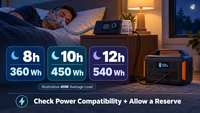
How to Size Backup Battery Capacity for a CPAP Overnight A CPAP machine can require relatively little electrical power, but running it throughout the night during an outage requires a reliable backup energy source. The battery capacity you need depends on the device's actual power consumption, operating hours, humidifier settings, heated tubing and power-conversion losses. A basic CPAP setup may c…
- home
- off-grid
- +1
-
Decision Tools for Energy Storage: Turning Battery Specs Into Better Choices
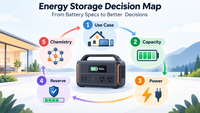
A portable power station may advertise 2,000Wh of battery capacity, 2,400W continuous output, 4,000 charge cycles and multiple charging options. Every specification provides useful information, but none independently tells you whether the system is suitable for a particular application. The real challenge is not finding more battery specifications. It is turning technical measurements into practic…
- battery
- energy
- +5
-
How Much Battery Capacity Does a Well Pump Need?
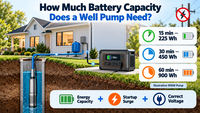
A well pump can provide essential household water during a power outage, but running it from a battery requires more than matching the pump's wattage to a portable power station. Well pumps can demand substantial startup power even when their total daily energy consumption is relatively modest. The battery capacity you need depends on the pump's actual electrical input, operating time, water cons…
- battery
- energy
- +5
-
How Much Battery Capacity Does a Furnace Blower Need?
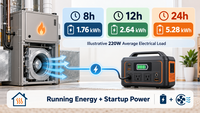
A gas furnace can produce heat using natural gas or propane, but its blower motor, control board and ignition components still need electricity. During a power outage, a battery backup system may keep the heating system operating even when the utility grid is unavailable. The battery capacity required depends on the furnace's electrical consumption, blower operating time, startup power and desire…
- battery
- energy
- +3
-
Why Refrigerator Running Watts Can Overestimate Daily Energy Use
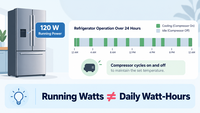
A refrigerator may draw 120 W while its compressor is running, but that does not mean it consumes 120 W continuously for 24 hours. If you multiply its running power by an entire day, you may significantly overestimate the energy required to keep it operating. The reason is simple: many refrigerators operate in cycles. Their compressors switch on when cooling is needed and switch off after the targ…
- electricity
- energy
- +3
-
Battery Health & Runtime Troubleshooting Index
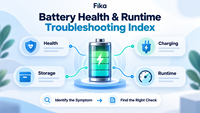
A battery that loses charge overnight, delivers less runtime than expected or shows 80% health is not necessarily failing. These symptoms can have very different explanations, from normal battery ageing and standby consumption to incorrect energy calculations or unsuitable operating conditions. The first step in battery troubleshooting is identifying which measurement or behaviour actually needs …
- batteries
- battery
- +3
-
Duty Cycle Explained for Battery Runtime
A refrigerator rated at 100 W does not necessarily consume 100 W continuously throughout the day. Its compressor switches on and off as temperatures change. The same principle applies to many pumps, compressors and other cycling appliances. Duty cycle describes the proportion of time equipment operates during a defined period. Understanding it helps estimate average energy consumption and battery …

- batteries
- blackout
- +2
-
How Standby Power Affects Overnight Battery Runtime
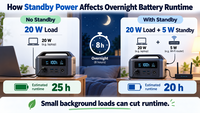
A portable power station may have enough stored energy to run a router, lights or other small appliances overnight, yet deliver less runtime than a simple battery-capacity calculation suggests. One possible reason is standby power consumption: electricity used by the power station itself while its electronic systems remain active. Even when connected appliances draw very little power, an inverter…
- batteries
- blackout
- +2
-
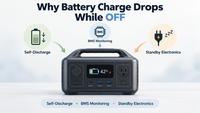
Why Portable Power Stations Lose Charge While Turned Off
A portable power station may show 80% charge when you switch it off and only 73% when you check it several weeks later. No appliances were connected, and the station was not being used. So where did the energy go? Portable power stations can lose charge while turned off because battery cells naturally self-discharge and some internal electronics may continue consuming electricity. Depending on th…
- blackout
- electricity
- +2
-
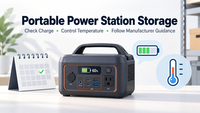
How Long Can a Portable Power Station Sit Unused?
A portable power station can remain unused for weeks or months, but there is no universal storage period after which every power station must be recharged. The appropriate interval depends on battery chemistry, initial state of charge, self-discharge, standby electronics, storage temperature and the manufacturer's recommendations. Some modern portable power stations are designed for extended stor…
- batteries
- electricity
- +3
-
Is It Bad to Leave a Battery at 100% Charge?
Charging a battery to 100% is normal for many devices. Smartphones, laptops, electric vehicles and portable power stations are designed to reach their defined full-charge level safely when used according to manufacturer instructions. But charging a battery to 100% and leaving it at 100% for weeks or months are not the same thing. For many lithium-ion batteries, prolonged storage at a high state of…
- batteries
- electricity
- +2
-
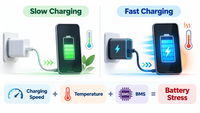
Does Fast Charging Shorten Battery Life?
Fast charging is convenient, but does it damage a battery or make it wear out faster? The answer depends on charging power, battery chemistry, temperature, state of charge and how the battery management system controls the process. Faster charging can increase stress inside battery cells, but it does not automatically cause significant damage every time it is used. Modern smartphones, electric veh…
- batteries
- blackout
- +3
-
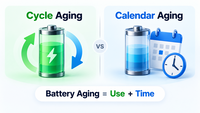
Cycle Life vs Calendar Life: What Ages a Battery Faster?
A rechargeable battery can lose capacity even when it is rarely used. Another battery may experience thousands of charging cycles while remaining useful for years. This happens because battery ageing is driven by both usage and time. Cycle life describes how a battery performs under repeated charging and discharging. Calendar life describes how its performance changes as time passes, including per…
- batteries
- blackout
- +3
-
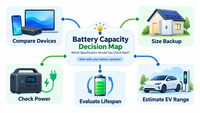
Battery Capacity Decision Map: Which Specification Should You Check Next?
Battery Capacity Decision Map: Which Specification Should You Check Next? Choosing a battery becomes much easier when you know which specification answers your actual question. Battery capacity, usable energy, power output, runtime, cycle life and charging performance are related, but they are not interchangeable. Looking at the wrong number can lead to buying too little capacity, paying for unnec…
- blackout
- electricity
- +3
-
Battery Capacity Sizing Checklist: From Loads to Final Reserve
Battery sizing becomes much easier when you stop looking for one magic number and instead move through the calculation in a fixed order. The practical sequence is: needs → load → runtime → energy → losses → reserve → power check → recharge This checklist turns battery sizing into a repeatable decision process rather than a guess. For the broader capacity framework: https://medium.com/@volodymyrzh/…

- batteries
- blackout
- +3
-
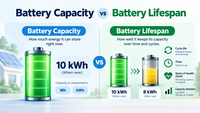
Battery Capacity vs Battery Lifespan: What’s the Difference?
Battery capacity and battery lifespan are closely related, but they are not the same thing. Capacity tells you how much energy a battery can store or deliver now. Lifespan tells you how that performance changes over time. A battery can have a large capacity and still be old. It can also have a relatively small capacity and still be in excellent health. For the broad battery-capacity framework: htt…
- batteries
- blackout
- +4