How Standby Power Affects Overnight Battery Runtime
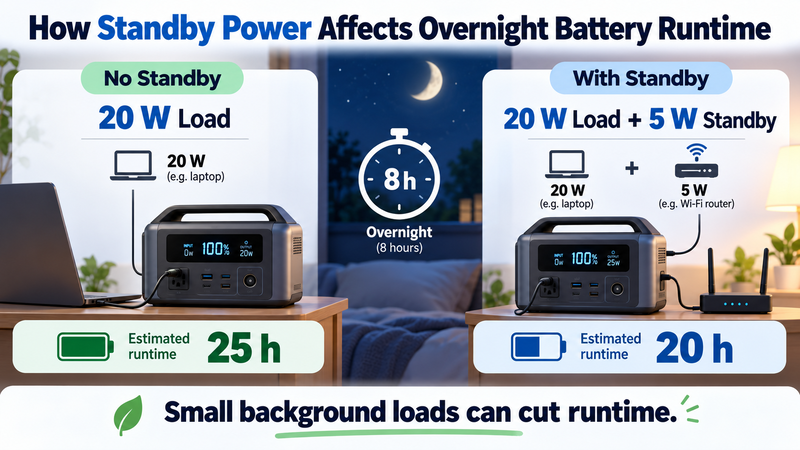
A portable power station may have enough stored energy to run a router, lights or other small appliances overnight, yet deliver less runtime than a simple battery-capacity calculation suggests. One possible reason is standby power consumption: electricity used by the power station itself while its electronic systems remain active.
Even when connected appliances draw very little power, an inverter, control circuit or another internal component may continue consuming electricity. Over eight, ten or twelve hours, those small loads can accumulate.
Understanding standby consumption helps explain why calculated battery runtime and actual overnight performance sometimes differ.
What Is Standby Power Consumption?
Standby power is electricity consumed by equipment while it is waiting, maintaining functions or operating without a substantial external load.
For a portable power station, standby-related consumption may come from several components:
An inverter remaining active with little or no AC load.
Electronic monitoring and control circuits.
Displays and communication systems.
Active DC conversion circuitry.
Product-specific background functions.
Not every component remains active in every operating mode. Actual consumption depends on the model, selected outputs and configuration.
For example, an inverter may draw some electricity simply to remain operational, even when no appliance is connected.
This is different from the natural self-discharge of battery cells.
For a dedicated explanation, see Standby Power Consumption:
https://app.fika.bar/blog/post/standby-power-consumption-01M2N3G16AGDKD6RQPH2K3S8NE
The important point is that zero external load does not necessarily mean zero battery consumption.
Why Standby Power Matters More for Small Loads
Standby power becomes particularly noticeable when the connected device uses relatively little electricity.
Consider two hypothetical situations.
Scenario A — A 500 W Appliance
Appliance demand: 500 W.
Additional internal standby consumption: 5 W.
Combined demand: approximately 505 W.
The standby component represents about 1% of the total in this simplified example.
Scenario B — A 10 W Router
Router demand: 10 W.
Additional internal standby consumption: 5 W.
Combined demand: approximately 15 W.
Here, the additional consumption increases the assumed total power demand by 50% relative to the router alone.
Both examples use the same illustrative 5 W background consumption, but its relative importance changes dramatically.
This is why low-power overnight applications can be especially sensitive to inverter idle consumption and other internal losses.
These examples are simplified: actual inverter losses may vary with load rather than remaining at one fixed wattage.
How to Calculate Overnight Standby Energy Loss
The basic energy formula is:
Energy (Wh) = Power (W) × Time (hours)
Suppose a power station has an illustrative continuous background consumption of 5 W while its AC output remains active.
Over eight hours:
5 W × 8 h = 40 Wh
Over ten hours:
5 W × 10 h = 50 Wh
Over twelve hours:
5 W × 12 h = 60 Wh
These figures represent energy consumed by the assumed background load alone.
For a battery with 500 Wh of usable energy, a 60 Wh background requirement would represent 12% of that capacity.
That energy is no longer available for the connected appliances.
The general calculation method is explained in Battery Runtime Formula:
https://digitalowl.fika.bar/battery-runtime-formula-01M2JVJ0DBC2706XRP728QTZQ3
The longer a background load remains active, the more energy it consumes — even when its power demand is small.
Overnight Runtime: With vs Without Standby Draw
Consider a simplified example involving a portable power station with 500 Wh of usable energy and a constant 20 W appliance load.
For clarity, assume that the 500 Wh figure represents energy available to support the combined demands under the modelled conditions.
Without Additional Standby Consumption
Available energy: 500 Wh.
Appliance demand: 20 W.
Additional background load: 0 W.
Combined demand: 20 W.
Estimated runtime:
500 Wh ÷ 20 W = 25 hours
With 5 W of Additional Background Consumption
Available energy: 500 Wh.
Appliance demand: 20 W.
Additional background load: 5 W.
Combined demand: 25 W.
Estimated runtime:
500 Wh ÷ 25 W = 20 hours
The difference is five hours of theoretical runtime.
The battery capacity and connected appliance remain unchanged. Only the assumed internal consumption changes.
This illustrates why a relatively small background load can substantially affect runtime when the external load is low.
Real-world results depend on efficiency, operating mode, battery conditions and whether the standby consumption is already included in the system's usable-energy rating.
How Much Energy Can Standby Power Waste Overnight?
To understand the scale, consider an eight-hour operating period.
Illustrative background loads would consume:
1 W: 8 Wh overnight.
3 W: 24 Wh overnight.
5 W: 40 Wh overnight.
8 W: 64 Wh overnight.
10 W: 80 Wh overnight.
These are examples for calculation, not verified idle-power measurements of particular power stations.
The importance depends on battery capacity and the application.
An additional 40 Wh may be relatively small for a large home battery system but meaningful for a compact portable power station supporting communications equipment.
For example, 40 Wh equals four hours of energy for a hypothetical constant 10 W load.
This comparison shows why checking internal power consumption can be just as useful as checking nominal battery capacity.
Standby Power vs Inverter Efficiency
Standby consumption and inverter efficiency are related, but they are not identical.
Inverter efficiency describes how effectively an inverter converts electrical energy from its DC input into AC output.
If an inverter operates at 90% efficiency at a particular load, delivering 90 Wh of AC energy requires approximately 100 Wh at the DC input under those conditions.
However, an inverter's efficiency may vary with output load.
It may be less efficient at very low power levels, and its idle consumption can become a substantial part of total energy demand.
This means a single advertised efficiency percentage may not accurately describe every overnight operating condition.
For the underlying concept, read What Is Inverter Efficiency?
https://app.fika.bar/blog/post/what-is-inverter-efficiency-01M2K65Q757EW3H13TCFP3JFJ7
A more complete runtime estimate should consider both conversion losses and any additional background consumption, without counting the same losses twice.
AC vs DC: Can Output Choice Improve Runtime?
For some devices, using an appropriate direct DC output instead of an AC adapter may reduce conversion losses.
For example, a router designed for DC input might normally receive electricity through an AC adapter.
Running that router from a compatible regulated DC output could avoid the power station's AC inverter and the router adapter's AC-to-DC conversion.
However, this does not guarantee better runtime in every case.
DC conversion circuitry also has losses, and some power stations have efficient low-load AC systems.
The actual result depends on:
Device input voltage and current requirements.
Output compatibility.
AC inverter efficiency at low load.
DC converter efficiency.
Internal standby consumption.
Whether other devices still require AC output.
Never connect a device to an incompatible voltage or polarity merely to reduce energy losses.
Where compatible DC operation is supported, comparing both modes can reveal meaningful differences in overnight battery performance.
Why Advertised Battery Capacity Does Not Guarantee Runtime
A power station labelled 1,000 Wh does not necessarily deliver exactly 1,000 Wh to every external load.
Usable energy depends on the battery system's operating limits, conversion losses, discharge conditions and other factors.
A runtime estimate based only on the headline capacity may therefore overstate actual operation.
A more realistic calculation separates:
Battery energy available under the relevant conditions.
Energy consumed by the connected equipment.
Conversion losses and internal operating consumption.
Any reserve capacity that must remain unused.
The relationships between stored watt-hours, real-world energy consumption and operating duration are explored in the LinkedIn article Battery Runtime and Energy Consumption: From Watt-Hours to Real-World Use:
https://www.linkedin.com/pulse/battery-runtime-energy-consumption-from-watt-hours-use-zhyliaev-vsznf
This distinction becomes especially important for backup systems expected to support essential equipment throughout the night.
How to Measure Your Power Station's Overnight Battery Use
The most useful method is to observe how your particular power station performs under realistic conditions.
A practical comparison can include two tests.
Test A — AC Output Enabled, No External Load
Charge the station according to manufacturer instructions.
Record its battery percentage and available energy information.
Enable AC output with no appliances connected.
Leave the system operating for a defined period.
Record the change in battery status.
Test B — AC Output Disabled
Start under comparable battery and temperature conditions.
Disable AC output.
Keep other relevant operating settings consistent.
Observe the battery status over the same duration.
The difference may help indicate whether maintaining the AC output contributes significantly to energy consumption.
However, percentage displays are estimates, and short tests may not resolve small losses accurately.
For better measurements, use reliable system telemetry or suitable external measurement equipment where supported. Do not assume an AC plug-in meter can measure a power station's internal battery-side idle consumption.
Also, avoid treating the result as a precise self-discharge rate because internal electronics and estimation behaviour may influence the reading.
How to Reduce Standby Losses Overnight
Reducing unnecessary internal consumption can improve battery runtime without increasing battery capacity.
Useful steps include:
Disable unused AC output: if all connected equipment uses supported DC connections, keeping the inverter active may be unnecessary.
Turn off unused ports: some systems allow independent control of AC and DC outputs.
Check wireless functions: remote monitoring may consume energy on certain models.
Use supported sleep modes: some stations offer lower-power operation when idle.
Choose compatible DC connections: avoid unnecessary conversion stages where technically appropriate.
Measure actual demand: use realistic power values instead of relying entirely on appliance labels.
Maintain a reserve: account for uncertainty, especially when powering essential equipment.
These actions should follow manufacturer instructions.
Some power stations automatically disable outputs when consumption falls below a threshold. That feature can reduce unnecessary standby drain but may interrupt very low-power devices.
For overnight applications, confirm that automatic shutoff settings will not disconnect equipment that must remain operational.
When Does Standby Consumption Matter Most?
Standby losses are particularly relevant when the external load is small relative to the power station's internal consumption.
Examples include:
Internet Backup
Routers, modems and network equipment may use relatively little power continuously. Background inverter consumption can represent a meaningful share of total demand.
Overnight Lighting
Small LED lighting loads may not require high output power. Efficiency at low loads becomes important.
Camping and RV Use
A power station may remain active throughout the night to operate a small refrigerator, fan or communication device.
Emergency Preparedness
Backup systems may need to preserve enough energy for an uncertain outage duration. Unnecessary background consumption can reduce that reserve.
In each case, the correct decision depends on how much energy the actual equipment consumes and which power station functions must remain active.
Final Takeaway
Standby power can substantially reduce overnight battery runtime, especially when connected appliances have low power demand.
A small continuous background load accumulates over time. In the illustrative example, adding 5 W of internal consumption to a 20 W appliance reduced theoretical runtime from 25 hours to 20 hours on the same 500 Wh energy budget.
The real effect varies with inverter design, operating mode, efficiency and battery conditions.
For realistic overnight estimates, compare the complete energy demand rather than dividing nominal battery capacity by appliance wattage alone.
The practical rule is simple: when every watt-hour matters, measure the power station's own consumption as carefully as the devices connected to it.
Comments
No comments yet. Be the first to comment!