Why Portable Power Stations Lose Charge While Turned Off
A portable power station may show 80% charge when you switch it off and only 73% when you check it several weeks later. No appliances were connected, and the station was not being used. So where did the energy go?
Portable power stations can lose charge while turned off because battery cells naturally self-discharge and some internal electronics may continue consuming electricity. Depending on the product, battery management circuits, monitoring systems and standby features can contribute to the difference.
However, not every power station behaves the same way. Some models have very low shutdown consumption, while others maintain electrical functions even when their main outputs are disabled.
Understanding the distinction helps you identify normal storage losses, unnecessary standby consumption and possible technical problems.
Why Does a Power Station Lose Charge When It Is Off?
A portable power station contains more than rechargeable battery cells. It is a complete energy-storage system with control electronics, power-conversion circuits and protective components.
Switching off the station usually stops its primary output functions, but it does not necessarily disconnect every electrical component from the battery.
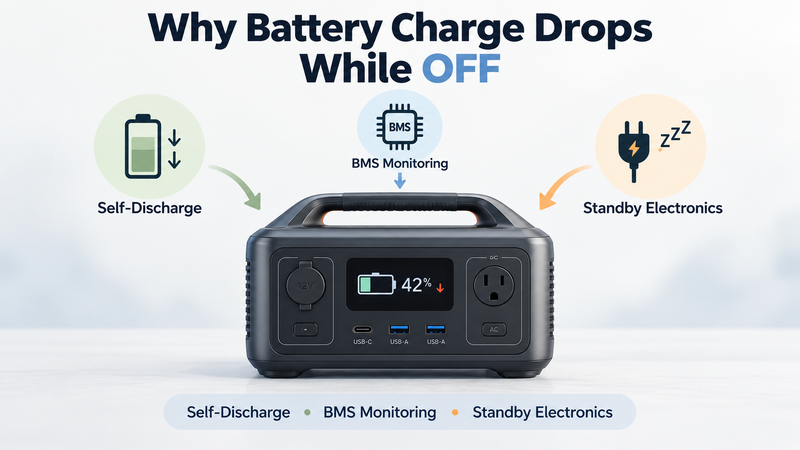
Three mechanisms can explain charge loss:
Battery self-discharge: energy gradually decreases because of internal electrochemical processes.
BMS and monitoring consumption: protective and monitoring electronics may continue drawing a small amount of energy.
Standby consumption: certain circuits or optional features may remain active even when the station appears inactive.
These effects should be considered separately because their causes and possible solutions are different.
A battery's displayed percentage may also change because the battery management system updates its estimate of the remaining charge.
Therefore, a lower reading does not always represent an exactly equivalent amount of newly consumed energy.
1. Battery Self-Discharge Happens Even Without External Loads
All rechargeable battery technologies experience some degree of self-discharge.
This means stored electrical charge gradually decreases through internal processes, even when a battery is disconnected from appliances and external electrical equipment.
The rate depends on battery chemistry, temperature, cell condition and storage duration.
For example, a lithium-ion battery stored under suitable conditions may retain much of its charge for an extended period. However, that does not mean its self-discharge rate is literally zero.
Older batteries, unfavourable temperatures and particular cell designs may produce different results.
Importantly, self-discharge is not the same as permanent capacity degradation.
A battery that falls from 80% to 75% State of Charge during storage has not necessarily lost 5% of its maximum capacity. It may simply have less stored charge available until it is recharged.
For a detailed explanation of the underlying process, see What Is Battery Self-Discharge?
https://digitalowl.fika.bar/what-is-battery-self-discharge-01M2TQ0MFHXTRT3EWYAKPKYG50
Key point: even a completely disconnected rechargeable battery can gradually lose stored charge.
2. Battery Management Electronics May Continue Working
Most modern portable power stations contain a Battery Management System, commonly called a BMS.
The BMS helps monitor battery conditions and maintain operation within the system's specified limits.
Depending on the product, its functions can include:
Monitoring cell voltage.
Measuring battery temperature.
Tracking charge and discharge current.
Estimating State of Charge.
Managing protective conditions.
Supporting cell balancing when required.
Some monitoring functions may remain active during storage or shutdown.
This means that switching off a station does not necessarily eliminate all electricity consumption inside the device.
However, BMS power consumption varies substantially between products and operating modes. It should not be assumed that every BMS draws the same amount of power continuously.
Some systems also enter low-power or deep-sleep modes to reduce consumption.
The role of battery management electronics is explained in What Does a Battery Management System Do?
https://digitalowl.fika.bar/what-does-a-battery-management-system-do-01M2VNAVCRSBTWHF3T6SPZMX9P
Key point: a power station can appear switched off while some battery-monitoring functions remain active.
3. Standby Power Can Consume Stored Energy
Standby consumption is another possible source of unexplained battery drain.
A power station may contain electronics associated with AC output, DC conversion, displays, wireless communication or remote monitoring.
Depending on its design, some of these features may remain active until they are explicitly disabled.
For example:
An inverter left enabled may draw power even when no appliance is connected.
Wireless connectivity may consume energy while waiting for commands.
A display or monitoring controller may require standby power.
DC or USB output circuits may have their own idle consumption.
It is important to distinguish between a power station being completely shut down and a station whose display is off but output systems remain enabled.
These states are not necessarily equivalent.
The broader concept of electricity consumption without an active external load is explained in Standby Power Consumption:
https://app.fika.bar/blog/post/standby-power-consumption-01M2N3G16AGDKD6RQPH2K3S8NE
Key point: no connected appliance does not always mean zero power consumption.
How Much Battery Can a Power Station Lose While Off?
There is no reliable universal percentage.
Actual charge loss depends on battery capacity, cell self-discharge, internal standby power, shutdown mode and storage conditions.
However, a simplified calculation can illustrate why small continuous loads matter.
Imagine a hypothetical power station with 1,000 Wh of usable battery energy and internal electronics consuming an average of 0.2 W while inactive.
Over 30 days:
0.2 W × 24 hours × 30 days = 144 Wh
That would represent approximately 14.4% of the assumed 1,000 Wh usable energy.
Now consider a much lower average internal consumption of 0.02 W:
0.02 W × 24 hours × 30 days = 14.4 Wh
That represents approximately 1.44% of the same battery's usable energy.
These are mathematical examples, not measured standby specifications for particular power stations. They also exclude cell self-discharge and changes in battery estimation.
The comparison demonstrates why seemingly small differences in shutdown consumption can become meaningful over long storage periods.
A fraction of a watt may appear insignificant during daily use, but continuous consumption accumulates over weeks and months.
Does a Falling Battery Percentage Mean Permanent Capacity Loss?
Not necessarily.
Two different changes must be distinguished.
Charge loss means the battery contains less stored energy than before. Recharging can normally restore its State of Charge within its present capacity limits.
Capacity degradation means the battery's maximum energy-storage capability has declined because of ageing or other changes.
For example, a power station originally capable of delivering 1,000 Wh may still retain nearly the same maximum capacity after its charge indicator falls during storage.
Conversely, an older station may display 100% charge while holding less energy than it did when new.
This is because State of Charge and battery health describe different properties.
A charge indicator alone cannot establish how much permanent degradation has occurred.
Why Can Battery Drain Vary Between Power Stations?
Two power stations with similar advertised capacities may have very different storage behaviour.
Possible reasons include differences in:
Battery chemistry and cell quality.
BMS design and power consumption.
Deep-sleep functionality.
Wireless features and monitoring systems.
Firmware and shutdown behaviour.
Battery age and temperature.
State-of-charge estimation methods.
A larger battery also does not automatically mean a lower self-discharge percentage or better shutdown efficiency.
Product-level design is important.
Therefore, conclusions based on one power station should not automatically be applied to other models.
How to Reduce Power Station Battery Drain During Storage
The most effective approach is to follow the manufacturer's instructions for the specific product.
Several general practices may help:
Turn off unused outputs. Disable AC and DC output functions before storage when instructed.
Disconnect accessories. Remove unnecessary connected devices and charging cables.
Use the recommended shutdown mode. Some power stations provide a lower-consumption storage or sleep mode.
Check optional connectivity. Disable wireless or remote-monitoring functions if the manufacturer recommends doing so.
Maintain suitable temperature. Avoid prolonged exposure to extreme heat or other unsuitable storage conditions.
Follow the specified maintenance schedule. Check and replenish charge at the intervals recommended for the model.
Avoid assuming that repeatedly switching the station on and off is necessary or beneficial.
Likewise, do not bypass protective electronics or attempt to disconnect internal battery components to eliminate small standby losses.
When Is Off-State Battery Drain a Problem?
Some charge loss during extended storage may be normal.
However, unusually rapid loss can indicate a configuration issue, active standby consumption, inaccurate charge estimation or a technical fault.
Potential warning signs include:
Charge decreasing much faster than the manufacturer's stated storage expectations.
The power station becoming unusually warm while supposedly inactive.
Unexpected shutdowns after relatively short storage periods.
Repeated diagnostic warnings.
A failure to retain sufficient energy for normal operation.
If these symptoms occur, review the product's operating instructions and troubleshooting guidance.
A controlled observation may also help: record the indicated charge level, use the manufacturer's recommended shutdown configuration and check the reading again after an appropriate interval.
Keep temperature and storage conditions reasonably consistent.
This will not produce a laboratory-grade self-discharge measurement, but it may help identify an unusual pattern.
If the unit shows physical damage, swelling, abnormal heating or other safety concerns, stop using it and seek manufacturer guidance.
Why This Matters for Emergency Backup
Off-state battery drain becomes particularly important when a portable power station is intended for emergency preparedness.
A battery stored with sufficient energy today may contain less energy when an outage occurs several months later.
For example, a station prepared to power a router, lighting and communication equipment may provide shorter backup time if part of its stored energy has been consumed during storage.
Emergency readiness therefore depends on more than the original battery capacity.
It also depends on the charge remaining when the equipment is actually needed.
For this reason, emergency backup equipment should be checked and maintained according to the manufacturer's recommendations rather than being assumed ready indefinitely.
The objective is not simply to reduce battery drain to the lowest possible level. It is to maintain enough available energy for the station's intended purpose.
Final Takeaway
Portable power stations can lose charge while turned off because of natural battery self-discharge, internal monitoring electronics and standby consumption.
The relative contribution of each mechanism depends on the product's battery chemistry, electronics, shutdown behaviour and storage conditions.
A lower charge percentage does not automatically mean permanent battery degradation, and there is no universal monthly charge-loss percentage suitable for every power station.
To reduce unnecessary losses, turn off unused outputs, use the recommended storage mode, maintain suitable temperature and follow the manufacturer's charge-check schedule.
The practical rule is simple: turning a power station off may reduce energy consumption, but it does not necessarily make the entire system electrically inactive.
Comments
No comments yet. Be the first to comment!