Why Refrigerator Running Watts Can Overestimate Daily Energy Use
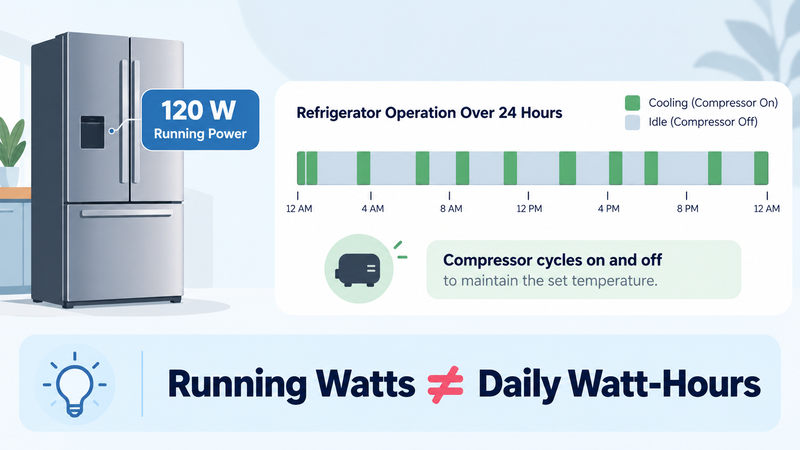
A refrigerator may draw 120 W while its compressor is running, but that does not mean it consumes 120 W continuously for 24 hours. If you multiply its running power by an entire day, you may significantly overestimate the energy required to keep it operating.
The reason is simple: many refrigerators operate in cycles. Their compressors switch on when cooling is needed and switch off after the target temperature is reached.
Understanding the difference between running watts and average energy consumption is essential when sizing a portable power station, home backup battery or solar energy system.
Running Watts Are Not the Same as Daily Energy Consumption
Running watts describe how much electrical power a refrigerator draws while operating in a particular state.
Daily energy consumption describes how much electricity it uses over 24 hours, including periods when the compressor is inactive.
These measurements use different units:
Watts (W): instantaneous or operating power.
Watt-hours (Wh): energy consumed over time.
Kilowatt-hours (kWh): larger units of energy, where 1 kWh equals 1,000 Wh.
Consider a refrigerator drawing 120 W while its compressor operates.
If it ran continuously for 24 hours:
120 W × 24 h = 2,880 Wh, or 2.88 kWh.
However, a cycling refrigerator may operate for only part of that period.
If the compressor runs for approximately eight hours in total, its active-operation energy consumption would be:
120 W × 8 h = 960 Wh.
The two calculations differ by 1,920 Wh because the assumed operating time is different.
Neither figure should be treated as a universal refrigerator specification. Actual consumption depends on the appliance and operating conditions.
The important distinction between energy and power is explained in Average Power vs Peak Power:
https://digitalowl.fika.bar/average-power-vs-peak-power-01M2K4KCTV720ZHP7EVSTJP6M6
Practical rule: running watts help describe electrical demand, while watt-hours describe how much energy the refrigerator needs over time.
Why Refrigerator Compressors Switch On and Off
A refrigerator maintains its internal temperature by moving heat from the cooled compartment to the surrounding environment.
In many conventional models, a thermostat or electronic controller activates the compressor when additional cooling is required.
Once the desired temperature is reached, the compressor may switch off.
The process repeats as heat enters the refrigerator through insulation, door openings and newly added food.
This operating pattern is described by the compressor's duty cycle.
Duty cycle represents the percentage of time a device operates during a defined period.
The basic formula is:
Duty Cycle (%) = Running Time ÷ Total Time × 100
For example:
15 minutes running per hour = 25% duty cycle.
20 minutes running per hour ≈ 33% duty cycle.
30 minutes running per hour = 50% duty cycle.
45 minutes running per hour = 75% duty cycle.
These figures are illustrative, not standard values for all refrigerators.
A refrigerator's actual duty cycle can vary throughout the day.
Example: A 120 W Refrigerator Operating at 35% Duty Cycle
Imagine a hypothetical refrigerator with the following characteristics:
Compressor running power: 120 W.
Average compressor duty cycle: 35%.
Observation period: 24 hours.
Off-state consumption: initially excluded for simplicity.
The compressor's estimated total running time is:
24 h × 0.35 = 8.4 hours.
Energy used while running:
120 W × 8.4 h = 1,008 Wh.
That equals approximately 1.01 kWh per day.
Now compare this with the continuous-running assumption:
Continuous 120 W load: 2,880 Wh/day.
35% duty cycle: 1,008 Wh/day.
Difference: 1,872 Wh/day.
The continuous-running estimate is about 2.86 times the simplified cycling estimate.
This is why using running watts alone can result in purchasing more battery capacity than the appliance actually requires under typical conditions.
However, the calculation is only as reliable as the assumed duty cycle.
How Off-State Consumption Changes the Calculation
A refrigerator may still use electricity when its compressor is inactive.
Depending on its design, electronic controls, displays, lighting or other components can contribute to energy consumption.
A more complete two-state calculation is:
Average Power = (Running Power × Duty Cycle) + (Off-State Power × Off-Time Fraction)
Suppose the refrigerator draws:
120 W while running.
3 W while its compressor is off.
Runs 35% of the time.
Remains in the lower-power state 65% of the time.
Average power becomes:
(120 × 0.35) + (3 × 0.65) = 43.95 W.
Daily energy consumption is:
43.95 W × 24 h = 1,054.8 Wh.
The additional 46.8 Wh represents the assumed off-state energy consumption.
This simplified example treats the refrigerator as having two operating states. Real appliances may have defrost heaters, fans, variable-speed compressors and other functions that require more detailed measurements.
Why Refrigerator Duty Cycle Changes During the Day
Duty cycle is not a permanent fixed characteristic.
Several conditions can make the compressor operate more frequently or for longer periods.
Ambient temperature: a refrigerator in a hot room may need more cooling than one operating in a cooler environment.
Door openings: opening the door allows warm air to enter, increasing the cooling requirement.
Food temperature: placing warm food inside requires additional energy to reduce its temperature.
Thermostat settings: maintaining a lower internal temperature can increase cooling demand.
Ventilation and installation: restricted airflow around a refrigerator's heat-rejection components can reduce performance.
Appliance condition: damaged door seals, poor insulation or mechanical problems may increase energy use.
Consequently, a refrigerator operating at a 30% duty cycle on one day could have a different duty cycle under more demanding conditions.
For battery backup planning, assumptions should represent realistic operating conditions rather than an unusually favourable short test.
What About Modern Inverter Refrigerators?
Not every refrigerator follows a simple compressor-on/compressor-off pattern.
Some modern refrigerators use variable-speed compressors that adjust their output according to cooling demand.
Instead of operating at one fixed power level and then stopping completely, they may run for longer periods at lower power.
In that case, using one nominal running-watt figure and an estimated on/off duty cycle can be misleading.
A better approach is to measure electricity consumption over a representative period.
For example, suppose a variable-speed refrigerator consumes 900 Wh during a 24-hour measurement.
Its average electrical power is:
900 Wh ÷ 24 h = 37.5 W.
That measured average can be used when calculating battery energy requirements.
For variable-speed appliances, measured watt-hours are often more useful than trying to estimate compressor duty cycle manually.
How Refrigerator Energy Consumption Affects Battery Sizing
Once daily energy consumption is estimated, it becomes possible to calculate the battery capacity needed for backup operation.
Suppose a refrigerator requires 1,050 Wh of electrical energy per day.
A hypothetical battery system has 1,500 Wh of nominal storage capacity.
It may seem that this is sufficient for a complete day, but nominal capacity is not always fully available to the connected appliance.
The final calculation must consider:
Usable battery capacity.
Inverter or conversion losses.
Internal power station consumption.
Expected refrigerator operating conditions.
Reserve capacity for uncertainty.
For example, if an assumed system delivers 85% of nominal battery energy to the relevant loads:
1,500 Wh × 0.85 = 1,275 Wh.
Under those assumptions, the refrigerator's estimated 1,050 Wh requirement would fit within the available energy budget.
The remaining 225 Wh could represent a limited margin, depending on which losses and consumption figures have already been included.
This does not guarantee a full day of operation because actual refrigerator consumption may differ.
For a detailed appliance-specific sizing method, see How Much Battery Capacity Does a Refrigerator Need?
Why Starting Watts Still Matter
A refrigerator can have relatively low average energy consumption but require substantially more electrical power when its compressor starts.
This creates two separate battery-system requirements.
Energy capacity (Wh): enough stored energy to support the refrigerator over the planned period.
Output capability (W): enough power to handle normal operation and any relevant startup surge.
For example, a refrigerator might average 45 W over several hours while requiring more than 100 W during compressor operation.
Its startup demand may be higher still, depending on motor and control design.
A battery with enough watt-hours can still be unsuitable if its inverter cannot start the compressor.
Therefore, average energy consumption should determine the energy-storage calculation, while operating and startup power should be checked against the system's output specifications.
How to Measure Real Refrigerator Energy Consumption
The most reliable practical approach is to measure actual energy use rather than rely entirely on estimated duty cycle.
A compatible plug-in energy meter can provide useful data for many household refrigerators.
A practical measurement process is:
Allow the refrigerator to reach its normal operating temperature.
Connect a suitable energy meter according to its instructions.
Measure consumption over at least one representative 24-hour period.
Record total Wh or kWh used.
Repeat measurements under different relevant conditions.
Use a realistic or conservative value for backup planning.
Longer measurements may better capture changes in temperature, compressor operation and automatic defrost cycles.
Make sure the monitoring equipment is appropriately rated for the refrigerator's electrical requirements.
Some appliance energy labels also report annual energy consumption under standardised testing conditions.
Dividing annual kWh by 365 can produce a useful daily reference, but it should not be treated as a guaranteed value for every household environment.
Calculating Battery Runtime From Daily Refrigerator Energy Use
Suppose a refrigerator consumes 900 Wh over 24 hours.
Its average power is:
900 Wh ÷ 24 h = 37.5 W.
If a battery system has 600 Wh of energy available to support that load under the assumed conditions:
600 Wh ÷ 37.5 W = 16 hours.
This is an idealised estimate assuming the measured average remains representative.
If the refrigerator experiences greater cooling demand, actual runtime may be shorter.
Likewise, additional system consumption or a required reserve may reduce the available energy budget.
The broader calculation is explained in Battery Runtime Formula:
https://digitalowl.fika.bar/battery-runtime-formula-01M2JVJ0DBC2706XRP728QTZQ3
The formula is useful, but realistic input measurements determine the reliability of its output.
Three Common Refrigerator Battery-Sizing Mistakes
Mistake 1: Multiplying Running Watts by 24 Hours
This assumes the refrigerator operates continuously at its running power. It can substantially overestimate daily energy consumption for cycling appliances, although continuous or near-continuous operation may occur under certain demanding conditions.
Mistake 2: Assuming One Duty Cycle Applies Everywhere
A refrigerator's duty cycle depends on temperature, thermostat settings, door openings and appliance design. A figure measured under one set of conditions may not apply to another.
Mistake 3: Ignoring Startup Power and Conversion Losses
Average daily energy does not establish whether a power station can start the compressor. Inverter losses, standby consumption and startup demand must be considered separately.
Avoiding these mistakes makes refrigerator backup calculations more realistic.
Final Takeaway
Refrigerator running watts can overestimate daily energy use when they are multiplied by 24 hours without accounting for compressor cycling.
A refrigerator drawing 120 W while operating does not necessarily consume 2.88 kWh every day. At an illustrative 35% duty cycle, its compressor would use approximately 1.01 kWh before off-state consumption and other operating modes are considered.
However, duty cycle varies, and modern variable-speed refrigerators may not follow a simple on/off pattern.
For reliable battery sizing, measure actual daily watt-hours where possible, use realistic average consumption and check startup power separately.
The practical rule is simple: use running watts to understand electrical demand, but use measured or realistically estimated daily watt-hours to size the battery.
Comments
No comments yet. Be the first to comment!