How to Size Backup Battery Capacity for a CPAP Overnight
How to Size Backup Battery Capacity for a CPAP Overnight
A CPAP machine can require relatively little electrical power, but running it throughout the night during an outage requires a reliable backup energy source. The battery capacity you need depends on the device's actual power consumption, operating hours, humidifier settings, heated tubing and power-conversion losses.
A basic CPAP setup may consume considerably less energy than one operating with a heated humidifier and heated hose. Consequently, selecting a battery using only a generic CPAP wattage estimate can lead to unrealistic runtime expectations.
The most useful approach is to calculate the complete overnight energy requirement, account for the power supply and maintain an appropriate reserve.
How Much Electricity Does a CPAP Machine Use?
CPAP electricity consumption varies by device, pressure settings, accessories and operating conditions.
Rather than assuming that every machine consumes the same amount of power, start with the manufacturer's specifications or an appropriate measured value.
For illustration, consider three hypothetical average electrical loads:
25 W: relatively low-consumption configuration.
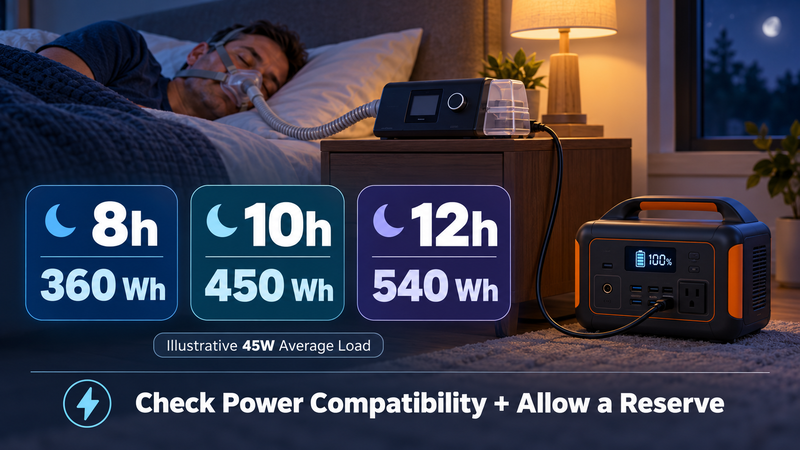
45 W: moderate average consumption.
70 W: higher-consumption configuration that may include powered comfort features.
These are calculation examples, not confirmed specifications for individual CPAP models.
Some devices can draw more power, particularly when heating elements operate. Actual consumption may also fluctuate during the night.
The battery should be sized using realistic energy demand rather than the maximum rating printed on a power adapter alone.
Step 1: Calculate CPAP Energy Consumption Overnight
Battery energy is measured in watt-hours (Wh).
The basic calculation is:
Energy Required (Wh) = Average Power (W) × Operating Time (hours)
Suppose a CPAP machine uses an average of 40 W.
For an eight-hour night:
40 W × 8 h = 320 Wh.
For ten hours:
40 W × 10 h = 400 Wh.
For twelve hours:
40 W × 12 h = 480 Wh.
These values represent electrical energy consumed by the device over the specified periods.
They do not necessarily equal the nominal battery capacity required because energy can be lost during conversion or restricted by battery operating limits.
If your CPAP machine uses a different amount of power, replace the illustrative 40 W with a suitable device-specific value.
For a general single-device sizing workflow, see How Much Battery Capacity Does a Device Need?
https://digitalowl.fika.bar/how-much-battery-capacity-does-a-device-need-01M2JVYX8GC5RDZQS859RWT5XB
Step 2: Understand How Humidifiers Affect Battery Runtime
Heated humidifiers can materially increase CPAP energy consumption.
Without heating, the machine primarily uses electricity for airflow generation, control electronics and other internal functions.
When humidifier heating is active, additional electrical energy is needed to warm the water.
A heated tube may add further consumption.
Consider two hypothetical configurations:
Configuration A — Without Heated Accessories
Average electrical demand: 25 W.
Operating time: 8 hours.
Energy requirement: 200 Wh.
Configuration B — With Heated Accessories
Average electrical demand: 65 W.
Operating time: 8 hours.
Energy requirement: 520 Wh.
The second configuration requires 320 Wh more energy under these assumptions.
This difference can determine whether a compact battery is sufficient or a larger backup system is needed.
However, humidifier and heated-hose consumption depends on device behaviour and settings. The heater may not operate continuously at its maximum rated power.
Do not disable prescribed or necessary comfort or therapy features solely to meet a battery estimate without considering the device manufacturer's guidance and your clinical needs.
The practical lesson: measure or estimate the complete CPAP setup, not just the blower.
Step 3: Account for AC and DC Power Conversion
CPAP machines may operate through an AC power adapter, a manufacturer-supported DC power connection or another approved supply arrangement.
Different power paths can have different efficiency characteristics.
A portable power station supplying AC electricity typically uses an inverter.
If the CPAP then converts that AC electricity back into DC, additional conversion losses may occur.
Some devices support compatible direct-DC solutions that can avoid certain conversion stages.
However, direct-DC operation is not automatically suitable for every machine.
Voltage, polarity, connector design, current capacity and manufacturer compatibility must be verified.
Never connect a CPAP machine to an improvised DC supply or an incompatible power source.
For a simplified AC backup estimate, suppose:
CPAP energy consumption: 320 Wh.
Illustrative battery-to-device delivery factor: 85%.
Required nominal battery energy before a separate reserve:
320 Wh ÷ 0.85 ≈ 376 Wh.
An appropriately supported DC setup may have different losses, but actual performance should be based on manufacturer specifications or reliable measurements.
Step 4: Add a Practical Battery Reserve
A backup system should not be sized so tightly that a small increase in power consumption causes it to run out before morning.
Possible sources of uncertainty include:
Changes in average device consumption.
Humidifier and heated-tube operation.
Conversion efficiency.
Battery ageing.
Temperature-dependent performance.
Differences between advertised and usable capacity.
Consider the earlier 320 Wh overnight requirement.
With an illustrative 85% delivery factor and a further 20% planning margin:
320 ÷ 0.85 × 1.20 ≈ 452 Wh.
Under these assumptions, approximately 452 Wh of nominal battery capacity meets the calculated planning target.
For the same eight-hour period, different average CPAP loads produce:
25 W: 200 Wh device demand; approximately 282 Wh nominal planning target.
45 W: 360 Wh device demand; approximately 508 Wh nominal planning target.
70 W: 560 Wh device demand; approximately 791 Wh nominal planning target.
These figures are illustrative sizing calculations rather than universal battery recommendations.
A reserve margin should reflect the actual risk of losing power, the user's needs and verified equipment performance.
Step 5: Calculate Battery Capacity for 8, 10 and 12 Hours
Suppose a CPAP setup averages 45 W and the same 85% delivery factor and 20% planning margin apply.
8-Hour Backup
Device energy: 45 × 8 = 360 Wh.
Nominal planning target: approximately 508 Wh.
10-Hour Backup
Device energy: 45 × 10 = 450 Wh.
Nominal planning target: approximately 635 Wh.
12-Hour Backup
Device energy: 45 × 12 = 540 Wh.
Nominal planning target: approximately 762 Wh.
The calculations show why a battery sufficient for one eight-hour night may not provide enough reserve for a longer period.
The same battery may also deliver less runtime if heated accessories increase consumption.
For additional calculation methods, read Battery Runtime Formula:
https://digitalowl.fika.bar/battery-runtime-formula-01M2JVJ0DBC2706XRP728QTZQ3
Step 6: Understand Why Battery Capacity Is Not the Only Requirement
A portable power station rated at 1,000 Wh appears to provide substantial energy for a relatively low-power CPAP machine.
However, capacity alone does not establish compatibility.
Before using any backup source, check:
Supported AC or DC output.
Correct operating voltage and frequency.
Manufacturer-approved power adapters.
Continuous output capability.
Output stability and automatic shutdown behaviour.
Battery protection and operating limits.
Whether the system can remain powered throughout the required period.
Some power stations automatically switch off outputs when they detect very low demand.
That behaviour could interrupt a medical device even when the battery has plenty of stored energy.
Always confirm that the power station supports sustained operation with the actual CPAP configuration.
Step 7: Check What Happens During a Power Outage
A backup battery and an uninterruptible power supply are not necessarily the same thing.
Some portable power stations require manual intervention when utility electricity fails.
Others provide pass-through operation or a backup switching feature, but transfer behaviour varies by product.
A brief power interruption may matter for devices intended to operate continuously overnight.
For this reason, verify the manufacturer's documentation on backup operation, transfer time and compatibility with medical equipment.
Do not assume a portable power station provides medical-grade uninterrupted power merely because it has an AC outlet or UPS-labelled feature.
For users who depend on continuous respiratory support, backup planning should be discussed with the relevant healthcare professional and equipment provider.
Step 8: Plan for More Than One Night
A battery sufficient for eight hours may not support a second night without recharging.
Suppose a CPAP machine consumes 360 Wh each night.
For two nights:
360 Wh × 2 = 720 Wh.
For three nights:
360 Wh × 3 = 1,080 Wh.
These amounts represent device energy requirements before battery losses and reserve.
Longer outages require consideration of available charging sources, battery capacity and how much energy will remain before the next use.
A charging method should also be compatible with the backup equipment and safe under the expected conditions.
For broader outage planning, see Battery Capacity for Emergency Preparedness:
https://digitalowl.fika.bar/battery-capacity-for-emergency-preparedness-01M45XD0SJ1SBJGP9QMVHZYBK6
The objective is to ensure that the backup strategy covers realistic outage duration, not just one ideal night.
How to Measure CPAP Energy Consumption
A more reliable estimate begins with the actual device and its normal operating configuration.
Where supported, a compatible electricity meter can help establish consumption when using the standard AC adapter.
Useful measurements include:
Power consumption under normal therapy settings.
Energy required during a full representative night.
Consumption with normally used humidifier and heated-tube settings.
Differences between supported power-supply configurations.
The battery energy remaining after a controlled backup test.
Do not open the CPAP machine or modify its power supply to obtain measurements.
A controlled test using manufacturer-approved equipment can provide more useful information than estimating consumption from a generic CPAP wattage figure.
Common CPAP Battery-Sizing Mistakes
Mistake 1: Ignoring Heated Accessories
A battery selected for the machine alone may provide insufficient runtime when humidifier or heated-tube functions are active.
Mistake 2: Treating Nominal Battery Capacity as Fully Usable Energy
Conversion losses and battery operating limits can reduce energy delivered to the device.
Mistake 3: Assuming Every Power Station Supports Overnight Medical Equipment
Some systems have automatic shutoff features, incompatible output characteristics or interruption behaviour unsuitable for the intended equipment.
Mistake 4: Planning for Exactly Eight Hours Without Reserve
Longer sleep periods, changing power requirements and battery ageing may affect runtime.
Mistake 5: Using Unapproved Adapters
An incorrect voltage, polarity or connector can damage equipment and create safety risks.
Final CPAP Backup Battery Checklist
Before selecting an overnight backup battery, confirm:
Device consumption: how many watts does the complete setup actually use?
Operating duration: eight, ten, twelve hours or longer?
Humidifier and heated tube: how much additional energy might they require?
Power connection: is the supply approved for the particular CPAP model?
Usable energy: how many watt-hours are available at the device?
Reserve: how much additional capacity is appropriate?
Continuous operation: can the backup source reliably maintain output all night?
Outage behaviour: does switching power sources create an interruption?
Recharging: will enough energy be available for the following night?
The best backup battery is not simply the one with the highest advertised capacity. It must deliver compatible, reliable power for the full required period.
Final Takeaway
CPAP overnight battery capacity depends on actual device consumption, operating time, heated accessories, conversion losses and appropriate reserve.
A hypothetical CPAP setup averaging 45 W consumes 360 Wh over eight hours. Using an illustrative 85% delivery factor and 20% planning margin, the nominal battery sizing target is approximately 508 Wh.
A different setup, especially one using heated humidification and heated tubing, may require substantially more energy.
For reliable preparation, verify the manufacturer's power requirements, use approved connections and test the complete backup arrangement under appropriate conditions.
The practical rule is simple: calculate the energy needed for the full night, include realistic losses and reserve, and prioritise reliable device compatibility over battery capacity alone.
This article provides general energy-planning information, not medical advice. CPAP therapy settings and equipment compatibility should be addressed with the device manufacturer, equipment provider or appropriate healthcare professional.
Comments
No comments yet. Be the first to comment!