Cycle Life vs Calendar Life: What Ages a Battery Faster?
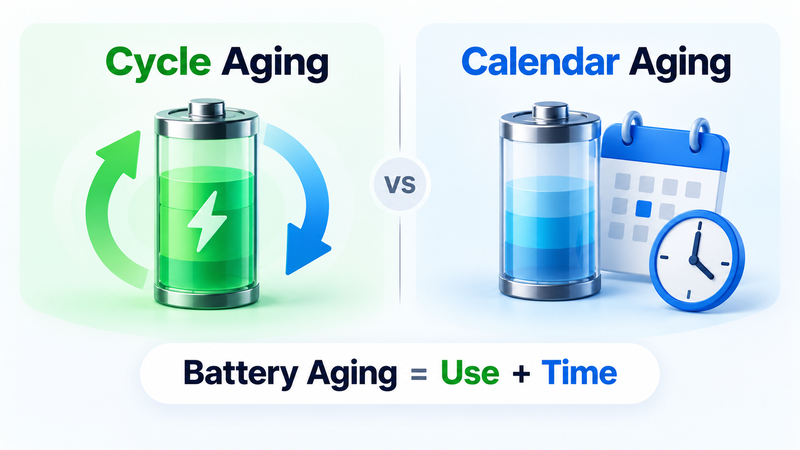
A rechargeable battery can lose capacity even when it is rarely used. Another battery may experience thousands of charging cycles while remaining useful for years. This happens because battery ageing is driven by both usage and time.
Cycle life describes how a battery performs under repeated charging and discharging. Calendar life describes how its performance changes as time passes, including periods when the battery is stored or used infrequently.
Neither measurement independently predicts exactly how long a battery will remain useful. Understanding both helps when comparing portable power stations, electric vehicles, home storage batteries and everyday rechargeable devices.
What Is Battery Cycle Life?
Battery cycle life describes durability under repeated charging and discharging. It is commonly reported as the number of cycles a battery can complete before its capacity declines to a specified retention threshold.
For example, a manufacturer might specify 3,000 cycles until the battery retains 80% of its reference capacity under defined test conditions.
This does not mean the battery fails after cycle 3,000. It means the battery is expected to reach a particular performance threshold under those conditions.
Cycle-life testing depends on several variables:
Depth of discharge during each cycle.
Charging and discharging current.
Operating temperature.
Battery chemistry and cell design.
The capacity-retention threshold used.
A battery subjected to shallow cycling may experience different degradation from one repeatedly discharged deeply.
Likewise, cycle life reported under controlled laboratory conditions may differ from performance in everyday use.
For a detailed explanation, read What Is Battery Cycle Life?
https://digitalowl.fika.bar/what-is-battery-cycle-life-01M2YNVWHAW1CQ4D7CFQ9DSEHH
Key point: cycle life measures repeated-use durability under specified conditions, not a guaranteed number of operating years.
What Is Battery Calendar Life?
Calendar life describes how long a battery can maintain acceptable performance as time passes. Unlike cycle life, calendar ageing can occur even when the battery is not being charged and discharged regularly.
A rechargeable battery may gradually lose capacity while sitting in storage.
The ageing rate depends on chemistry, storage temperature, state of charge and other conditions.
For many lithium-ion batteries, elevated temperatures and prolonged storage at high states of charge can accelerate calendar ageing.
This means that a battery stored for several years at an unsuitable temperature may lose meaningful capacity despite experiencing relatively few cycles.
A more detailed explanation is available in What Is Calendar Aging?
https://digitalowl.fika.bar/what-is-calendar-aging-01M2ZBHQS2S5H5MVW4N7BH1DJ5
Key point: low cycle count does not necessarily indicate a battery is still in near-new condition.
Cycle Life vs Calendar Life: The Main Difference
The distinction comes down to two different sources of ageing.
Cycle ageing is associated with charging and discharging activity.
Calendar ageing is associated with time-dependent changes occurring whether the battery is actively used or not.
Consider two hypothetical batteries of the same chemistry and design.
Battery A — Frequent Use
Used daily.
Experiences substantial charge-discharge throughput.
Completes hundreds of equivalent full cycles each year.
Accumulates both cycle ageing and calendar ageing.
Battery B — Occasional Use
Used only during occasional emergencies.
Completes relatively few charging cycles.
Spends most of its life in storage.
Still experiences calendar ageing.
Battery A may accumulate more cycling-related degradation. Battery B may have lower cycle-related wear but still lose capacity through time-dependent processes.
The outcome depends on their operating histories, not cycle count alone.
What Ages a Battery Faster: Cycles or Time?
There is no universal answer.
For a battery used intensively every day, cycling can be a major contributor to degradation. For a battery that remains stored for years, calendar ageing can become more important.
However, both processes happen together during a battery's life.
For example, an electric vehicle battery used for frequent long-distance travel may experience significant cycling. The same vehicle also undergoes calendar ageing simply because time passes.
Similarly, a portable power station used every day for solar energy storage faces different conditions from one kept primarily for emergencies.
The more useful question is:
Which ageing mechanism is likely to dominate under the intended operating conditions?
Answering it requires information about usage frequency, temperature, charge levels, battery chemistry and expected service duration.
Why Temperature Matters for Both Ageing Mechanisms
Temperature can strongly influence battery degradation.
For many lithium-ion systems, prolonged exposure to high temperatures accelerates unwanted chemical reactions within the cells.
This can reduce usable capacity and affect internal resistance.
High temperature may contribute to both cycle-related and calendar-related degradation.
For example:
A battery frequently charged and discharged at elevated temperatures may experience accelerated cycling-related wear.
A battery stored fully charged in a hot environment may experience substantial calendar ageing without frequent use.
A battery operated within its recommended temperature range may maintain better long-term performance, although degradation cannot be eliminated.
Cold temperatures introduce different considerations. They can temporarily reduce available power and energy, while charging below the manufacturer's permitted temperature range can create additional degradation and safety risks.
Temperature effects vary by battery chemistry and design, so manufacturer operating limits remain important.
Why Storage State of Charge Matters
The level of charge at which a battery is stored can influence calendar ageing.
For many lithium-ion batteries, prolonged storage at very high states of charge can increase time-dependent degradation, particularly at elevated temperatures.
However, storing a battery at an excessively low charge level may also create problems if self-discharge or standby consumption causes it to fall below its permitted operating limits.
There is no universal storage percentage suitable for every battery chemistry and product.
A practical storage approach involves:
Following the manufacturer's recommended storage charge level.
Avoiding unnecessary prolonged exposure to heat.
Keeping the battery within its specified storage temperature range.
Checking charge periodically when required.
Preventing excessive self-discharge during long storage periods.
For emergency backup batteries, maintaining sufficient readiness may be more important than minimising calendar ageing under every possible condition.
The best storage strategy balances battery longevity with the system's actual purpose.
How Cycle Ageing and Calendar Ageing Affect Capacity
Both ageing mechanisms can contribute to reduced energy-storage capability.
Imagine a battery originally rated at 1,000 Wh.
After several years, its measured capacity might decline to 850 Wh under comparable conditions.
That represents 85% capacity retention.
However, the capacity measurement alone cannot establish how much degradation came from cycling and how much came from calendar ageing.
Separating the effects requires suitable test data, operating history and a battery-specific degradation model.
The broader reasons batteries lose capacity are explained in Why Batteries Lose Capacity Over Time:
https://digitalowl.fika.bar/why-batteries-lose-capacity-over-time-01M2Z5S6B6REX9ZM18HDCS7SGV
This is why a single capacity-retention figure should not be treated as a complete explanation of battery ageing.
Can a Battery Reach Its Calendar-Life Limit Before Its Cycle-Life Limit?
Yes.
Consider a hypothetical battery rated for several thousand cycles under a particular testing protocol.
If the battery is used only a few times each year, it may never approach that cycle count before ageing substantially over time.
Calendar ageing continues even when the battery is inactive.
The opposite scenario is also possible. A battery cycled intensively may reach its specified capacity-retention threshold through combined ageing effects much earlier than a lightly used battery of similar age.
Therefore, cycle-life ratings should not be converted into years without considering realistic operating conditions.
For example, dividing 3,000 cycles by one cycle per day gives approximately 8.2 years of cycling.
But 8.2 years is only a mathematical conversion of cycle count into time, not a guaranteed battery lifespan.
Calendar ageing, operating conditions and changes in battery performance can alter the real outcome.
Which Matters More for Different Battery Applications?
Different applications place different demands on battery longevity.
Home Backup Batteries
Systems used mainly during occasional outages may experience limited cycling. Calendar ageing and storage conditions can therefore be particularly important.
Daily Solar Storage
Batteries charged and discharged frequently may accumulate significant cycle-related degradation. Temperature control, operating limits and long-term capacity retention also matter.
Electric Vehicles
Both calendar ageing and cycling matter. Driving distance, charging behaviour, temperature exposure and time all contribute to the battery's ageing history.
Portable Power Stations
The dominant factors depend on usage. A frequently cycled power station has a different ageing profile from one stored for emergency preparedness.
Phones and Laptops
Daily charging and discharging contribute to cycling-related wear, while calendar ageing continues as the device gets older. Temperature and charge-management behaviour can influence both.
The correct comparison therefore depends on how the battery will actually be used.
How to Compare Batteries for Long-Term Durability
When assessing battery longevity, avoid relying on advertised cycle count alone.
A more useful comparison should consider:
Cycle-life specification: how many cycles are stated and at what retention threshold?
Testing conditions: what temperature, discharge depth and charging rates were used?
Calendar-life expectations: how does the battery perform after years of ageing?
Intended use: will the battery cycle daily or remain stored for extended periods?
Environmental conditions: what temperatures and charge levels will it experience?
Replacement criteria: how much capacity loss can the application tolerate?
A battery with a high cycle-life rating may be attractive for frequent cycling, but its long-term suitability still depends on calendar ageing and real operating conditions.
Likewise, low cycle count should not automatically be interpreted as evidence of excellent battery health.
Final Takeaway
Cycle life and calendar life describe different aspects of battery ageing.
Cycle life focuses on repeated charging and discharging. Calendar life focuses on changes that occur as time passes, including periods of inactivity.
Both mechanisms can reduce capacity, and their relative importance depends on chemistry, usage patterns, temperature and storage conditions.
A battery used heavily may accumulate significant cycle-related wear. A rarely used battery can still age while sitting in storage.
The practical rule is simple: battery lifespan depends on both how much you use it and how long it exists—not on cycle count alone.
Comments
No comments yet. Be the first to comment!