Duty Cycle Explained for Battery Runtime
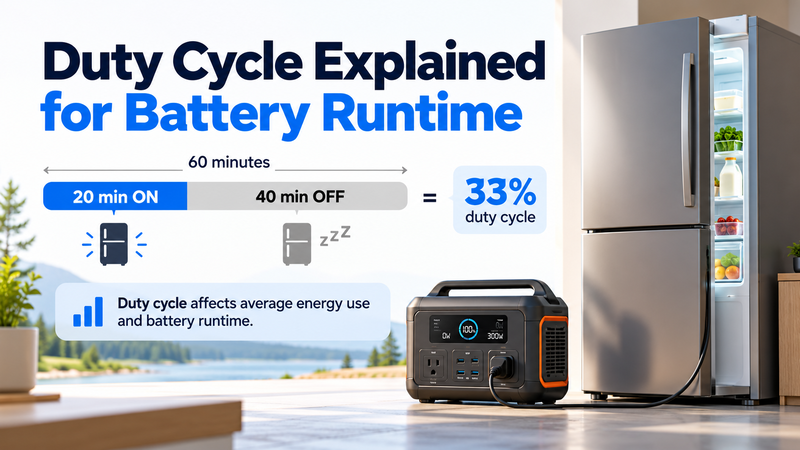
A refrigerator rated at 100 W does not necessarily consume 100 W continuously throughout the day. Its compressor switches on and off as temperatures change. The same principle applies to many pumps, compressors and other cycling appliances.
Duty cycle describes the proportion of time equipment operates during a defined period. Understanding it helps estimate average energy consumption and battery runtime without assuming that every appliance runs constantly at its rated power.
For battery backup planning, this distinction can significantly change the amount of stored energy required. However, duty cycle does not eliminate the need to consider startup power, inverter losses and actual operating conditions.
What Is Duty Cycle?
Duty cycle expresses the percentage of time a device remains active during a complete operating period.
The basic formula is:
Duty Cycle (%) = Active Time ÷ Total Time × 100
For example, imagine a refrigerator compressor that operates for 20 minutes during a 60-minute period.
20 ÷ 60 × 100 = 33.3% duty cycle.
This means the compressor runs for approximately one-third of the observed period and remains off for the other two-thirds.
Other examples include:
25% duty cycle: active for 15 minutes per hour.
40% duty cycle: active for 24 minutes per hour.
50% duty cycle: active for 30 minutes per hour.
75% duty cycle: active for 45 minutes per hour.
100% duty cycle: active continuously.
These percentages describe operating time, not battery charge level or appliance efficiency.
A 50% duty cycle does not automatically mean an appliance consumes exactly half its nameplate energy. That depends on its actual power consumption while running and while idle.
Why Duty Cycle Matters for Battery Runtime
Battery capacity is commonly measured in watt-hours (Wh), while electrical power is measured in watts (W).
Energy consumption depends on both power and operating time.
Energy (Wh) = Power (W) × Time (hours)
If an appliance consumes 100 W continuously for eight hours, its energy consumption is:
100 W × 8 h = 800 Wh.
But if the appliance only operates for half that period, its active operating time becomes four hours.
Assuming negligible off-state consumption:
100 W × 4 h = 400 Wh.
The estimated energy requirement is half as large, even though the appliance's running power has not changed.
This explains why calculating battery capacity from nameplate watts alone can produce misleading results for cycling equipment.
How to Calculate Average Power From Duty Cycle
For a device with two operating states, average power can be estimated using:
Average Power = (Running Power × Duty Cycle) + (Off-State Power × (1 − Duty Cycle))
Duty cycle must be expressed as a decimal in this formula.
Consider a hypothetical refrigerator:
Running power: 100 W.
Duty cycle: 40%, or 0.40.
Off-state consumption: 2 W.
Average power becomes:
(100 × 0.40) + (2 × 0.60) = 41.2 W.
Over 24 hours:
41.2 W × 24 h = 988.8 Wh.
This is a simplified estimate assuming the observed duty cycle remains representative throughout the day.
If off-state consumption is negligible, the calculation becomes simpler:
Average Power ≈ Running Power × Duty Cycle
The distinction between average and maximum power is explained in Average Power vs Peak Power:
https://digitalowl.fika.bar/average-power-vs-peak-power-01M2K4KCTV720ZHP7EVSTJP6M6
Average power helps estimate energy consumption. Peak power determines whether equipment can handle short-duration electrical demands.
Refrigerator Example: How Much Battery Energy Is Needed Overnight?
Imagine a refrigerator with these hypothetical operating characteristics:
Compressor running power: 120 W.
Compressor duty cycle: 35%.
Off-state consumption: 3 W.
Overnight operating period: 10 hours.
Average power is:
(120 × 0.35) + (3 × 0.65) = 43.95 W.
Estimated overnight energy consumption:
43.95 W × 10 h = 439.5 Wh.
Compare that with assuming the compressor operates continuously:
120 W × 10 h = 1,200 Wh.
The difference is substantial.
However, the duty-cycle estimate is only useful if the 35% assumption reflects realistic conditions.
A refrigerator's duty cycle may change with ambient temperature, door openings, thermostat settings, food temperature and insulation quality.
For a more complete refrigerator-specific calculation, see How Much Battery Capacity Does a Refrigerator Need?
The practical lesson: measuring real refrigerator energy consumption is more reliable than assuming either continuous operation or one fixed duty cycle.
Duty Cycle vs Startup Surge: Two Different Problems
A cycling appliance can have relatively low average energy consumption while requiring a much higher electrical power level when starting.
A refrigerator compressor, for example, may draw a brief startup surge above its normal running power.
Duty cycle does not describe that surge.
For battery backup planning, two independent checks are necessary:
Energy requirement: how many Wh the appliance needs over the intended period.
Power requirement: whether the inverter can handle normal running demand and permitted startup surges.
A battery system may contain enough energy for several hours of operation yet fail to start a compressor if its output capability is insufficient.
Likewise, a powerful inverter does not guarantee long runtime when battery capacity is limited.
This is why watts and watt-hours must remain separate parts of the calculation.
How Duty Cycle Changes as Conditions Change
Duty cycle is not necessarily a fixed appliance specification.
Many cycling devices operate differently depending on their environment and workload.
For a refrigerator, compressor activity can increase when:
Ambient temperature rises.
The door is opened frequently.
Warm food is placed inside.
Cooling settings become more demanding.
Ventilation around the appliance is restricted.
For a water pump, the duty cycle depends on how frequently water is needed.
For an air compressor, it depends on air consumption, tank size and pressure settings.
A device that operated at a 30% duty cycle during one test might operate at 60% under more demanding conditions.
Therefore, the safest sizing approach is to use representative measurements and allow appropriate energy reserve.
How to Estimate Battery Runtime for Cycling Appliances
Once average power is estimated, the basic runtime formula becomes:
Runtime (hours) = Usable Battery Energy (Wh) ÷ Average Total Power (W)
Suppose a portable power station provides an illustrative 800 Wh of usable energy after relevant conversion losses.
The connected refrigerator has an estimated average power consumption of 40 W.
Idealised runtime:
800 Wh ÷ 40 W = 20 hours.
Now suppose the power station also consumes an additional 5 W internally to maintain the required output mode.
Combined average demand:
40 W + 5 W = 45 W.
Revised runtime:
800 Wh ÷ 45 W ≈ 17.8 hours.
This illustrates why standby consumption can matter even when a compressor operates only part of the time.
The full calculation method is explained in Battery Runtime Formula:
https://digitalowl.fika.bar/battery-runtime-formula-01M2JVJ0DBC2706XRP728QTZQ3
These estimates assume constant average consumption and a defined usable-energy budget. Actual results may differ because of temperature, cycling behaviour, efficiency and battery operating limits.
Duty Cycle Does Not Always Apply to Variable-Speed Equipment
Not all appliances operate in a simple fully-on or fully-off pattern.
Some modern refrigerators, air conditioners and pumps use variable-speed motors.
Instead of repeatedly switching between one fixed running power and zero power, they may operate at several different power levels.
For this type of equipment, a single on/off duty cycle can oversimplify energy consumption.
A better approach is to calculate a time-weighted average:
Average Power = Total Energy Consumed ÷ Measurement Time
For example, if a variable-speed appliance consumes 600 Wh over 12 hours:
600 Wh ÷ 12 h = 50 W average power.
This measured average can be used directly in a battery runtime estimate.
When possible, real energy measurements are preferable to approximating multiple operating modes with one duty-cycle percentage.
Why Real-World Energy Consumption Matters
Battery runtime is not determined by nominal capacity alone.
Actual energy demand depends on how equipment behaves over time, how electrical power is converted and which additional components remain active.
Duty cycle is one part of this larger picture.
A realistic battery assessment may need to include:
Average appliance power.
Compressor or motor duty cycle.
Startup surge requirements.
Inverter efficiency at the relevant load.
Background and standby consumption.
Usable rather than nominal battery capacity.
Reserve energy for uncertain operating conditions.
These relationships are explored in the LinkedIn article Battery Runtime and Energy Consumption: From Watt-Hours to Real-World Use:
https://www.linkedin.com/pulse/battery-runtime-energy-consumption-from-watt-hours-use-zhyliaev-vsznf
The central principle is that battery runtime should be calculated from realistic total energy consumption, not from one isolated power specification.
How to Measure an Appliance's Duty Cycle
If the appliance uses a clear on/off operating pattern, duty cycle can be estimated through direct observation.
A practical measurement process is:
Allow the appliance to reach normal operating conditions.
Observe it over a representative period.
Record the total time its main load is active.
Divide active time by total observation time.
Repeat under different expected operating conditions.
Use the measured duty cycle with actual running and off-state power values.
For instance, if a compressor runs for 90 minutes during a three-hour observation period:
90 ÷ 180 × 100 = 50% duty cycle.
However, an energy meter that records total Wh over time can often provide a more reliable input for battery sizing.
For safety, use compatible external monitoring equipment and do not open electrical appliances or battery systems to measure internal components.
Three Common Duty-Cycle Mistakes
Mistake 1: Assuming Rated Watts Are Used Continuously
This may significantly overestimate energy demand for appliances that cycle regularly. However, rated power should still be considered when checking output capability.
Mistake 2: Treating Duty Cycle as a Fixed Number
Compressor activity can change substantially with ambient temperature and operating conditions. One short observation may not represent a full day or an unusually demanding situation.
Mistake 3: Ignoring Other Electrical Consumption
An appliance may consume some electricity when its main motor is off. Inverters, controllers, fans and other supporting electronics can also contribute to total energy demand.
Avoiding these mistakes produces more realistic runtime estimates.
Final Takeaway
Duty cycle describes the percentage of time equipment operates during a defined period. For cycling appliances, it helps convert running power into an estimate of average energy consumption.
A 100 W compressor operating 40% of the time does not necessarily consume 100 W continuously. Its average power may be considerably lower, depending on off-state demand and operating conditions.
However, duty cycle does not describe startup surge, and it may not adequately represent variable-speed equipment.
For reliable battery sizing, use measured energy consumption where possible, calculate average power over a representative period and check maximum electrical demand separately.
The practical rule is simple: size battery energy around realistic average consumption, but size output power around the appliance's actual operating and startup requirements.
Comments
No comments yet. Be the first to comment!