How Long Can a Portable Power Station Sit Unused?
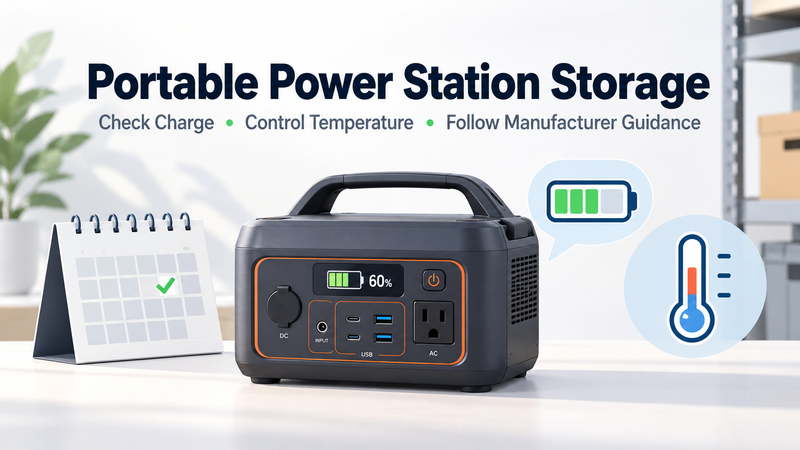
A portable power station can remain unused for weeks or months, but there is no universal storage period after which every power station must be recharged. The appropriate interval depends on battery chemistry, initial state of charge, self-discharge, standby electronics, storage temperature and the manufacturer's recommendations.
Some modern portable power stations are designed for extended storage, while others require more frequent charge checks. Even when switched off, a power station may gradually lose stored energy. Over longer periods, its battery also continues to age.
The practical goal is to keep the battery within its permitted storage conditions and maintain enough charge for its intended purpose.
Can a Portable Power Station Sit Unused for Months?
Yes. Many portable power stations can be stored unused for several months when prepared and maintained according to their manufacturer's instructions.
However, storage capability should not be confused with guaranteed readiness.
A power station placed in storage at 60% charge may display a lower level months later because of self-discharge, internal electronics or other system losses.
How much charge remains depends on the specific equipment.
A battery's calendar age also increases during storage, even if it completes no charging cycles.
For this reason, storage planning should answer three questions:
How quickly does the system lose charge while unused?
What storage charge level and temperature does the manufacturer recommend?
How much energy must remain available when the station is needed?
A power station intended for occasional camping has different readiness requirements from one used for emergency backup during unexpected outages.
Why Do Power Stations Lose Charge While Unused?
Rechargeable batteries gradually lose some stored charge even when disconnected from external equipment. This process is called self-discharge.
The rate varies with battery chemistry, temperature, age and operating conditions.
However, a portable power station is more than a collection of battery cells. It also contains electronic systems that may consume electricity.
Potential sources of energy loss include:
Natural self-discharge of battery cells.
Battery management electronics.
Monitoring circuits and internal controllers.
Wireless communication features, where fitted.
Output systems that remain active in standby.
Other product-specific background consumption.
Importantly, the displayed battery percentage does not always represent a precise measurement of stored energy. Some apparent changes may result from estimation or recalibration.
The fundamentals are covered in What Is Battery Self-Discharge?
https://digitalowl.fika.bar/what-is-battery-self-discharge-01M2TQ0MFHXTRT3EWYAKPKYG50
Key distinction: cell self-discharge and electricity consumed by internal electronics are separate processes. Both can affect how much usable energy remains after storage.
Does Switching Off the Power Station Stop Battery Drain?
Switching off a portable power station can reduce energy consumption, but it does not necessarily eliminate every source of drain.
Many systems disable major outputs when powered down. Nevertheless, some internal circuits may remain active for monitoring, protection, memory or other functions.
The behaviour differs between models.
A product with a dedicated storage or shutdown mode may consume less power than one that keeps communication or monitoring features active.
Likewise, leaving AC output enabled without connecting an appliance may still consume energy because the inverter and associated electronics can draw standby power.
Before storage, check whether the manufacturer recommends:
Turning off AC and DC outputs.
Disconnecting charging cables and external equipment.
Disabling optional wireless or remote-control features.
Using a dedicated storage or shutdown mode.
Avoid assuming that pressing the power button disconnects every internal electrical load.
How Does the Battery Management System Affect Storage?
A Battery Management System (BMS) monitors and manages important operating conditions within the battery pack.
Depending on the product, it may supervise cell voltage, temperature, current and charging or discharging limits.
These functions support battery safety and reliable operation, but electronic monitoring may also contribute to energy consumption while the unit is unused.
A BMS can also protect against certain abnormal conditions, but it cannot indefinitely compensate for self-discharge or guarantee that a stored battery will remain charged.
If a system stays unused for too long, its charge level may eventually fall below the manufacturer's recommended storage range.
Some products may enter protective states that require specific recovery procedures.
For the underlying technology, see What Does a Battery Management System Do?
https://digitalowl.fika.bar/what-does-a-battery-management-system-do-01M2VNAVCRSBTWHF3T6SPZMX9P
Practical rule: a BMS provides monitoring and protection, but it does not make periodic storage maintenance unnecessary.
What Is the Best Charge Level for Long-Term Storage?
There is no single ideal storage percentage for every portable power station.
Many lithium-ion battery products recommend storing at a moderate state of charge rather than remaining near completely full or empty for extended periods.
However, the appropriate level depends on battery chemistry, internal electronics, anticipated storage duration and manufacturer guidance.
For example, a manufacturer may recommend a particular storage charge range and a specific schedule for checking or replenishing the battery.
Other systems may have different requirements.
A portable power station using lithium iron phosphate (LiFePO4) cells should not automatically be given the same maintenance schedule as a product using another lithium-ion chemistry.
The design of the complete power station matters alongside the battery cells themselves.
For seasonal storage, follow the product's specified storage charge. For emergency readiness, consider how much usable energy must remain immediately available.
These goals may require different charging strategies.
Why Storage Temperature Matters
Temperature affects both charge retention and long-term battery condition.
For many lithium-ion batteries, prolonged exposure to elevated temperatures can accelerate calendar ageing.
A power station stored in a hot vehicle, poorly ventilated shed or other unsuitable environment may experience more degradation than one kept within its recommended storage range.
Low temperatures create different challenges. Cold conditions can temporarily reduce available energy and charging capability.
Some lithium-ion batteries must not be charged below specified temperature limits unless the system provides suitable temperature management.
Avoid:
Leaving a power station exposed to direct sunlight during storage.
Storing it near heat sources.
Exposing it to moisture or condensation.
Charging it outside the manufacturer's permitted temperature range.
Assuming that freezing conditions are acceptable for every battery chemistry.
A cool, dry, stable environment within the manufacturer's specified limits is generally preferable to one exposed to extreme temperatures.
Can a Power Station Lose Capacity Without Being Used?
Yes. This is one of the important distinctions between self-discharge and calendar ageing.
Self-discharge means stored charge gradually decreases. Recharging may restore the battery's state of charge.
Calendar ageing refers to time-dependent changes that can permanently reduce maximum capacity or affect other battery characteristics.
Consider a hypothetical 1,000 Wh power station.
After storage, its charge indicator might show 70% rather than 100%. That does not automatically mean it has permanently lost 30% of its maximum capacity.
It may simply need recharging.
However, over several years, the battery could also experience gradual capacity degradation even if it completes relatively few cycles.
The ageing mechanism is explained in What Is Calendar Aging?
https://digitalowl.fika.bar/what-is-calendar-aging-01M2ZBHQS2S5H5MVW4N7BH1DJ5
Remember: losing charge during storage is not the same as permanently losing storage capacity.
How Often Should You Recharge a Stored Power Station?
The appropriate recharge interval depends on the model and storage conditions.
A fixed recommendation such as charging every month or every six months cannot reliably apply to all portable power stations.
Instead, the manufacturer's storage maintenance instructions should determine the schedule.
A practical approach involves recording the initial charge, periodically checking the battery and recharging when required by the product's specified storage procedure.
A stored station should also be inspected for abnormal conditions before charging or use.
If the battery level decreases faster than expected, consult the manufacturer's troubleshooting guidance rather than repeatedly forcing charging cycles.
The objective is to prevent the system from falling outside its permitted storage range without creating unnecessary maintenance.
A Practical Power Station Storage Timeline
Rather than using one universal calendar interval, organise storage into four stages.
Stage 1 — Before Storage
Read the product's storage instructions.
Charge or discharge to the recommended storage level.
Disconnect unnecessary accessories and loads.
Disable outputs and features as instructed.
Choose a suitable storage location.
Record the battery percentage and date.
Stage 2 — During Storage
Follow the manufacturer's inspection schedule.
Check the displayed charge level when required.
Look for physical damage, swelling or other abnormalities.
Confirm that the storage environment remains appropriate.
Recharge according to the product's recommended procedure.
Stage 3 — Before Returning to Service
Inspect the enclosure, ports and cables.
Confirm that the equipment is dry and within its permitted operating temperature range.
Charge the battery if necessary.
Check for unusual warnings or behaviour.
Verify that required outputs function as expected.
Stage 4 — Before Emergency Use
Confirm the remaining state of charge.
Test the equipment needed for essential loads.
Check charging accessories and compatible cables.
Make sure the available energy still meets the expected backup requirement.
This method is more reliable than assuming that every battery needs maintenance after the same number of days.
Is Long-Term Storage Different From Emergency Readiness?
Yes. These are related but distinct use cases.
For seasonal camping equipment, preserving battery condition during inactivity may be the main priority.
For emergency backup, sufficient immediately available energy is essential.
A station stored at a moderate charge level might be appropriate for long-term preservation, but that same level could provide insufficient runtime during an unexpected outage.
For this reason, a backup-ready configuration may differ from a long-term storage configuration.
Some manufacturers provide dedicated backup modes or recommendations that balance immediate readiness with battery care.
When no such feature exists, the user must consider the likely outage duration, essential loads, battery capacity and manufacturer-approved maintenance procedure.
Battery longevity matters, but emergency equipment must also be ready to perform its intended function.
What If the Power Station Has Been Unused for a Year?
If a power station has remained unused for a year, do not assume it is either fully functional or permanently damaged.
Its condition depends on how it was stored and maintained.
Before returning it to service:
Inspect it for physical damage, swelling, unusual smells or leakage.
Check the manufacturer's instructions for recovering equipment after prolonged storage.
Confirm that it is within the permitted temperature range.
Check its displayed battery status and any diagnostic warnings.
Follow the approved charging procedure, if charging is permitted.
Test outputs using appropriate equipment before relying on it for important loads.
If the power station shows damage, abnormal heating or persistent errors, stop using it and seek manufacturer guidance.
Do not attempt to bypass protective circuitry or force a battery to charge after a suspected deep-discharge fault.
A low displayed charge after storage does not automatically mean the battery has permanently lost capacity, but unusual behaviour should be treated seriously.
Final Takeaway
A portable power station can often sit unused for months, but the safe and practical storage period depends on the specific product.
Self-discharge and internal electronics gradually reduce stored charge, while calendar ageing continues even without regular use.
Battery chemistry, temperature, BMS design, storage charge and maintenance practices influence the outcome.
For long-term storage, follow the manufacturer's recommended charge level, storage conditions and inspection schedule. For emergency backup, also consider how much energy must remain immediately available.
The best rule is not to recharge every power station on an arbitrary universal schedule. It is to store, inspect and maintain the equipment according to its design and intended use.
Comments
No comments yet. Be the first to comment!