Digitalowl
- Home
- Why Beginners Should Build Small Projects Before Learning Everything
- What to Power First During a 72-Hour Blackout
Recent posts
-
1,000Wh vs 2,000Wh Power Station: What Changes in Real Use?
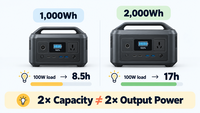
A 2,000Wh portable power station stores approximately twice as much energy as a 1,000Wh model. But twice the battery capacity does not automatically mean twice the output power, faster charging or better performance in every situation. The most significant difference is how long the station can support connected equipment. A larger battery may keep a refrigerator running longer, provide more reser…
- batteries
- electricity
- +4
-
How Much Battery Capacity Does a Freezer Need During an Outage?
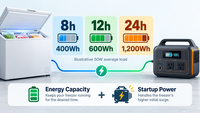
A freezer can often maintain a safe temperature for several hours without electricity, especially when it is full and the door stays closed. But during longer power outages, a portable power station or home battery system may be needed to keep the compressor operating. The battery capacity required depends on the freezer's actual energy consumption, outage duration, inverter losses, startup power …
- battery
- electricity
- +4
-
Can a 1,000Wh Power Station Run a Refrigerator Overnight?
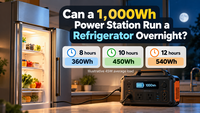
Yes, a 1,000Wh portable power station can run many refrigerators overnight, but the result depends on actual refrigerator energy consumption, inverter losses, standby power and the number of hours you need. A battery labelled 1,000Wh does not necessarily deliver the full 1,000Wh to an AC appliance. A relatively efficient refrigerator may require only a few hundred watt-hours during an eight-hour p…
- electricity
- energy
- +3
-
Why Refrigerator Running Watts Can Overestimate Daily Energy Use
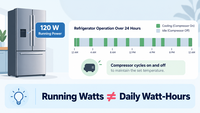
A refrigerator may draw 120 W while its compressor is running, but that does not mean it consumes 120 W continuously for 24 hours. If you multiply its running power by an entire day, you may significantly overestimate the energy required to keep it operating. The reason is simple: many refrigerators operate in cycles. Their compressors switch on when cooling is needed and switch off after the targ…
- electricity
- energy
- +3
-
How Standby Power Affects Overnight Battery Runtime
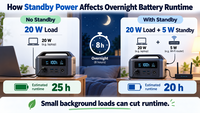
A portable power station may have enough stored energy to run a router, lights or other small appliances overnight, yet deliver less runtime than a simple battery-capacity calculation suggests. One possible reason is standby power consumption: electricity used by the power station itself while its electronic systems remain active. Even when connected appliances draw very little power, an inverter…
- batteries
- blackout
- +2
-
Why Portable Power Stations Lose Charge While Turned Off
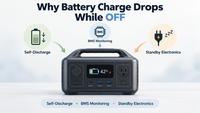
A portable power station may show 80% charge when you switch it off and only 73% when you check it several weeks later. No appliances were connected, and the station was not being used. So where did the energy go? Portable power stations can lose charge while turned off because battery cells naturally self-discharge and some internal electronics may continue consuming electricity. Depending on th…
- blackout
- electricity
- +2
-
How Long Can a Portable Power Station Sit Unused?
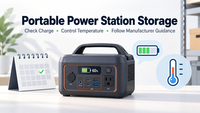
A portable power station can remain unused for weeks or months, but there is no universal storage period after which every power station must be recharged. The appropriate interval depends on battery chemistry, initial state of charge, self-discharge, standby electronics, storage temperature and the manufacturer's recommendations. Some modern portable power stations are designed for extended stor…
- batteries
- electricity
- +3
-
Is It Bad to Leave a Battery at 100% Charge?
Charging a battery to 100% is normal for many devices. Smartphones, laptops, electric vehicles and portable power stations are designed to reach their defined full-charge level safely when used according to manufacturer instructions. But charging a battery to 100% and leaving it at 100% for weeks or months are not the same thing. For many lithium-ion batteries, prolonged storage at a high state of…
- batteries
- electricity
- +2
-
Does Fast Charging Shorten Battery Life?
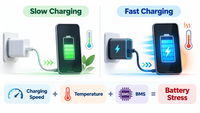
Fast charging is convenient, but does it damage a battery or make it wear out faster? The answer depends on charging power, battery chemistry, temperature, state of charge and how the battery management system controls the process. Faster charging can increase stress inside battery cells, but it does not automatically cause significant damage every time it is used. Modern smartphones, electric veh…
- batteries
- blackout
- +3
-
Cycle Life vs Calendar Life: What Ages a Battery Faster?
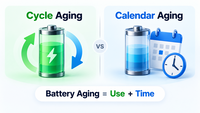
A rechargeable battery can lose capacity even when it is rarely used. Another battery may experience thousands of charging cycles while remaining useful for years. This happens because battery ageing is driven by both usage and time. Cycle life describes how a battery performs under repeated charging and discharging. Calendar life describes how its performance changes as time passes, including per…
- batteries
- blackout
- +3
-
What Does 80% Battery Health Actually Mean?
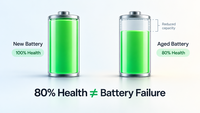
A battery health reading of 80% can sound alarming, especially when a device previously displayed 100%. But 80% battery health does not mean the battery is 80% charged, 80% damaged or about to stop working. In many cases, it means the battery's estimated maximum capacity has declined to approximately 80% of its original reference capacity. That distinction matters for smartphones, laptops, electri…
- batteries
- blackout
- +1
-
State of Charge vs Depth of Discharge: What's the Difference?
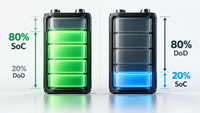
State of Charge (SoC) and Depth of Discharge (DoD) describe two sides of the same battery measurement. SoC tells you how much charge remains relative to a defined full-charge capacity, while DoD tells you how much of that capacity has been used. Both are usually expressed as percentages, but they answer opposite questions. A battery at 80% State of Charge has a Depth of Discharge of 20%. At 50% So…
- batteries
- blackout
- +2
-
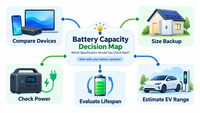
Battery Capacity Decision Map: Which Specification Should You Check Next?
Battery Capacity Decision Map: Which Specification Should You Check Next? Choosing a battery becomes much easier when you know which specification answers your actual question. Battery capacity, usable energy, power output, runtime, cycle life and charging performance are related, but they are not interchangeable. Looking at the wrong number can lead to buying too little capacity, paying for unnec…
- blackout
- electricity
- +3
-
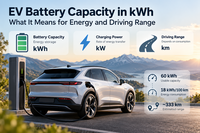
EV Battery Capacity in kWh: What It Means for Energy and Driving Range
Electric vehicle battery capacity is usually measured in kilowatt-hours (kWh). This number tells you how much electrical energy a battery can store, but it does not directly tell you how far an electric car will travel on a charge. A 60 kWh EV battery may provide very different driving ranges depending on the vehicle, speed, temperature, terrain and energy consumption. Understanding EV battery cap…
- batteries
- electricity
-
Battery Capacity Sizing Checklist: From Loads to Final Reserve
Battery sizing becomes much easier when you stop looking for one magic number and instead move through the calculation in a fixed order. The practical sequence is: needs → load → runtime → energy → losses → reserve → power check → recharge This checklist turns battery sizing into a repeatable decision process rather than a guess. For the broader capacity framework: https://medium.com/@volodymyrzh/…

- batteries
- blackout
- +3
-
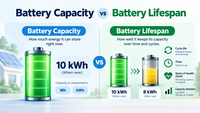
Battery Capacity vs Battery Lifespan: What’s the Difference?
Battery capacity and battery lifespan are closely related, but they are not the same thing. Capacity tells you how much energy a battery can store or deliver now. Lifespan tells you how that performance changes over time. A battery can have a large capacity and still be old. It can also have a relatively small capacity and still be in excellent health. For the broad battery-capacity framework: htt…
- batteries
- blackout
- +4
-
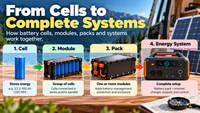
Battery Modules and Packs Explained: From Cells to Complete Energy Systems
Battery specifications often jump directly from individual cells to a complete battery pack, but there is usually another layer in between: the module. Understanding the hierarchy from cell → module → pack → system makes it much easier to understand voltage, capacity, expandability and why large battery systems are built from many smaller components. For the broad battery-capacity framework: https…
- batteries
- blackout
- +2