State of Charge vs Depth of Discharge: What's the Difference?
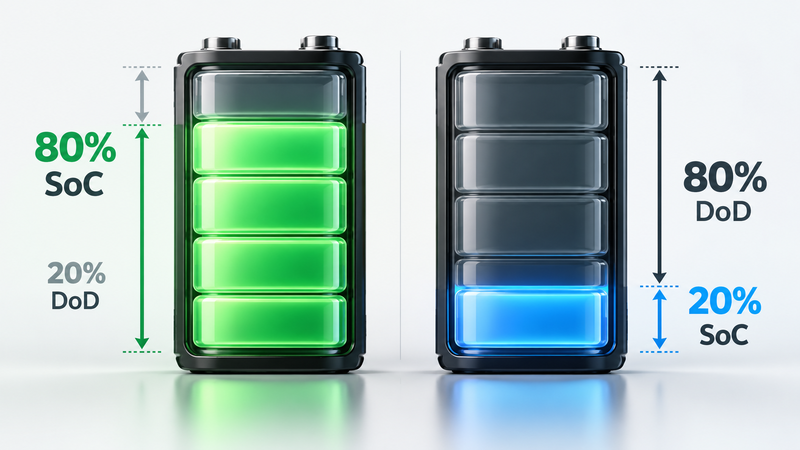
State of Charge (SoC) and Depth of Discharge (DoD) describe two sides of the same battery measurement. SoC tells you how much charge remains relative to a defined full-charge capacity, while DoD tells you how much of that capacity has been used. Both are usually expressed as percentages, but they answer opposite questions.
A battery at 80% State of Charge has a Depth of Discharge of 20%. At 50% SoC, the DoD is 50%. At 20% SoC, the DoD is 80%.
Understanding this relationship helps when monitoring battery levels, estimating remaining energy, managing discharge limits and interpreting battery lifespan specifications.
What Is State of Charge (SoC)?
State of Charge represents the estimated percentage of a battery's current reference capacity that remains available.
It is the familiar battery-level indicator displayed on smartphones, laptops, electric vehicles and portable power stations.
Typical SoC readings include:
100% SoC: the battery is at its defined full-charge level.
80% SoC: approximately 80% of its reference charge remains.
50% SoC: approximately half remains.
20% SoC: approximately one-fifth remains.
0% SoC: the battery has reached its defined empty or lower operating limit.
These percentages describe the battery's charge level, not necessarily its original energy capacity.
For example, an ageing battery can display 100% SoC even after losing part of its original capacity. It is fully charged relative to its present usable capacity, not necessarily its factory-new capacity.
SoC is an estimate generated through battery monitoring methods. Real-world accuracy depends on battery chemistry, calibration, operating conditions and the battery management system.
For a more detailed explanation, see What Is State of Charge? Battery SoC Explained Simply:
What Is Depth of Discharge (DoD)?
Depth of Discharge measures the percentage of a battery's defined capacity that has been discharged.
While State of Charge focuses on what remains, DoD focuses on how much has been used.
Typical DoD readings include:
0% DoD: no discharge from the defined full-charge level.
20% DoD: 20% of the reference capacity has been used.
50% DoD: half has been discharged.
80% DoD: 80% has been discharged.
100% DoD: the battery has reached its defined fully discharged condition.
A high DoD does not necessarily mean a battery has been damaged. The effect of deep discharge depends on chemistry, temperature, current, manufacturer limits and other operating conditions.
Depth of Discharge is particularly important when evaluating battery cycling and long-term durability. Manufacturers may specify cycle life under particular DoD conditions because repeated shallow and deep cycling can produce different degradation patterns.
For a dedicated explanation, read What Is Depth of Discharge? Battery DoD Explained Simply:
SoC vs DoD: The Simple Formula
When both percentages use the same capacity reference, the relationship is straightforward:
SoC (%) + DoD (%) = 100%
Therefore:
DoD (%) = 100% − SoC (%)
And:
SoC (%) = 100% − DoD (%)
Examples:
100% SoC = 0% DoD
80% SoC = 20% DoD
50% SoC = 50% DoD
20% SoC = 80% DoD
0% SoC = 100% DoD
This inverse relationship is the central distinction between the two measurements.
However, the equations assume a consistent definition of full and empty. Battery systems may impose protective operating limits, so displayed percentages do not always represent the complete physical capacity of the cells.
Example 1: Battery at 80% State of Charge
Imagine a battery with 1,000 Wh of usable energy when fully charged under specified conditions.
At 80% SoC, a simplified proportional estimate gives:
Reference usable capacity: 1,000 Wh.
Remaining energy: approximately 800 Wh.
Energy discharged: approximately 200 Wh.
SoC: 80%.
DoD: 20%.
The battery has used approximately one-fifth of its reference usable energy.
For a portable power station, this could indicate that substantial stored energy remains available for connected equipment.
However, actual runtime still depends on appliance power consumption, conversion losses and operating conditions.
Example 2: Battery at 50% State of Charge
Using the same hypothetical 1,000 Wh battery:
Remaining energy: approximately 500 Wh.
Energy discharged: approximately 500 Wh.
SoC: 50%.
DoD: 50%.
At this point, SoC and DoD have identical numerical values.
This is the midpoint of the relationship, not a special battery-health threshold.
A battery at 50% SoC is not necessarily operating at 50% of its possible power output. Stored energy and output power are different properties.
The battery may still support a relatively demanding appliance if its output system and operating conditions permit it.
Example 3: Battery at 20% State of Charge
Now consider the battery after further discharge:
Remaining energy: approximately 200 Wh.
Energy discharged: approximately 800 Wh.
SoC: 20%.
DoD: 80%.
This is a deep discharge relative to the specified usable-capacity reference.
For an emergency backup system, the remaining energy might support only essential equipment for a limited period.
For a rechargeable battery used daily, repeated operation at high DoD may influence long-term degradation, although the extent depends on the battery technology and operating conditions.
The important distinction is that 20% SoC means 20% remains, while 80% DoD means 80% has already been used.
Why SoC and DoD Matter for Battery Lifespan
State of Charge and Depth of Discharge are not direct measurements of battery health, but operating patterns involving them can affect long-term performance.
For many rechargeable battery technologies, repeated deep cycling can be more demanding than shallower cycling. However, the relationship is chemistry-specific and should not be reduced to a universal rule.
Lithium iron phosphate (LiFePO4), other lithium-ion chemistries and lead-acid batteries may respond differently to charging, storage and discharge conditions.
For example, cycle-life specifications might describe performance after a defined number of cycles at 80% DoD.
That does not mean the battery permanently loses 80% of its capacity during each cycle. It means that each specified cycle uses 80% of the reference capacity before recharging.
Another specification might report capacity retention after thousands of such cycles.
DoD describes the discharge extent. Capacity retention describes how much battery capacity remains after ageing or cycling.
Confusing these measurements can lead to incorrect conclusions about battery durability.
DoD vs Battery Cycle: Are They the Same?
Depth of Discharge and cycle count are related, but they are not identical.
A discharge from 100% to 50% SoC represents approximately 50% DoD. Recharging the battery completes that partial cycling event, but it does not necessarily count as one full-equivalent cycle.
Depending on the counting method, multiple partial discharges may accumulate into one equivalent full cycle.
For example, two discharge events each using 50% of the reference capacity can represent approximately one equivalent full cycle in terms of cumulative discharge throughput.
This is a simplified accounting approach. Actual battery degradation depends on more than accumulated energy throughput.
A battery cycled frequently between moderate charge levels may age differently from one exposed to repeated deep discharge, high temperatures or prolonged storage near extreme charge levels.
Cycle count, DoD and time therefore need to be considered together.
Why Displayed SoC Is Not Always Exact
A battery percentage on a screen is an estimate rather than a direct measurement of stored energy.
Battery management systems may use current measurements, voltage models, temperature information and other techniques to estimate charge state.
These estimates can change with calibration, battery ageing and operating conditions.
A battery showing 50% SoC does not always have exactly half of its nominal watt-hours available at the output terminals.
Discharge rate, temperature and power-conversion losses may affect energy delivery.
Likewise, a reading of 0% SoC may represent the manufacturer's defined lower operating boundary rather than the complete removal of energy from every cell.
This is one reason why SoC and DoD should be interpreted within the limits of the particular battery system.
How to Use SoC and DoD in Practice
For everyday battery monitoring, SoC is usually the more intuitive measurement. It directly answers how much charge remains.
For analysing discharge patterns, battery cycling and durability specifications, DoD is often more informative.
A practical battery management approach involves three questions:
How much charge remains? Check SoC.
How much of the reference capacity has been used? Calculate or monitor DoD.
How does this operating pattern affect long-term performance? Consult chemistry-specific durability information and manufacturer recommendations.
These questions are particularly useful for home battery storage, portable power stations, electric vehicles and other rechargeable energy systems.
Neither metric should be interpreted independently of usable capacity, energy demand and operating conditions.
Final Takeaway
State of Charge and Depth of Discharge are complementary measurements with an inverse relationship.
SoC shows the percentage of defined battery capacity remaining. DoD shows the percentage discharged.
At 80% SoC, DoD is 20%. At 50% SoC, DoD is 50%. At 20% SoC, DoD is 80%.
The distinction becomes valuable when interpreting battery-level indicators, comparing cycle-life specifications and evaluating discharge behaviour.
Remember the practical rule: SoC tells you what is left; DoD tells you what has been used.
Comments
No comments yet. Be the first to comment!