EV Battery Capacity in kWh: What It Means for Energy and Driving Range
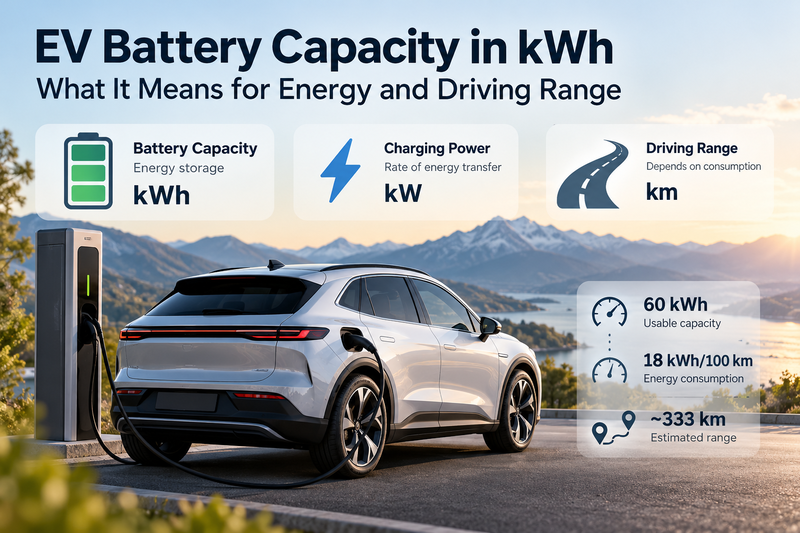
Electric vehicle battery capacity is usually measured in kilowatt-hours (kWh). This number tells you how much electrical energy a battery can store, but it does not directly tell you how far an electric car will travel on a charge. A 60 kWh EV battery may provide very different driving ranges depending on the vehicle, speed, temperature, terrain and energy consumption.
Understanding EV battery capacity starts with three distinctions: kWh measures energy, kW measures power, and driving range depends on how efficiently that energy is used.
Why EV Batteries Use kWh Instead of mAh
Small rechargeable batteries are commonly labelled in milliamp-hours (mAh), while portable power stations frequently display capacity in watt-hours (Wh). Electric vehicles operate on a much larger energy scale, making kilowatt-hours more practical.
1 kWh = 1,000 Wh.
Typical examples of battery capacity include:
Smartphone: approximately 15 Wh.
Laptop: approximately 60 Wh.
Portable power station: 1,000 Wh (1 kWh).
Electric vehicle: 60,000 Wh (60 kWh).
These are illustrative values, not universal specifications.
A 60 kWh battery stores sixty times the nominal energy of a 1 kWh portable power station. Both use the same underlying measurement of energy, but the larger unit makes EV specifications easier to read.
The basic relationship between electrical measurements is explained in Battery Capacity Explained: mAh, Wh & Amp Hours Decoded:
https://medium.com/@volodymyrzh/battery-capacity-explained-mah-wh-amp-hours-decoded-1dc676be5a38
For a direct conversion guide, see How to Convert Wh to kWh: Formula and Examples:
https://digitalowl.fika.bar/how-to-convert-wh-to-kwh-formula-and-examples-01M2JE8YDBE05JCVYQWXA7P4G6
EV Battery Capacity: Gross vs Usable kWh
An EV battery may have two different capacity figures.
Gross capacity describes the battery pack's nominal total energy capacity, while usable capacity represents the energy the vehicle makes available for normal operation within the battery management system's limits.
Manufacturers may reserve part of the battery's energy to protect the cells and manage long-term performance.
Consider a hypothetical battery:
Gross battery capacity: 64 kWh.
Usable battery capacity: 60 kWh.
Reserved difference: 4 kWh.
The 4 kWh difference is not necessarily energy that can be manually unlocked or used while driving. Battery management systems impose operating limits for technical and durability reasons.
When estimating range, usable capacity is generally the more relevant specification. However, it is important to confirm whether an advertised capacity figure refers to gross or usable energy before comparing vehicles.
How Battery Capacity Affects EV Driving Range
Battery capacity determines how much energy is available. Vehicle efficiency determines how quickly that energy is consumed.
EV energy consumption is commonly expressed as kWh per 100 km, or as Wh/km and miles per kWh in some markets.
A simplified range calculation is:
Estimated range (km) = Usable battery capacity (kWh) ÷ Consumption (kWh/100 km) × 100
For example, imagine an EV with 60 kWh of usable capacity and an average consumption of 18 kWh/100 km.
60 ÷ 18 × 100 = approximately 333 km.
This is an arithmetic estimate based on assumed consumption, not a promised real-world range.
Now consider how consumption changes the result for the same 60 kWh battery:
15 kWh/100 km: approximately 400 km.
18 kWh/100 km: approximately 333 km.
20 kWh/100 km: approximately 300 km.
24 kWh/100 km: approximately 250 km.
The battery capacity remains unchanged. Only the assumed energy consumption changes.
That is why two EVs with identical battery capacities can have substantially different driving ranges.
For the underlying energy calculation, see How to Calculate Energy Consumption in Watt-Hours:
Why a Bigger EV Battery Does Not Always Mean More Range
A larger battery stores more energy, but range also depends on how much electricity the vehicle uses per kilometre.
Consider two hypothetical electric vehicles.
EV A: Larger Battery, Higher Consumption
Usable battery capacity: 75 kWh.
Energy consumption: 25 kWh/100 km.
Estimated driving range: 300 km.
EV B: Smaller Battery, Better Efficiency
Usable battery capacity: 60 kWh.
Energy consumption: 15 kWh/100 km.
Estimated driving range: 400 km.
EV B has a smaller battery yet achieves a greater calculated range because it uses significantly less energy.
Vehicle weight, aerodynamics, tyre characteristics, drivetrain efficiency and driving conditions all influence consumption.
A larger battery may also add weight, although the actual effect on energy efficiency depends on vehicle design and usage.
The useful comparison is not simply battery size. It is usable capacity measured alongside realistic energy consumption.
What Changes EV Battery Consumption?
The energy required to drive a particular distance is not constant. Several operating conditions can change it.
Driving speed: aerodynamic resistance becomes increasingly important at higher speeds.
Temperature: battery performance, cabin heating and cooling can affect energy consumption.
Terrain: climbing hills requires energy, while regenerative braking may recover some energy during descents.
Vehicle load: passengers, luggage and towing can increase energy demand.
Tyres and road conditions: rolling resistance and road surfaces influence efficiency.
This means a range estimate based on one driving cycle may not represent every trip.
A vehicle that performs efficiently in moderate urban conditions may consume more energy during sustained motorway driving in cold weather.
When planning travel, especially between charging stations, using a realistic consumption estimate and maintaining an appropriate reserve is more useful than relying entirely on advertised range.
Battery Capacity vs Charging Power
EV specifications often include both kWh and kW, but these units measure different things.
kWh measures energy capacity. kW measures the rate at which energy is transferred or used.
A 60 kWh battery can store a specified amount of energy. A 100 kW charger describes a possible rate of power delivery, not the capacity of the vehicle's battery.
In an idealised calculation, adding 30 kWh at a constant 100 kW would require:
30 kWh ÷ 100 kW = 0.3 hours, or 18 minutes.
Real charging sessions are more complicated. The vehicle may not accept the charger's maximum power, and charging rates typically vary with state of charge, temperature and battery management limits. Charging losses also affect the energy drawn from the electricity supply.
Therefore, battery capacity alone cannot determine charging time.
Battery Capacity Is Not the Same as Battery Runtime
An EV battery is fundamentally an energy-storage system, just like a smaller rechargeable battery. The difference is how its stored energy is used.
For a stationary appliance, battery capacity and power demand can be used to estimate operating time.
For an electric vehicle, stored energy and consumption per distance are used to estimate driving range.
Both calculations describe how long a finite energy supply can support a particular demand, but neither capacity nor range should be treated as a fixed real-world guarantee.
The distinction is explored in Battery Capacity vs Battery Runtime: What's the Difference?:
How to Read an EV Battery Specification
When comparing electric vehicles, start with the battery's usable capacity and the vehicle's documented energy consumption.
Then examine its tested driving range, charging capabilities and the conditions under which those measurements were obtained.
Do not assume that a larger kWh figure automatically means better efficiency, faster charging or greater practical range.
A useful EV comparison should answer four questions:
How many usable kWh does the battery provide? This determines the energy available within the vehicle's normal operating limits.
How many kWh does the vehicle consume per 100 km? This indicates how efficiently stored energy is converted into driving distance.
How do temperature, speed and other conditions affect consumption? Real-world range can differ from laboratory or standardised test results.
What charging performance and energy reserve are appropriate for the intended journeys? A battery should be evaluated as part of the complete vehicle and charging system.
Together, these specifications offer a much clearer picture of EV energy performance than battery capacity alone.
Final Takeaway
EV battery capacity in kWh describes stored electrical energy, not guaranteed driving distance. A larger battery can provide more energy, but actual range depends on how efficiently the vehicle uses it.
Gross and usable capacity should be distinguished, kWh should not be confused with charging power in kW, and range estimates should always be connected to an explicit consumption assumption.
Understanding these relationships makes it easier to compare electric vehicles, interpret battery specifications and plan journeys around realistic energy needs.
Comments
No comments yet. Be the first to comment!