How Much Battery Capacity Does a Freezer Need During an Outage?
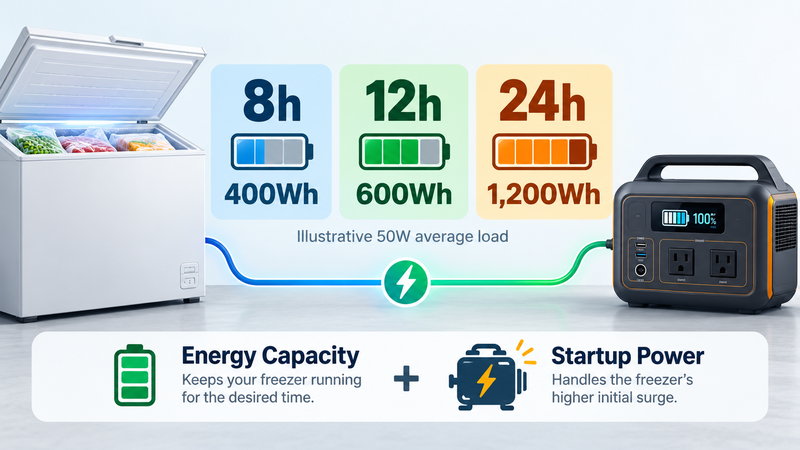
A freezer can often maintain a safe temperature for several hours without electricity, especially when it is full and the door stays closed. But during longer power outages, a portable power station or home battery system may be needed to keep the compressor operating.
The battery capacity required depends on the freezer's actual energy consumption, outage duration, inverter losses, startup power and available energy reserve. A freezer rated at 150 W does not necessarily consume 150 W continuously because many compressors operate in cycles.
For a realistic backup plan, calculate energy requirements in watt-hours (Wh), check the compressor's starting demand separately and consider how ambient temperature affects operation.
How Much Electricity Does a Freezer Use?
Freezer electricity consumption varies considerably by size, design, insulation, age, ambient temperature and usage patterns.
Many conventional freezers operate with compressors that switch on and off to maintain the required internal temperature. Consequently, their average consumption over several hours can be substantially lower than their running wattage.
Consider a hypothetical freezer with:
Compressor running power: 150 W.
Average compressor duty cycle: 30%.
Additional off-state consumption: 3 W.
Average power is estimated as:
(150 W × 0.30) + (3 W × 0.70) = 47.1 W.
Over 24 hours, this represents:
47.1 W × 24 h = 1,130.4 Wh, or approximately 1.13 kWh.
This is an illustrative calculation, not a universal freezer specification. Actual duty cycle can change with room temperature, door openings, contents and appliance condition.
For comparison, the same calculation method is used for refrigerators in How Much Battery Capacity Does a Refrigerator Need?
The key measurement for battery sizing is total energy consumption over time, not compressor running watts alone.
Freezer Backup Capacity for 8, 12 and 24 Hours
Suppose a freezer consumes an average of 50 W under representative conditions.
Its estimated energy needs are:
8-hour outage
Average power: 50 W.
Operating time: 8 hours.
Freezer energy consumption: 400 Wh.
12-hour outage
Average power: 50 W.
Operating time: 12 hours.
Freezer energy consumption: 600 Wh.
24-hour outage
Average power: 50 W.
Operating time: 24 hours.
Freezer energy consumption: 1,200 Wh.
These values describe electricity required by the freezer, not necessarily the nominal capacity of the battery supplying it.
The battery system must account for conversion losses, operating limits and an appropriate reserve.
The same 50 W average also assumes that the freezer's cooling requirements remain reasonably consistent. In hotter conditions, actual consumption may increase.
How to Calculate Required Battery Capacity
A simplified battery sizing formula is:
Required Battery Capacity (Wh) = Appliance Energy Demand (Wh) ÷ Delivery Efficiency
If an additional planning reserve is applied:
Required Battery Capacity = (Energy Demand ÷ Delivery Efficiency) × Reserve Factor
For example, consider a freezer requiring 600 Wh over 12 hours.
Assume:
Energy demand: 600 Wh.
Illustrative usable-energy delivery factor: 85%.
Additional planning margin: 20%.
The calculation becomes:
600 Wh ÷ 0.85 × 1.20 ≈ 847 Wh.
Under these assumptions, a battery with approximately 850 Wh nominal capacity reaches the calculated planning target.
However, selecting equipment with some additional flexibility may be appropriate, especially when actual energy consumption is uncertain.
The 85% delivery factor and 20% reserve are illustrative assumptions. They are not standard specifications for all power stations.
The method is explained in Battery Runtime Formula:
https://digitalowl.fika.bar/battery-runtime-formula-01M2JVJ0DBC2706XRP728QTZQ3
Actual manufacturer data should replace general assumptions whenever available.
What Size Battery Does a Freezer Need for One Day?
For the hypothetical freezer consuming 1,200 Wh in 24 hours, the same assumptions give:
1,200 Wh ÷ 0.85 × 1.20 ≈ 1,694 Wh.
This suggests a nominal battery capacity of roughly 1.7 kWh under the modelled conditions.
A station rated at 1,000 Wh may be insufficient for the full 24-hour requirement, while a larger system may offer a more suitable energy budget.
Nevertheless, a 1.7 kWh estimate should not be treated as a universal recommendation.
An efficient freezer could require considerably less energy. Another freezer operating in a hot environment, recovering from frequent door openings or running defrost cycles might consume more.
If the freezer's daily consumption is unknown, measure it before selecting equipment.
Why Freezer Compressor Startup Power Matters
Battery capacity and output power are different specifications.
A portable power station might contain sufficient stored energy to operate a freezer for many hours but lack enough inverter power to start its compressor.
Some compressor motors require a brief startup surge above their normal running demand.
For example, a freezer drawing 150 W while running may briefly require considerably more power during startup.
The actual requirement depends on compressor technology and appliance design.
Before selecting a power station, verify:
Continuous AC output rating.
Supported short-duration surge capability.
Freezer running-power requirement.
Compressor starting-power requirement.
Output voltage and frequency compatibility.
Do not assume a fixed startup multiplier applies to every freezer.
Watt-hours determine how long the battery may operate the freezer. Watts determine whether the electrical system can power and start it.
Does Ambient Temperature Change Freezer Battery Runtime?
Yes. Ambient temperature can significantly affect freezer energy consumption.
A freezer operating in a hot garage may require more frequent compressor operation than the same appliance in a cooler room.
Other relevant factors include:
Door-opening frequency.
Freezer insulation and door seals.
Amount and temperature of stored food.
Thermostat settings.
Ventilation around the condenser.
Automatic defrost cycles.
Appliance age and maintenance condition.
For example, if average consumption rises from 50 W to 70 W, a 12-hour outage requires:
50 W × 12 h = 600 Wh under the first assumption.
70 W × 12 h = 840 Wh under the second.
That represents 240 Wh of additional energy demand.
This difference can materially affect the battery capacity needed for backup.
For conservative planning, use measurements from conditions reasonably similar to those expected during an outage.
Should You Run the Freezer Continuously During an Outage?
Not every short outage requires immediate battery backup.
A properly functioning freezer can retain cold temperatures for some time when its door remains closed.
As a general food-safety planning reference, a full freezer may maintain safe temperatures for approximately 48 hours without electricity, while a half-full freezer may maintain them for approximately 24 hours, provided the door remains closed. These are approximate guidance values, not guarantees for every freezer or environment.
Actual food safety depends on internal temperature and the condition of the food. Frozen food that still contains ice crystals or remains at or below approximately 4°C (40°F) may be safe to refreeze or cook according to established food-safety guidance. Do not judge safety by smell or appearance alone.
For a relatively short outage, keeping the door closed may be more practical than operating a backup system immediately.
For longer or uncertain outages, backup electricity can help maintain cooling, but sufficient battery capacity and reliable starting power are essential.
A thermometer inside the freezer provides more useful information than elapsed time alone.
Freezer Backup vs Whole-Home Backup
A battery sized for one freezer is not the same as a system designed to support multiple household appliances.
If the backup system must also operate a router, lighting, refrigeration or other equipment, their energy demands must be included.
Consider a simplified 12-hour scenario:
Freezer: 600 Wh.
Router: 15 W × 12 h = 180 Wh.
Lighting: 20 W × 5 h = 100 Wh.
Combined appliance energy demand:
600 + 180 + 100 = 880 Wh.
Using the illustrative 85% delivery factor and 20% planning margin:
880 ÷ 0.85 × 1.20 ≈ 1,242 Wh.
This gives a nominal planning target of approximately 1.25 kWh under the assumed conditions.
You must also check maximum simultaneous power, not merely the combined watt-hours.
A broader approach is covered in How Much Battery Capacity Do You Need for Home Backup?
How to Measure Your Freezer's Actual Energy Consumption
A freezer's energy label provides a useful reference, but measured household consumption can be more relevant for backup planning.
Use an appropriately rated energy meter compatible with the appliance.
A practical process includes:
Allow the freezer to reach its normal operating temperature.
Measure energy use over at least a representative 24-hour period.
Record total watt-hours or kilowatt-hours.
Calculate average power by dividing energy by measurement time.
Repeat under different relevant temperature or usage conditions.
Use a conservative measured value for battery sizing.
Longer monitoring may capture periodic defrost cycles or changing compressor behaviour more accurately.
For example, if a freezer consumes 1.08 kWh over 24 hours:
1,080 Wh ÷ 24 h = 45 W average power.
A 12-hour estimate based on that average is:
45 W × 12 h = 540 Wh.
This is a stronger starting point than assuming the freezer operates continuously at its compressor's rated wattage.
Three Mistakes When Sizing Freezer Backup Batteries
Mistake 1: Multiplying Running Watts by the Entire Outage Duration
This assumes the compressor operates continuously. It can substantially overestimate energy demand for cycling freezers, although high cooling loads may cause prolonged operation.
Mistake 2: Ignoring Startup Surge
A battery system can have adequate energy capacity but insufficient output capability to start the compressor.
Mistake 3: Forgetting Real Storage Conditions
A freezer located in a warm environment may consume more electricity than expected. Battery conversion losses and the need for reserve energy can further reduce available runtime.
Avoiding these mistakes produces a more realistic backup plan.
Final Freezer Backup Sizing Checklist
Before buying a battery or portable power station, establish:
Daily energy consumption: how many Wh or kWh does the freezer actually use?
Required backup duration: eight, twelve, twenty-four hours or longer?
Operating conditions: will ambient temperature increase cooling demand?
Startup requirements: can the power station start the compressor?
Usable battery capacity: how much energy reaches the appliance?
Additional loads: must the same system power other equipment?
Reserve margin: how much uncertainty should be covered?
Recharging options: can the battery be recharged during an extended outage?
The best freezer backup system is not automatically the one with the largest nominal battery capacity. It is the one that can start the compressor and provide sufficient usable energy for the expected outage conditions.
Final Takeaway
Freezer battery sizing starts with measured or realistically estimated daily energy consumption.
A freezer averaging 50 W requires approximately 400 Wh for eight hours, 600 Wh for twelve hours or 1,200 Wh for twenty-four hours before battery-system losses and reserve margins.
However, actual demand depends on compressor duty cycle, ambient temperature, defrost behaviour and how the freezer is used.
For shorter outages, keeping the freezer closed may preserve food temperatures without immediately consuming battery energy. For longer outages, reliable backup requires both adequate watt-hours and sufficient starting power.
The practical rule is simple: calculate energy in Wh, verify startup power in W and size the battery around realistic conditions rather than appliance running watts alone.
Comments
No comments yet. Be the first to comment!