Can a 1,000Wh Power Station Run a Refrigerator Overnight?
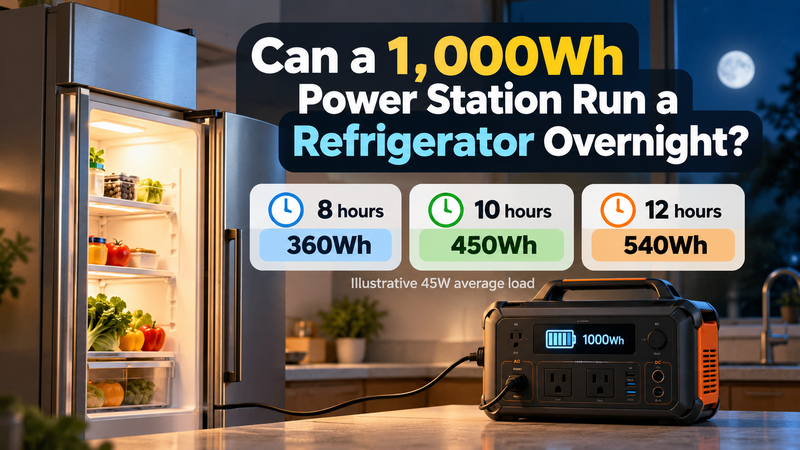
Yes, a 1,000Wh portable power station can run many refrigerators overnight, but the result depends on actual refrigerator energy consumption, inverter losses, standby power and the number of hours you need. A battery labelled 1,000Wh does not necessarily deliver the full 1,000Wh to an AC appliance.
A relatively efficient refrigerator may require only a few hundred watt-hours during an eight-hour period. A larger, older or heavily loaded refrigerator may consume substantially more. Compressor startup power also matters because a power station must be capable of starting the appliance, not merely storing enough energy.
The best way to evaluate a 1,000Wh power station is to calculate a realistic overnight energy budget rather than assume that every refrigerator operates continuously at its rated wattage.
How Much Usable Energy Does a 1,000Wh Power Station Provide?
A 1,000Wh capacity rating describes nominal stored energy under specified conditions.
In practice, the energy delivered to an AC refrigerator may be lower because of inverter conversion losses, battery operating limits and internal power consumption.
For a simplified example, assume:
Nominal battery capacity: 1,000Wh.
Illustrative energy conversion and availability factor: 85%.
Estimated energy available to the load: 850Wh.
The calculation is:
1,000Wh × 0.85 = 850Wh.
This is not a universal efficiency rating. Different power stations can deliver different amounts of usable energy depending on load, output mode, temperature and system design.
For planning purposes, also assume that 100Wh should remain unused as an emergency reserve.
That gives an estimated operating budget of:
850Wh − 100Wh = 750Wh.
In this example, the refrigerator must consume no more than approximately 750Wh during the intended overnight period.
The important distinction is between nominal battery capacity and energy actually available for the appliance.
How Much Energy Does a Refrigerator Use Overnight?
A refrigerator's energy consumption depends on its average electrical demand rather than its maximum running power alone.
Many refrigerators use compressors that switch on and off throughout the day. This operating pattern is called the duty cycle.
For example, a refrigerator drawing 120W while its compressor operates may run only 30% of the time under certain conditions.
Ignoring other appliance loads for simplicity:
120W × 0.30 = 36W average power.
Over eight hours:
36W × 8h = 288Wh.
Over ten hours:
36W × 10h = 360Wh.
Over twelve hours:
36W × 12h = 432Wh.
These figures are illustrative. Actual consumption may include defrost heaters, fans, control electronics and different compressor operating patterns.
For a more detailed sizing method, see How Much Battery Capacity Does a Refrigerator Need?
The practical lesson: refrigerator wattage is not enough to predict overnight battery runtime. You need average energy consumption over a representative period.
Example: Running a Refrigerator for 8, 10 or 12 Hours
Consider a hypothetical refrigerator with average AC consumption of 45W, measured or estimated over representative operating conditions.
Assume the power station has an energy budget of 750Wh after the previously defined availability factor and reserve.
The refrigerator's energy requirement becomes:
8-hour overnight period
Average refrigerator demand: 45W.
Required energy: 45W × 8h = 360Wh.
Remaining energy budget: 750Wh − 360Wh = 390Wh.
10-hour overnight period
Average refrigerator demand: 45W.
Required energy: 45W × 10h = 450Wh.
Remaining energy budget: 750Wh − 450Wh = 300Wh.
12-hour overnight period
Average refrigerator demand: 45W.
Required energy: 45W × 12h = 540Wh.
Remaining energy budget: 750Wh − 540Wh = 210Wh.
Under these assumptions, the power station can support all three overnight periods.
However, this result depends on the refrigerator maintaining approximately 45W average consumption and the station delivering the assumed energy budget.
The estimated remaining amounts are planning margins, not guaranteed readings on a real power station.
What Happens if the Refrigerator Uses More Power?
Now consider the same 750Wh operating budget with different refrigerator consumption levels.
Efficient refrigerator — 30W average
8 hours: 240Wh.
10 hours: 300Wh.
12 hours: 360Wh.
Moderate consumption — 50W average
8 hours: 400Wh.
10 hours: 500Wh.
12 hours: 600Wh.
Higher consumption — 80W average
8 hours: 640Wh.
10 hours: 800Wh.
12 hours: 960Wh.
With the assumed reserve, the 80W refrigerator exceeds the 750Wh operating budget for ten and twelve hours.
This demonstrates why the answer to the overnight-runtime question depends on the appliance.
A 1,000Wh power station may comfortably support one refrigerator while providing insufficient reserve for another.
How to Estimate Runtime From Daily Refrigerator Consumption
If you know the refrigerator's daily energy consumption, you can calculate average power.
For example, suppose an energy meter shows that a refrigerator consumes 1.2kWh over 24 hours.
First convert to watt-hours:
1.2kWh = 1,200Wh.
Then calculate average power:
1,200Wh ÷ 24h = 50W.
Using the hypothetical 750Wh operating budget:
750Wh ÷ 50W = 15 hours.
This gives an approximate runtime of 15 hours under the same average consumption and energy-availability assumptions.
Actual runtime may vary because compressor operation changes with ambient temperature, door openings and other conditions.
The underlying method is explained in Battery Runtime Formula:
https://digitalowl.fika.bar/battery-runtime-formula-01M2JVJ0DBC2706XRP728QTZQ3
For more reliable estimates, use measured daily consumption rather than relying entirely on manufacturer running-watt figures.
Why Refrigerator Starting Watts Matter
A power station can contain enough energy to operate a refrigerator overnight but still be unable to start its compressor.
This happens because startup power and running power are different electrical requirements.
A compressor may briefly demand considerably more power while starting than it uses during normal operation.
For example, a refrigerator might draw 120W while running but require a substantially higher short-duration starting demand.
The actual starting requirement varies by refrigerator design, motor technology and operating conditions.
When comparing a refrigerator with a portable power station, check:
Continuous AC output rating.
Supported surge capability.
Refrigerator running power.
Refrigerator starting-power requirements.
Manufacturer guidance on motor-driven appliances.
Do not assume that every refrigerator has the same startup multiplier.
A detailed explanation is available in Starting Watts vs Running Watts:
https://digitalowl.fika.bar/starting-watts-vs-running-watts-01M2K3FNMK1HM1FQDAYVFRT1PM
Remember: battery capacity determines the energy budget, while output capability determines whether the power station can operate and start the refrigerator.
How Inverter and Standby Losses Affect Overnight Runtime
Portable power stations supplying household AC electricity use inverters to convert battery DC energy into AC output.
This process involves conversion losses.
Some stations also consume electricity internally while their AC output remains active.
These losses become especially important when the refrigerator has a relatively low average power demand.
Suppose a refrigerator consumes 40W on average and the inverter electronics draw an additional illustrative 5W continuously.
The total average demand on the assumed battery-side energy budget, before any other conversion losses, would be:
40W + 5W = 45W.
Over ten hours:
45W × 10h = 450Wh.
Without the additional background consumption, the same refrigerator would require:
40W × 10h = 400Wh.
The difference is 50Wh.
However, when using a capacity figure already reduced by an overall conversion-efficiency assumption, avoid counting the same inverter losses twice.
A transparent calculation must identify whether the energy budget is measured at the battery, inverter input or AC output.
For a broader discussion, see the LinkedIn article Battery Runtime and Energy Consumption: From Watt-Hours to Real-World Use:
https://www.linkedin.com/pulse/battery-runtime-energy-consumption-from-watt-hours-use-zhyliaev-vsznf
The important principle is that realistic runtime depends on the complete energy system, not simply advertised battery capacity divided by appliance wattage.
Why Refrigerator Runtime Changes in Real Conditions
Even an accurate measurement from one day may not predict every overnight period.
Several factors can increase refrigerator energy consumption.
Ambient temperature: a refrigerator operating in a warm room may require longer compressor operation.
Door openings: frequent access allows warm air to enter and increases cooling demand.
Food temperature: adding warm food can temporarily increase energy consumption.
Thermostat settings: lower target temperatures may require more cooling energy.
Automatic defrosting: certain refrigerators use heating elements or other functions that add to total consumption.
Compressor technology: variable-speed refrigerators may operate differently from traditional on/off compressor models.
These factors explain why average electrical demand should be measured under conditions reasonably representative of the planned backup scenario.
For emergency use, leave room for uncertainty rather than designing the battery budget around the lowest observed consumption.
How to Test Your Refrigerator Before an Outage
A practical measurement is more valuable than a theoretical estimate based solely on the appliance label.
Use this process:
Measure energy consumption. Use an appropriately rated plug-in energy meter to record refrigerator consumption over a representative period, preferably covering complete operating and defrost cycles.
Calculate average demand. Divide measured watt-hours by the observation time.
Establish overnight duration. Decide whether you need eight, ten, twelve or more hours of backup.
Check power station output. Confirm continuous and startup capability against the refrigerator's requirements.
Estimate usable energy. Use manufacturer data or appropriately documented test results.
Allow a reserve. Account for uncertain consumption and avoid planning to exhaust the entire available energy supply.
Perform a controlled test. Where safe and practical, verify how the refrigerator and power station operate together.
When testing, follow manufacturer instructions and do not bypass electrical protection systems.
If the equipment behaves abnormally, stop the test and investigate the cause before relying on it during an outage.
Is a 1,000Wh Power Station Enough for a Full Day?
An overnight backup requirement is different from a 24-hour requirement.
Using the same illustrative 750Wh operating budget:
At 25W average consumption: 24 hours requires 600Wh.
At 40W average consumption: 24 hours requires 960Wh.
At 50W average consumption: 24 hours requires 1,200Wh.
At 80W average consumption: 24 hours requires 1,920Wh.
Only the first example fits within the assumed 750Wh budget.
This means that a 1,000Wh portable power station may provide useful overnight refrigerator backup without being sufficient for a full day.
For longer outages, options may include more battery capacity, additional compatible batteries or an appropriate recharging source.
Any solution should be evaluated against the refrigerator's measured energy use, the power station's specifications and realistic charging availability.
Three Mistakes That Lead to Unrealistic Refrigerator Runtime Estimates
Mistake 1: Assuming Nominal Capacity Equals Usable AC Energy
A 1,000Wh label does not guarantee that an AC appliance receives exactly 1,000Wh. Battery limits and conversion losses matter.
Mistake 2: Using Compressor Running Watts as Continuous Consumption
Many refrigerators cycle on and off. Multiplying running watts by the entire overnight period can overestimate energy consumption.
Mistake 3: Checking Runtime but Ignoring Startup Power
A station may have adequate stored energy while lacking sufficient surge capability to start a refrigerator compressor.
Avoiding these mistakes creates a more useful battery backup estimate.
Final Takeaway
A 1,000Wh portable power station can run many refrigerators overnight, but the actual runtime depends on average refrigerator energy consumption, usable battery energy, conversion losses and startup requirements.
In the illustrative example, a station with a 750Wh operating budget can support a refrigerator averaging 45W for eight, ten or twelve hours, while retaining the planned reserve.
A less efficient refrigerator may exceed that budget before the night is over.
The best approach is to measure the refrigerator's actual energy consumption, check the power station's output capability and calculate the complete energy requirement.
The practical rule: start with measured watt-hours per day, not refrigerator running watts, and size the backup system with a realistic reserve.
Comments
No comments yet. Be the first to comment!