2,000W vs 2,000Wh: Why These Specs Mean Different Things
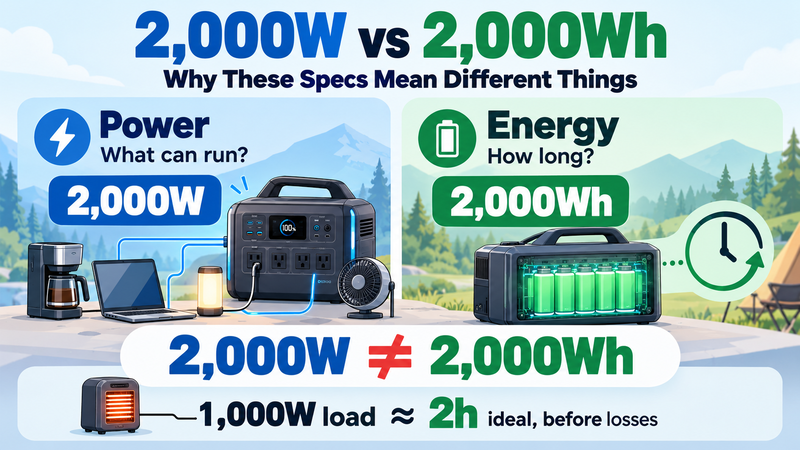
A portable power station advertised as 2,000W is not necessarily equipped with a 2,000Wh battery. Although the numbers look similar, watts (W) measure power, while watt-hours (Wh) measure energy. They describe different parts of how an energy storage system performs.
A 2,000W output rating tells you how much electrical power the station can continuously supply under specified conditions. A 2,000Wh battery capacity tells you how much energy it nominally stores.
Understanding the distinction helps avoid two common purchasing mistakes: buying a battery that cannot run a demanding appliance or choosing a powerful inverter with insufficient energy for the required runtime.
What Does 2,000W Mean on a Power Station?
2,000W is a power rating. On a portable power station, it commonly describes the maximum continuous AC output available from its inverter.
For example, a station rated at 2,000W continuous output may be able to support:
One 1,500W appliance, if its actual operating requirements are compatible.
Two 800W devices operating simultaneously, provided combined limits are respected.
Several small electronics with a total demand below the supported output.
Motor-driven equipment, provided starting requirements are also within the system's capabilities.
However, 2,000W is not automatically the battery's energy capacity, and it does not establish how many hours the station will operate.
It also does not guarantee compatibility with every appliance below 2,000W. Voltage, frequency, outlet limits, startup current and other restrictions still matter.
A complete explanation is available in What Is Continuous Power Output?
https://digitalowl.fika.bar/what-is-continuous-power-output-01M2JYJBJJHR19Q9ZVAPNTN5GX
Practical rule: the continuous watt rating tells you whether the system can supply the required power, not how long its battery will last.
What Does 2,000Wh Mean?
2,000Wh is an energy-capacity rating. It indicates that the battery nominally stores approximately 2,000 watt-hours, equivalent to 2 kilowatt-hours (2kWh).
Watt-hours combine power and time:
Energy (Wh) = Power (W) × Time (hours)
In a perfectly efficient theoretical system, 2,000Wh could provide:
100W for 20 hours.
200W for 10 hours.
500W for 4 hours.
1,000W for 2 hours.
2,000W for 1 hour.
These are ideal mathematical relationships, not guaranteed operating times.
Real portable power stations lose some energy during conversion and operation. Their actual usable energy also depends on battery management limits, temperature, load and product design.
Most importantly, a 2,000Wh battery does not automatically come with a 2,000W inverter.
For the broader capacity concepts, see Portable Power Station Capacity Explained:
https://digitalowl.fika.bar/portable-power-station-capacity-explained-01M418WTCRZQBSBGP2JVK082W9
2,000W vs 2,000Wh: A Simple Example
Imagine two hypothetical power stations.
Power Station A
Battery capacity: 1,000Wh.
Continuous AC output: 2,000W.
Power Station B
Battery capacity: 2,000Wh.
Continuous AC output: 1,000W.
Station A offers higher continuous output but less stored energy.
Station B stores more energy but cannot necessarily operate appliances requiring more than 1,000W continuously.
Suppose you want to run a 1,500W appliance.
Station A may support it, assuming its other electrical requirements are satisfied.
Station B may be unable to operate it because the appliance exceeds the station's continuous output rating.
Now suppose you want to operate a 100W device overnight.
Station B has more stored energy and could offer substantially longer runtime under comparable efficiency and operating conditions.
Neither system is universally better.
The correct choice depends on whether your primary constraint is output power, stored energy or both.
How Long Will a 2,000Wh Battery Actually Last?
A more realistic runtime calculation begins with usable energy.
Suppose a hypothetical 2,000Wh power station delivers an illustrative 85% of its nominal stored energy to the connected AC load.
2,000Wh × 0.85 = 1,700Wh.
Using the simplified runtime formula:
Runtime = Delivered Energy ÷ Average Load
Estimated operating times become:
100W load
1,700Wh ÷ 100W = 17 hours.
500W load
1,700Wh ÷ 500W = 3.4 hours.
1,000W load
1,700Wh ÷ 1,000W = 1.7 hours.
2,000W load
1,700Wh ÷ 2,000W = 0.85 hours, or approximately 51 minutes.
These calculations assume the station can support each load and delivers the stated usable energy.
Actual efficiency may vary with load. At very low power, inverter idle consumption may become a meaningful part of total consumption. At high output, thermal or discharge restrictions may affect performance.
Therefore, the same 2,000Wh battery can provide very different runtimes depending on what it powers.
Can a 2,000W Power Station Run for Two Hours?
Possibly, but only if it has enough usable battery energy for the load.
Suppose an appliance consumes 2,000W continuously.
Two hours of operation require:
2,000W × 2h = 4,000Wh at the appliance.
If the battery-to-load delivery factor is assumed to be 85%, nominal battery capacity before adding a separate reserve would need to be approximately:
4,000Wh ÷ 0.85 ≈ 4,706Wh.
That is approximately 4.7kWh of nominal storage under the illustrative assumptions.
A 2,000W inverter does not determine whether the station contains 1kWh, 2kWh, 5kWh or another amount of battery energy.
This is why output power and stored capacity must be evaluated separately.
Does a 2,000Wh Battery Always Support a 2,000W Load?
No.
A 2,000Wh battery could be paired with an inverter rated below 2,000W.
For example, a station with 2,000Wh capacity and 1,200W continuous AC output would not ordinarily support a constant 2,000W AC load within its rated operating limits.
The battery stores enough nominal energy to make the calculation seem plausible, but the inverter cannot necessarily deliver the required power.
This distinction also applies to individual ports.
A power station might advertise a relatively high total output rating while imposing lower limits on certain AC or DC connections.
Always check the manufacturer's complete output specifications.
What About Starting Watts and Surge Power?
Some appliances temporarily require more power during startup than during normal operation.
Examples include refrigerators, compressors, pumps and motor-driven tools.
A device drawing 700W while running may require a higher short-duration starting demand.
A station with 2,000W continuous output may support that appliance, but compatibility depends on its actual surge capability and the appliance's electrical behaviour.
Surge ratings vary between manufacturers. The permitted duration, voltage behaviour and overload response matter.
Do not assume that a station's advertised peak rating guarantees every motor will start successfully.
A useful comparison therefore separates three measurements:
Stored energy (Wh): how much energy the battery contains.
Continuous power (W): how much power it can normally deliver.
Surge power (W): its supported short-duration output capability.
These three specifications answer different questions.
What Changes for Refrigerator and Home Backup?
Suppose a refrigerator consumes an average of 50W over a representative operating period.
Using the hypothetical 1,700Wh delivered-energy budget:
1,700Wh ÷ 50W = 34 hours.
That suggests approximately 34 hours of theoretical operation under the assumed conditions.
But a refrigerator has compressor cycling, possible defrost activity and potentially substantial starting-power requirements.
The average energy calculation is useful for estimating runtime, while inverter output must be checked separately.
For a home backup system, the distinction becomes even more important.
A 2,000W inverter could theoretically support several small devices operating simultaneously, but their total energy consumption determines how quickly the battery empties.
For example:
Router: 15W for 10 hours = 150Wh.
Laptop: 60W for 4 hours = 240Wh.
Lighting: 20W for 6 hours = 120Wh.
Fan: 40W for 5 hours = 200Wh.
Total appliance energy demand:
710Wh.
A station with 2,000Wh nominal capacity may have sufficient energy for this illustrative scenario, but the actual answer depends on usable energy, losses, reserve and electrical compatibility.
Why Charging Speed Is Another Separate Specification
A third number can create additional confusion: charging power.
A power station may be described using:
2,000W continuous AC output.
2,000Wh nominal battery capacity.
1,000W maximum AC charging input.
These figures describe separate capabilities.
The first concerns delivering power to appliances.
The second concerns stored energy.
The third concerns how quickly the battery may accept energy while charging.
A simplified recharge calculation is:
Charging Time ≈ Energy to Replenish ÷ Average Charging Power
For a hypothetical 2,000Wh battery receiving an average of 1,000W:
2,000Wh ÷ 1,000W = 2 hours.
Real charging may take longer because of losses, charging curves, temperature and battery management limits.
A 2,000W output rating therefore does not imply that the system charges at 2,000W.
How to Compare Power Stations Without Mixing Up W and Wh
A useful comparison starts with the intended application.
First, calculate required energy. Determine how many watt-hours the connected equipment will consume over the relevant period.
Second, establish maximum continuous load. Add the power requirements of devices likely to operate simultaneously.
Third, check startup requirements. Confirm that motor-driven appliances can start within the inverter's supported limits.
Fourth, estimate usable energy. Account for conversion losses, internal consumption and battery operating restrictions.
Fifth, add reserve. Allow for uncertainty, longer operating periods and changing consumption.
Sixth, evaluate practical constraints. Compare charging options, weight, size, durability and cost.
The broader difference between watts and watt-hours is explained in Watts vs Watt-Hours: What's the Difference?
https://digitalowl.fika.bar/watts-vs-watt-hours-what-s-the-difference-01M2GNJJ68FM3605JW1JW54A99
For a complete framework that connects use case, capacity, power, reserve and other specifications, read Decision Tools for Energy Storage: Turning Battery Specs Into Better Choices:
A structured decision process prevents buyers from choosing a system based on one impressive-looking number.
Three Common 2,000W vs 2,000Wh Mistakes
Mistake 1: Assuming 2,000W Means a 2,000Wh Battery
A watt rating alone does not describe stored energy. Always check the Wh or kWh specification separately.
Mistake 2: Assuming 2,000Wh Guarantees 2,000W Output
A large battery can be paired with a smaller inverter. Stored capacity does not establish maximum output.
Mistake 3: Expecting Exactly One Hour at 2,000W
Even a station with both 2,000Wh capacity and 2,000W continuous output may run for less than one hour at full load because of conversion losses and operating limits.
Real energy delivery must be considered.
Final 2,000W vs 2,000Wh Decision Checklist
Before purchasing a power station, confirm:
Battery capacity: how many Wh or kWh does it store?
Usable energy: how much reaches the connected equipment?
Continuous output: what total load can it sustain?
Starting power: can it support motor-driven appliances?
Required runtime: how long must devices operate?
Charging input: how quickly can the system recharge?
Electrical compatibility: do the ports, voltage and frequency match the devices?
Reserve: how much additional energy is appropriate?
A complete comparison should show both the energy budget and the power limits instead of treating them as one rating.
Final Takeaway
2,000W and 2,000Wh are not interchangeable specifications.
2,000W describes power delivery. It helps determine which appliances a power station can operate.
2,000Wh describes nominal stored energy. It helps determine how long the system may operate those appliances.
Under an illustrative 85% energy-delivery assumption, a 2,000Wh battery provides approximately 1,700Wh to the connected load. That could support a 100W appliance for approximately 17 hours or a 1,000W appliance for approximately 1.7 hours, provided the station's output capabilities are compatible.
Neither specification tells the whole story alone.
The practical rule is simple: watts determine what can run; watt-hours help determine for how long. Always check both.
Calculations are illustrative. Actual performance varies with appliance demand, conversion efficiency, battery condition and operating conditions.
Comments
No comments yet. Be the first to comment!