Battery Modules and Packs Explained: From Cells to Complete Energy Systems
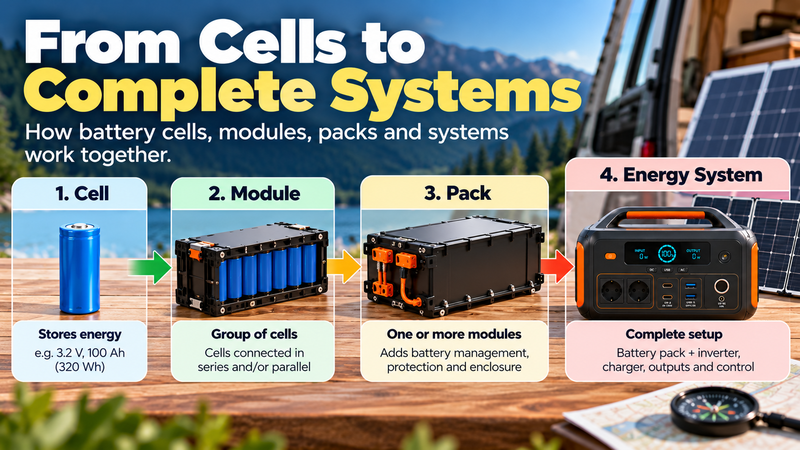
Battery specifications often jump directly from individual cells to a complete battery pack, but there is usually another layer in between: the module.
Understanding the hierarchy from cell → module → pack → system makes it much easier to understand voltage, capacity, expandability and why large battery systems are built from many smaller components.
For the broad battery-capacity framework:
https://medium.com/@volodymyrzh/battery-capacity-explained-mah-wh-amp-hours-decoded-1dc676be5a38
Start With the Battery Cell
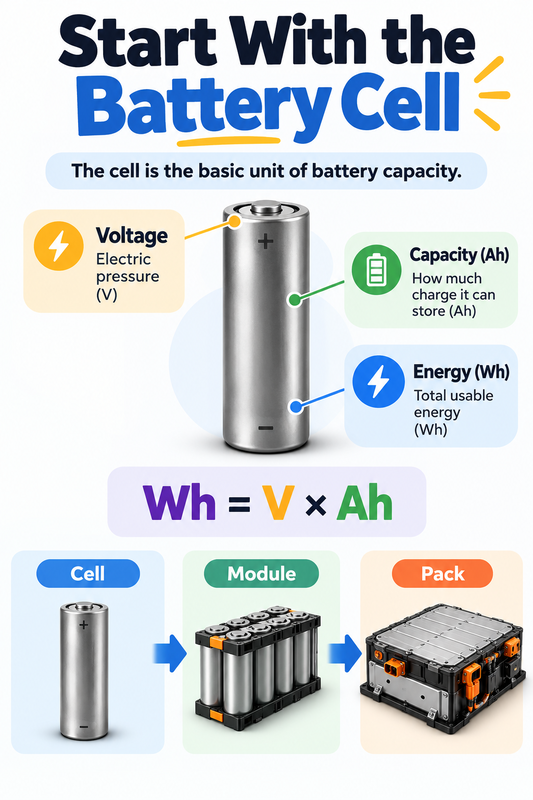
The cell is the basic electrochemical unit.
A single lithium-ion or LiFePO4 cell has its own:
nominal voltage;
capacity in Ah;
stored energy in Wh;
chemistry;
current limits.
For example, a hypothetical cell might be rated:
3.2 V, 100 Ah
Its nominal energy would be:
3.2 V × 100 Ah = 320 Wh
One cell may be enough for a small application, but larger systems usually need more voltage, more capacity or both.
What Is a Battery Module?
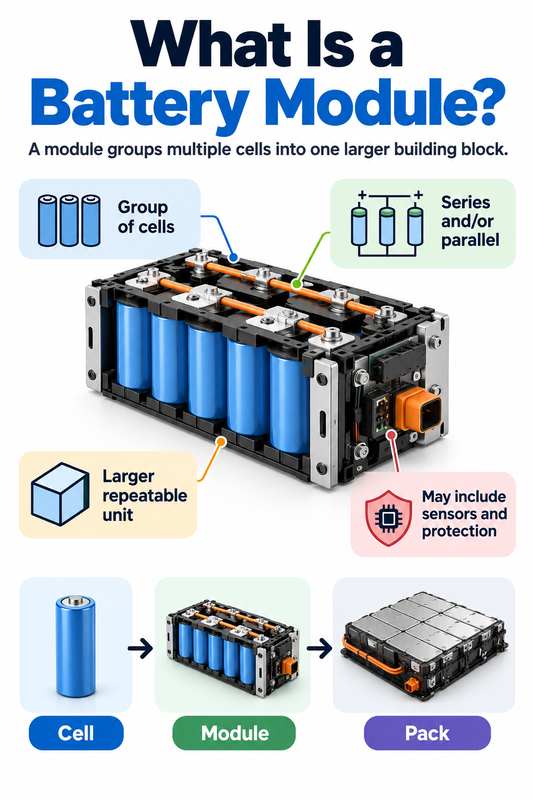
A battery module is a group of cells assembled into a larger electrical and mechanical unit.
Cells inside a module may be connected in:
series;
parallel;
a combination of both.
The module simplifies construction because manufacturers can work with larger repeatable building blocks rather than handling every cell individually at the final system level.
A module may also include:temperature sensors;
voltage monitoring;
mechanical protection;
electrical connections;
communication components.
The exact design varies widely between battery systems.
What Is a Battery Pack?
A battery pack combines one or more modules into a complete battery assembly.
The pack usually includes more than cells and modules.
Depending on the design, it may also contain:
battery-management electronics;
fuses or contactors;
current sensors;
thermal-management components;
structural enclosure;
communication interfaces;
high-current connections.
The pack is usually the level at which users think of the product as “the battery.”
Cell, Module, Pack and System
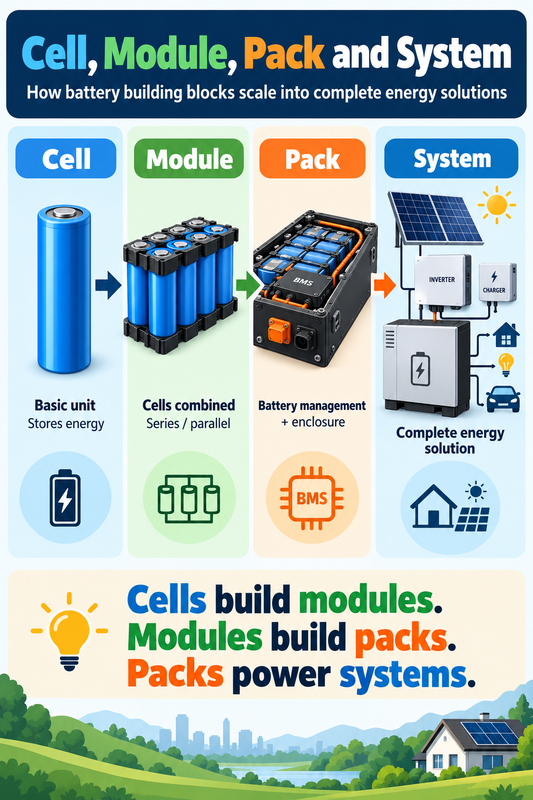
A useful hierarchy is:
Cell → Module → Pack → Energy System
The cell stores energy.
The module combines cells.
The pack combines modules and adds control and protection.
The complete energy system may then combine the battery pack with:
inverter;
charger;
solar controller;
AC/DC outputs;
monitoring software;
additional expansion batteries.
This distinction matters because battery capacity and system capability do not always increase in the same way.
Series Connections Increase Voltage
Cells or modules connected in series increase total voltage while Ah capacity remains approximately the same.
For example, four identical 3.2 V, 100 Ah cells in series produce:
3.2 V × 4 = 12.8 V
Capacity remains:
100 Ah
Energy becomes:
12.8 V × 100 Ah = 1,280 Wh
The same principle applies when complete modules are placed in series, provided the system is designed for that configuration.
For the underlying concept:
https://digitalowl.fika.bar/batteries-in-series-vs-parallel-01M3ADSFCS839DE87JYK879SPD
Parallel Connections Increase Ah Capacity
Parallel connections work differently.
If four identical 3.2 V, 100 Ah cells are connected in parallel:
Voltage remains:
3.2 V
Capacity becomes:
400 Ah
Energy is again:
3.2 V × 400 Ah = 1,280 Wh
So series and parallel configurations can both increase total stored energy when additional identical cells are added, but they change the electrical architecture differently.
Pack Voltage Comes From Cell Configuration
A battery pack does not have an arbitrary voltage.
Its nominal voltage is largely determined by:
cell chemistry;
nominal cell voltage;
number of cells connected in series.
For example, sixteen 3.2 V LiFePO4 cells in series produce approximately:
16 × 3.2 V = 51.2 V nominal
This is why many nominal “48 V” LiFePO4 systems are specified around 51.2 V.
For a deeper explanation:
https://digitalowl.fika.bar/cell-voltage-vs-pack-voltage-01M3AENP96N8XCVC6ZJFN5SCQG
More Modules Can Increase Energy Capacity
Suppose one battery module stores:
2.5 kWh
A compatible system with two identical modules may provide approximately:
5 kWh
Three may provide:
7.5 kWh
and four:
10 kWh
This modular architecture makes it possible to scale stored energy without redesigning the entire system from scratch.
But this does not mean every battery system supports unlimited expansion.
Expandable Capacity Depends on System Design
Some batteries are specifically designed to accept additional modules or expansion packs.
Others are not.
Expansion can be limited by:
BMS architecture;
communication protocols;
maximum supported module count;
pack voltage;
current limits;
charger capability;
inverter compatibility;
firmware.
So adding another battery module is not simply a matter of connecting more stored energy.
The system must be designed to recognise, manage and safely operate the expanded battery bank.
For more on this:
https://digitalowl.fika.bar/what-is-expandable-battery-capacity-01M3AN3GFYFR9MDEEQESPCNH27
More Capacity Does Not Automatically Mean More Power
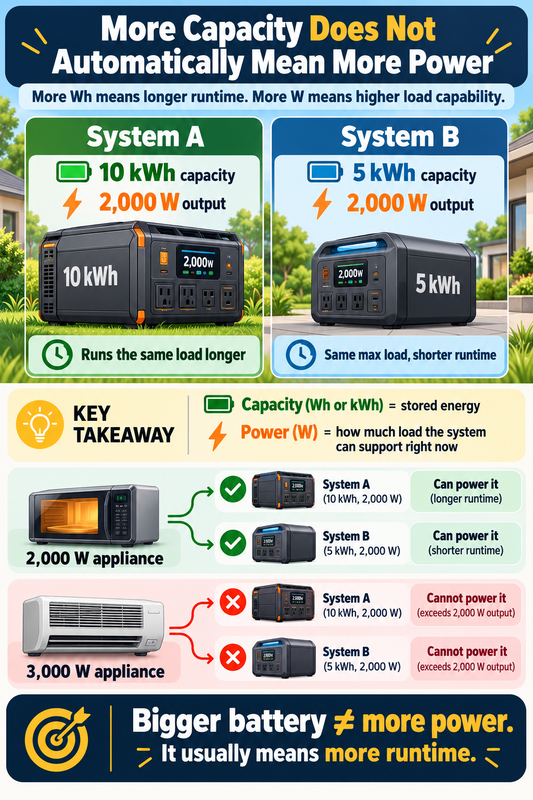
This is an important distinction.
Imagine a system with:
5 kWh battery capacity
and:
2,000 W inverter output
Adding another 5 kWh battery module might increase total storage to:
10 kWh
But the inverter may still be limited to:
2,000 W
The system can potentially run the same load for longer, but it cannot necessarily run a larger load.
Stored energy and output power remain separate specifications.
Why Modules Are Useful
Modular architecture offers several practical benefits.
It can make systems:
easier to manufacture;
easier to scale;
easier to transport;
easier to configure for different capacity levels;
easier to service at the assembly level;
more flexible for product families.
A manufacturer can use the same module architecture in several products with different total energy capacities.
Modules Also Create Constraints
Modularity is not automatically unlimited flexibility.
Modules often need to match in:
chemistry;
nominal voltage;
BMS communication;
firmware;
age or state of health;
current capability;
manufacturer-approved configuration.
A battery should not be treated like a generic building block simply because it has compatible-looking terminals.
Compatibility is an electrical and control-system question, not only a physical one.
Battery Packs Need Management
As batteries become larger, monitoring becomes increasingly important.
The system may need to track:
cell voltage;
module voltage;
current;
temperature;
state of charge;
faults;
balancing conditions.
The battery-management system helps keep cells and modules within defined operating limits.
In a large pack, the weakest or most imbalanced part can influence the usable performance of the whole system.
Capacity Can Be Discussed at Several Levels
A specification may refer to:
Cell capacity — the Ah or Wh of one cell.
Module capacity — the combined energy of the cells in one module.
Pack capacity — the energy of all modules in the pack.
System capacity — the total energy available when multiple packs or expansion batteries are combined.
These levels should not be mixed.
A 100 Ah cell does not mean the complete battery pack is 100 Ah at the same voltage unless the pack architecture supports that interpretation.
Wh is often the clearer metric for comparing total stored energy across different architectures.
Energy Density Is Different From Total Capacity
A battery pack can store more energy simply because it contains more cells.
That does not necessarily mean it has higher energy density.
Energy density describes how much energy is stored relative to mass or volume.
Total capacity describes how much energy is stored overall.
A large, heavy battery can have very high total Wh while having lower energy density than a smaller pack using a different chemistry or architecture.
This distinction is explored here:
https://www.linkedin.com/pulse/energy-density-vs-battery-capacity-what-matters-storage-zhyliaev-rzyif/
Example: Building a Larger Pack
Suppose each module contains:
51.2 V
50 Ah
Module energy:
51.2 × 50 = 2,560 Wh
or approximately:
2.56 kWh
If the system supports four modules operating together:
2.56 × 4 = 10.24 kWh
The system now has roughly four times the stored energy of one module.
But its inverter output does not automatically become four times larger.
That depends on the inverter, BMS and electrical architecture.
Why Pack Architecture Matters When Comparing Batteries
Two batteries may both advertise:
5 kWh
but reach that number differently.
One could use:
one large integrated pack.
Another could use:two 2.5 kWh modules.
A third might use:five 1 kWh modules.
The total nominal energy can be similar while differences remain in:voltage;
weight distribution;
expandability;
redundancy;
installation;
current capability;
service architecture.
So Wh alone tells you total stored energy, but not how the system is built.
The Practical Rule
Think of battery architecture as a hierarchy:
Cells create modules.
Modules create packs.
Packs become part of complete energy systems.
Adding more compatible cells or modules can increase total stored energy, but voltage, Ah, power capability and expandability depend on how those components are connected and managed.
When comparing battery systems, check both:
how much energy the system stores
and
how the pack architecture creates that capacity.
That distinction makes specifications such as voltage, Ah, Wh, module count and expandable capacity much easier to interpret.
Comments
No comments yet. Be the first to comment!