What Does 80% Battery Health Actually Mean?
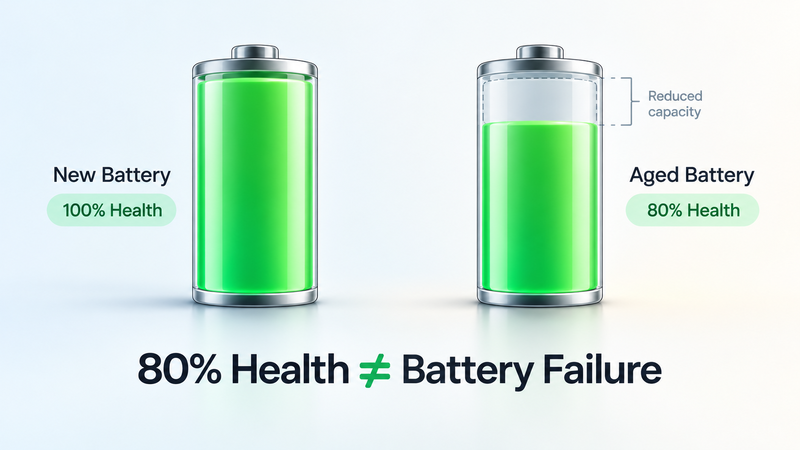
A battery health reading of 80% can sound alarming, especially when a device previously displayed 100%. But 80% battery health does not mean the battery is 80% charged, 80% damaged or about to stop working. In many cases, it means the battery's estimated maximum capacity has declined to approximately 80% of its original reference capacity.
That distinction matters for smartphones, laptops, electric vehicles, portable power stations and home battery systems. A battery can still operate normally at 80% health, although it may store less energy and provide shorter runtime than it did when new.
The practical question is not simply whether battery health has reached 80%. It is whether the battery still meets the device's energy and power requirements.
What Does 80% Battery Health Mean?
Battery health describes the condition of a battery relative to a defined reference, often its original performance when new.
A common capacity-based interpretation is:
Battery health (%) = Current maximum measured capacity ÷ Original reference capacity × 100
For example, imagine a rechargeable battery that originally stored 1,000 Wh of energy under specified test conditions.
After prolonged use, its measured capacity has decreased to 800 Wh under comparable conditions.
Original capacity: 1,000 Wh.
Current measured capacity: 800 Wh.
Capacity decrease: 200 Wh.
Capacity-based health estimate: 80%.
The battery has lost approximately 20% of its original measured energy-storage capacity.
However, not every battery management system calculates health in exactly the same way. Some estimates may also reflect internal resistance, power capability or other diagnostic measurements.
The broader concept is explained in What Is Battery State of Health?
https://digitalowl.fika.bar/what-is-battery-state-of-health-01M2YV5RRYGFSKJYQWQH8RWS0V
The important distinction: 80% battery health describes a reduction relative to an earlier reference, not the battery's current charging level.
Is 80% Battery Health Good or Bad?
There is no universal answer because battery suitability depends on the application.
For a smartphone, reduced maximum capacity may mean charging more frequently. For a laptop, it may mean shorter operation away from a power outlet.
For an electric vehicle, lower available capacity can reduce driving range under otherwise comparable conditions.
For a home backup battery, reduced capacity may shorten the time essential appliances can operate during an outage.
Yet a battery at 80% health can still be useful if its remaining energy capacity and power delivery are sufficient.
For example, a portable power station that originally delivered 1,000 Wh and now delivers approximately 800 Wh may still support a 100 W load for several hours, subject to efficiency, temperature and operating limitations.
The same battery might no longer meet an application that requires nearly its full original capacity.
Battery health is therefore a performance indicator, not an automatic pass-or-fail result.
Does 80% Battery Health Mean 20% Capacity Loss?
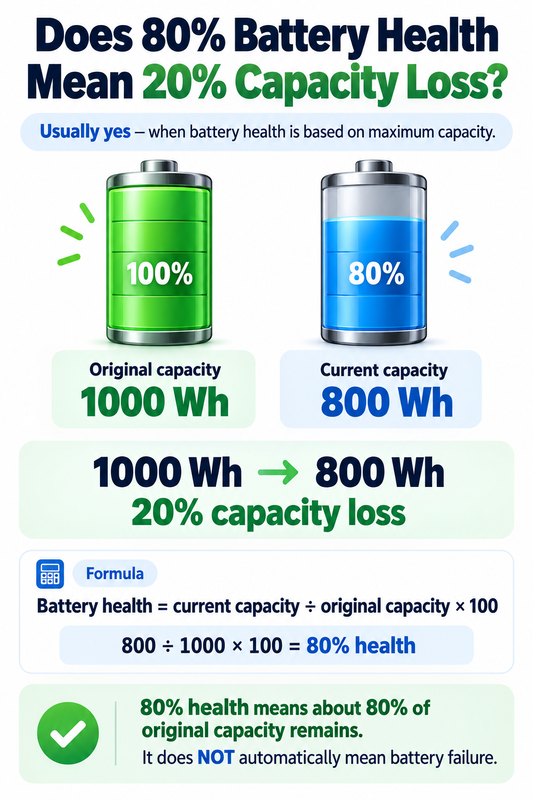
When battery health is explicitly defined using maximum capacity, an 80% reading generally corresponds to approximately 20% capacity loss relative to the reference value.
However, it is important to distinguish the estimated percentage from an independently measured capacity.
Battery management systems often estimate battery health using models and operating history. Their displayed results may include uncertainty.
Capacity can also vary with temperature, discharge rate and test conditions.
This is why comparisons are most meaningful when measurements use a consistent methodology.
The relationship between original and remaining capacity is explored in What Is Capacity Retention?
https://digitalowl.fika.bar/what-is-capacity-retention-01M2YVXR04YVB9906154JB79PB
Capacity retention describes the percentage of reference capacity remaining after ageing or cycling.
An 80% capacity-retention result therefore indicates that approximately four-fifths of the reference capacity remains under the relevant measurement conditions.
Can You Charge an 80% Health Battery to 100%?
Yes. An ageing rechargeable battery can usually still display 100% State of Charge even when its maximum capacity has decreased.
These percentages describe different things:
100% State of Charge (SoC): the battery is fully charged relative to its defined present operating range.
80% State of Health (SoH): the battery's estimated condition is approximately 80% of the reference according to the system's health metric.
Imagine a battery that originally stored 1,000 Wh but now has a measured maximum capacity of 800 Wh.
When fully charged, it can display 100% SoC while storing approximately 800 Wh under the reference conditions.
Its charge indicator is not necessarily wrong. It simply uses a different reference.
Confusing charge level with health can lead people to assume that a battery cannot charge completely after ageing.
In reality, a battery can be fully charged without retaining its original maximum capacity.
How Does 80% Battery Health Affect Runtime?
Reduced battery capacity can shorten runtime, although the exact change depends on how the battery and connected device operate.
A simplified runtime relationship is:
Runtime (hours) = Usable energy (Wh) ÷ Average power demand (W)
Consider an illustrative battery with:
Original usable energy: 500 Wh.
Current usable energy: 400 Wh.
Average appliance demand: 50 W.
When new, its idealised runtime would have been:
500 Wh ÷ 50 W = 10 hours.
With 400 Wh remaining:
400 Wh ÷ 50 W = 8 hours.
In this example, the battery provides approximately two hours less operating time at the same power demand.
Real performance can differ because of conversion losses, device behaviour, temperature and battery management limits.
A smartphone may also change its power consumption depending on screen brightness, network activity and software workload.
An 80% health reading suggests reduced energy availability, but it does not guarantee precisely 20% less runtime in every situation.
Why Is 80% Often Used as a Battery Lifespan Benchmark?
Battery manufacturers and researchers frequently use an 80% capacity-retention threshold when reporting cycle life.
For example, a battery specification might state that capacity retention reaches 80% after 3,000 cycles under defined laboratory conditions.
This does not mean the battery suddenly fails at the 3,000th cycle.
Instead, 80% serves as a specified comparison point for measuring durability.
A battery may continue functioning after crossing this threshold, although its performance may no longer meet the requirements of its original application.
Cycle-life results also depend on operating conditions, including:
Battery chemistry.
Temperature.
Depth of discharge.
Charge and discharge rates.
Cycling methodology.
Capacity-retention criteria.
The measurement principles are explained in What Is Battery Cycle Life?
https://digitalowl.fika.bar/what-is-battery-cycle-life-01M2YNVWHAW1CQ4D7CFQ9DSEHH
An 80% retention threshold is a durability benchmark, not a universal prediction of battery failure.
Does Battery Health Continue Declining After 80%?
Battery degradation generally continues with use and ageing, but the rate is not necessarily constant.
A battery does not automatically lose its next 10% of capacity at the same rate as the previous 10%.
Degradation depends on multiple factors, including temperature exposure, cycling patterns, storage conditions and chemistry.
Some battery systems may experience relatively gradual capacity reduction for an extended period, while others can show more pronounced deterioration later in their operating life.
This makes it difficult to predict remaining lifespan from a single health reading.
Two batteries displaying 80% health may have different ages, histories and future degradation patterns.
To evaluate long-term condition, it is more useful to consider health trends over time alongside actual runtime, charging behaviour and any diagnostic warnings.
Should You Replace a Battery at 80% Health?
Not necessarily.
An 80% health reading can be a useful reason to evaluate battery performance, but replacement should depend on the device and its intended use.
Replacement may become worthwhile when:
Available runtime no longer meets practical needs.
The device experiences unexpected shutdowns.
Reduced power capability affects normal operation.
The manufacturer recommends service based on diagnostic findings.
Battery condition or safety warnings require professional evaluation.
A battery can also become unsuitable before reaching 80% health if other problems affect its operation.
Conversely, a battery below 80% capacity retention may remain adequate for less demanding applications.
Safety is a separate consideration. Physical swelling, overheating, damage or other abnormal behaviour should not be dismissed simply because the reported health percentage appears acceptable.
Use battery health as one diagnostic input, not the sole replacement criterion.
How to Interpret an 80% Battery Health Reading Correctly
When a device reports 80% battery health, ask four questions:
What exactly does the percentage measure? Is it based primarily on capacity, or does the system use a broader health model?
What was the original reference capacity? A percentage becomes more meaningful when paired with Wh or Ah.
Does the battery still meet the required runtime? Actual energy needs matter more than a percentage in isolation.
Are there signs of abnormal operation? Unexpected shutdowns, excessive heating and diagnostic warnings may indicate issues beyond ordinary capacity loss.
These questions help separate normal ageing from performance limitations that require attention.
They also prevent confusion between a reported health threshold and the battery's actual serviceability.
Final Takeaway
80% battery health usually indicates that a battery retains approximately 80% of its original capacity when the health metric is capacity-based. It does not mean the battery has stopped working, cannot charge to 100% or must automatically be replaced.
The remaining energy may provide shorter runtime than when the battery was new, but its practical usefulness depends on the application.
An 80% capacity-retention threshold is also commonly used in cycle-life specifications because it provides a consistent durability benchmark.
The most useful interpretation is simple: 80% battery health means reduced performance relative to the original reference—not necessarily the end of the battery's useful life.
Comments
No comments yet. Be the first to comment!