Digitalowl
- Home
- Why Beginners Should Build Small Projects Before Learning Everything
- What to Power First During a 72-Hour Blackout
Recent posts
-
Battery Chemistry and Pack Architecture: How Capacity Is Built
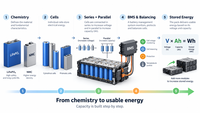
Battery capacity is often presented as a single number: 500 Wh, 2 kWh, 10 kWh. But that number is the result of several layers working together. The chemistry influences cell voltage, energy density, cycle behaviour and other characteristics. Cells are arranged into series and parallel groups. Those groups determine pack voltage and amp-hour capacity. A battery-management system monitors the cells…
- batteries
- electricity
- +1
-
What Is Expandable Battery Capacity?
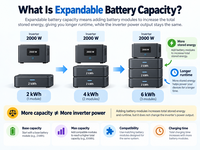
Expandable battery capacity means that an energy-storage system can increase its total stored energy by adding compatible battery modules. A system might begin with one battery and later support one or more expansion batteries. The result is usually more watt-hours or kilowatt-hours of stored energy and therefore potentially longer runtime. But there is an important limitation: Adding battery capa…
- blackout
- electricity
- +2
-
What Is Battery Cell Balancing?
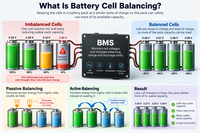
A battery pack can contain many individual cells, but those cells do not always behave identically. Small differences in capacity, internal resistance, temperature and aging can cause some cells to reach their voltage limits before others. Over time, those differences can grow. Battery cell balancing is the process of reducing these differences so the cells in a battery pack remain closer to the s…
- batteries
- electricity
- +1
-
12V vs 24V vs 48V Battery Banks
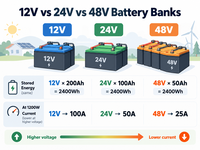
Battery banks are commonly described as 12V, 24V or 48V systems, but a higher voltage does not automatically mean a battery stores more energy. Voltage is only one part of the specification. The same amount of stored energy can be arranged as a lower-voltage bank with more amp-hours or a higher-voltage bank with fewer amp-hours. The major practical difference appears when the system needs to deliv…
- batteries
- blackout
- +3
-
Cell Voltage vs Pack Voltage
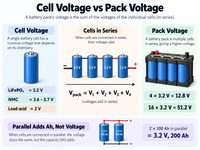
A battery pack may be labelled 12 V, 24 V, 48 V or another system voltage, but the individual cells inside it usually operate at much lower voltages. The connection between those two numbers is straightforward: cell voltage × number of cells in series = pack voltage But battery labels can become confusing because cell chemistry, nominal voltage, state of charge and series configuration all affect …
-
Batteries in Series vs Parallel
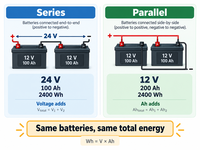
Connecting batteries in series or parallel changes how the battery bank behaves electrically. The simplest distinction is: Series increases voltage while amp-hours stay the same. Parallel increases amp-hours while voltage stays the same. But there is an important third number: watt-hours. When identical batteries are combined, both series and parallel arrangements can produce the same total sto…
- batteries
- blackout
- +3
-
Energy Density vs Battery Capacity
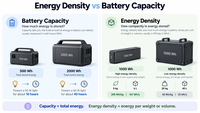
Battery capacity and energy density are closely related concepts, but they answer different questions. Battery capacity tells you how much energy a battery stores. Energy density tells you how much energy is stored relative to its weight or volume. That distinction matters when comparing batteries for portable power stations, electric vehicles, home storage, electronics and other applications wher…
- batteries
- blackout
- +3
-
Lithium-Ion vs Lead-Acid Batteries
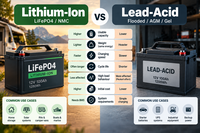
Lithium-ion and lead-acid batteries can both store electrical energy, but the same capacity label does not mean they will behave the same way in real use. The differences become especially important when comparing usable energy, weight, charging behaviour, cycle life and performance under higher loads. There is also an important terminology point: lithium-ion is not one single chemistry. LiFePO4 a…
- batteries
- blackout
- +3
-
LiFePO4 vs NMC
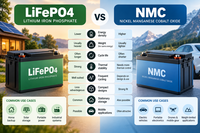
LiFePO4 and NMC are two common lithium-ion battery chemistries, but they are optimized around different priorities. One tends to emphasize long cycle life and thermal stability, while the other can offer higher energy density when size and weight matter. That does not make either chemistry universally better. The useful question is: Which trade-offs matter most for the application? Before comparin…
- batteries
- electricity
- +1
-
What Is an NMC Battery?
NMC is one of the most common families of lithium-ion battery chemistry. The abbreviation refers to the three main metals used in the cathode: nickel, manganese and cobalt. NMC batteries are widely used where relatively high energy density matters, including electric vehicles, power tools and many portable electronic devices. But “NMC” does not describe one identical battery chemistry. Different N…

- batteries
- blackout
- +2
-
What Is a LiFePO4 Battery?
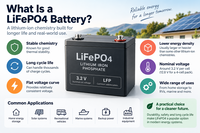
LiFePO4 is one of the most widely used lithium-ion battery chemistries for applications where long cycle life, predictable performance and durability are important. The abbreviation stands for lithium iron phosphate. Like other lithium-ion batteries, LiFePO4 cells move lithium ions between positive and negative electrodes during charging and discharging. What makes the chemistry different is the m…
- batteries
- electricity
- +2
-
Battery Health & Lifespan Topic Map: What to Read Next
Battery lifespan is rarely controlled by one number. Cycle count matters. Temperature matters. Depth of discharge matters. Charge rate matters. Time matters even when the battery is sitting unused. And the battery management system influences how much of that stress the cells are actually allowed to experience. That makes battery health difficult to understand through isolated specifications. This…

- batteries
- blackout
- +3
-
Charge Rate and Battery Lifespan
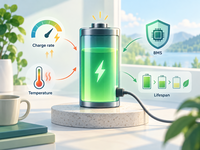
Fast charging is convenient, but does charging a battery faster also make it wear out faster? Sometimes it can. A higher charge rate can increase heat and electrochemical stress, and under unfavourable conditions it may accelerate battery degradation. But the relationship is not as simple as “fast charging damages batteries.” Battery chemistry, temperature, state of charge, cell design, cooling an…
- batteries
- electricity
- +2
-
Depth of Discharge and Cycle Life
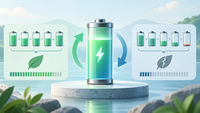
How deeply a battery is discharged can influence how quickly it ages. This relationship is often simplified into advice such as “never discharge a battery below 20%” or “use only 80% of its capacity.” Those rules can sometimes be useful as practical guidelines, but they are not universal laws. Battery chemistry, cell design, temperature, charge rate, discharge rate and the manufacturer’s operating…
- batteries
- electricity
- +4
-
What Is Calendar Aging?
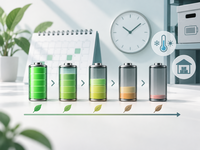
A battery can lose capacity even when it is barely being used. That may sound surprising because battery wear is often associated with charging and discharging. But cycling is only one part of battery degradation. Chemical reactions continue inside many batteries while they sit in storage, remain installed in a device or spend long periods at a particular state of charge. This time-dependent degra…
- batteries
- blackout
- +3
-
Why Batteries Lose Capacity Over Time
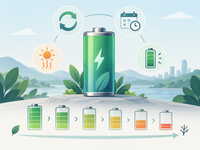
A battery rarely loses capacity because of one single event. In most cases, degradation is gradual: chemical and physical changes accumulate while the battery is being used, charged, stored and exposed to different temperatures. That is why an older battery may still charge to “100%” while storing less energy than it did when it was new. The state-of-charge display describes how full the battery i…
- batteries
- blackout
- +3
-
What Is Capacity Retention?
Battery capacity retention describes how much of a battery's original capacity remains after ageing, cycling or a defined period of use. If a battery originally provides 1,000 Wh and later provides 850 Wh under comparable test conditions, its capacity retention is approximately 85%. This sounds simple, but capacity-retention figures are often misunderstood. A specification such as “80% capacity af…

- batteries
- electricity
- +3
-
What Is Battery State of Health?
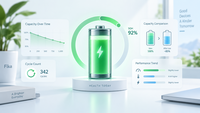
Battery State of Health, usually shortened to SoH, is an estimate of how a battery's present condition compares with its condition when it was new. A new battery is generally treated as being close to 100% SoH. As the battery ages, repeated cycling, time, temperature and operating conditions can reduce its ability to perform as originally specified. SoH attempts to describe that change in a compac…
- batteries
- electricity
- +2