Battery Chemistry and Pack Architecture: How Capacity Is Built
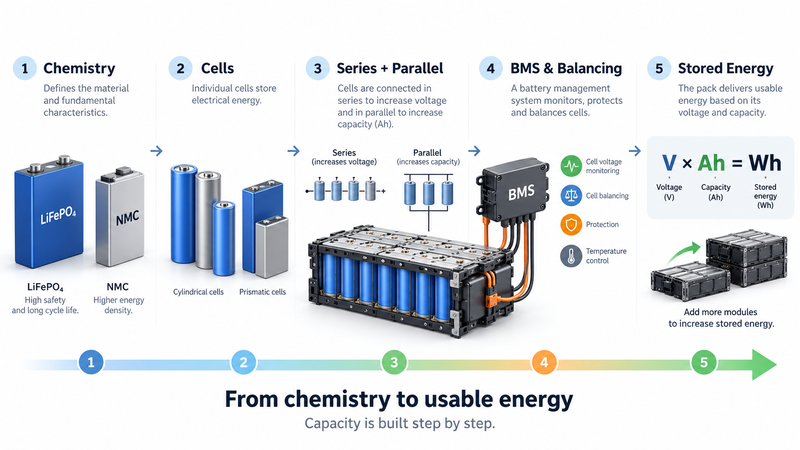
Battery capacity is often presented as a single number: 500 Wh, 2 kWh, 10 kWh.
But that number is the result of several layers working together.
The chemistry influences cell voltage, energy density, cycle behaviour and other characteristics. Cells are arranged into series and parallel groups. Those groups determine pack voltage and amp-hour capacity. A battery-management system monitors the cells, and some systems allow additional modules to expand total stored energy.
So a battery's capacity is not just a number printed on the case.
It is the result of an architecture:
chemistry → cells → series/parallel configuration → pack voltage and Ah → Wh → battery-management limits → usable system capacity
For the broader foundation behind mAh, Ah and Wh, start here:
https://medium.com/@volodymyrzh/battery-capacity-explained-mah-wh-amp-hours-decoded-1dc676be5a38
Chemistry Defines the Starting Point
Battery chemistry affects the characteristics of the individual cells from which the pack is built.
Two important lithium chemistries are LiFePO4 and NMC.
LiFePO4 is commonly used where cycle life, durability and thermal behaviour are important:
https://digitalowl.fika.bar/what-is-a-lifepo4-battery-01M2ZXCSGCM7R3AZWCTMWBDNGP
NMC is another widely used lithium-ion chemistry and is often attractive where higher energy density is important:
https://digitalowl.fika.bar/what-is-an-nmc-battery-01M30ZRDJ2SAT2PSPFN5WHV631
Neither chemistry can be described as universally better.
The relevant trade-off depends on whether the system prioritises weight, volume, cycle life, operating conditions, cost or another constraint.
A direct comparison is available here:
https://digitalowl.fika.bar/lifepo4-vs-nmc-01M399CP24380Y52X0BBYXTMVV
Chemistry Also Changes the Physical Size of Capacity
Two batteries can contain the same number of watt-hours while differing significantly in mass or volume.
That is where energy density enters the picture.
Battery capacity asks:
How much energy is stored?
Energy density asks:
How much energy is stored per unit of mass or volume?
The difference matters especially in EVs, portable equipment and other applications where size and weight are constraints:
https://digitalowl.fika.bar/energy-density-vs-battery-capacity-01M39NR873XE0DZXFH5CASVK0S
The same distinction becomes even clearer when comparing lithium-ion technology with lead-acid batteries, where weight, usable capacity, charging behaviour and cycle characteristics can differ substantially:
https://digitalowl.fika.bar/lithium-ion-vs-lead-acid-batteries-01M39AX7YH5SZZSQWD24KHC0A9
So chemistry influences how practical a given amount of capacity is — but chemistry alone does not determine the pack's total Wh.
Cells Have to Be Combined Into a Pack
A single cell operates at a chemistry-dependent voltage.
A useful battery system normally needs many cells arranged together.
Two basic relationships matter:
Series connections increase voltage.
Parallel connections increase amp-hour capacity.
The detailed relationship is explained here:
https://digitalowl.fika.bar/batteries-in-series-vs-parallel-01M3ADSFCS839DE87JYK879SPD
Imagine identical cells.
Connecting more of them in series raises pack voltage while the Ah value of the series string remains the same.
Adding equivalent parallel strings increases Ah while maintaining the same system voltage.
The final stored energy still follows:
Wh = V × Ah
This is how cell architecture turns many relatively small electrochemical units into a useful battery pack.
Cell Voltage Becomes Pack Voltage
The difference between cell voltage and pack voltage is another important part of the architecture.
A LiFePO4 cell may have a nominal voltage around 3.2 V.
Four such cells in series produce approximately:
4 × 3.2 V = 12.8 V nominal
Sixteen produce approximately:
16 × 3.2 V = 51.2 V nominal
The relationship is explained here:
https://digitalowl.fika.bar/cell-voltage-vs-pack-voltage-01M3AENP96N8XCVC6ZJFN5SCQG
This is why familiar labels such as 12V, 24V and 48V describe system-voltage classes rather than necessarily giving the exact nominal voltage of every chemistry.
12V, 24V and 48V Do Not Describe Capacity by Themselves
A higher-voltage battery bank does not automatically store more energy.
For example:
12V × 200Ah = 2,400Wh
24V × 100Ah = 2,400Wh
48V × 50Ah = 2,400Wh
All three examples represent the same nominal stored energy.
The major difference appears when delivering power: at the same wattage, a higher-voltage architecture requires less current.
That system-level comparison is covered here:
https://digitalowl.fika.bar/12v-vs-24v-vs-48v-battery-banks-01M3AJV0M7MTZ1WTJZGRN475YR
So pack voltage describes one part of the architecture. Watt-hours describe the stored energy produced by voltage and charge capacity together.
The BMS Helps Keep the Pack Inside Its Limits
A multi-cell battery is not simply a passive collection of cells.
Individual cells can gradually differ in voltage and state of charge because of small variations in capacity, resistance, temperature and aging.
If one cell reaches its upper or lower limit early, the complete pack may need to stop charging or discharging even though other cells still have available capacity.
Cell balancing helps reduce that difference.
Passive balancing generally dissipates excess energy from higher cells, while active balancing can redistribute energy between cells or cell groups.
The concept is explained here:
https://digitalowl.fika.bar/what-is-battery-cell-balancing-01M3AKY2YBAZ6ZEMBB2YVF33S1
Balancing does not create additional rated capacity. It helps the pack operate with its cells closer together so that one cell is less likely to become the limiting factor prematurely.
This is one reason nominal capacity and practically usable system capacity are not always identical.
Capacity Can Also Be Modular
Some battery systems allow additional modules to be connected later.
A system might begin with:
2 kWh
and expand to:
4 kWh → 6 kWh → 8 kWh
within the manufacturer's supported architecture.
That concept is covered here:
https://digitalowl.fika.bar/what-is-expandable-battery-capacity-01M3AN3GFYFR9MDEEQESPCNH27
Expansion primarily adds stored energy.
It does not necessarily increase inverter output.
A system might therefore grow from 2 kWh to 6 kWh while its inverter remains rated at the same 2,000 W.
The additional batteries increase how long the system can potentially support a load, not necessarily how large a load it can run.
Capacity, Energy Density and Power Need Separate Questions
This is where battery specifications become much easier to interpret if they are separated into distinct questions:
Capacity: How many Wh or kWh are stored?
Energy density: How much energy is stored per kg or litre?
Voltage: At what electrical potential does the pack operate?
Ah: How much charge capacity does the architecture provide?
Power: How many watts can the system deliver?
Expandable capacity: How much additional stored energy can compatible modules add?
None of these numbers replaces the others.
A useful broader discussion of why energy density and battery capacity matter differently in energy-storage systems is available here:
Pack Architecture Connects Chemistry to Usable Capacity
The easiest way to understand a modern battery is not to start with one specification.
Follow the architecture:
1. Chemistry determines important cell characteristics.
2. Cell voltage establishes the electrical building block.
3. Series configuration creates the required pack voltage.
4. Parallel capacity contributes additional Ah where the design requires it.
5. Voltage × Ah determines nominal Wh.
6. The BMS and balancing keep cells within operating limits.
7. System limits determine how much of the nominal energy is practically accessible.
8. Expansion modules may increase total stored energy within the supported architecture.
Battery health then changes this picture over time. Capacity retention, state of health, cycle life, temperature and other degradation mechanisms gradually influence what the pack can actually deliver.
For that side of the system, use the Battery Health & Lifespan Topic Map:
The Complete Capacity Picture
A battery's Wh rating may look like one simple specification, but behind it is an entire technical structure.
Chemistry influences the cells.
Cells create the pack.
Series and parallel arrangements create voltage and Ah.
Voltage and Ah create nominal Wh.
The BMS manages operating limits.
Balancing helps keep cells aligned.
Expansion modules can add more stored energy.
That is why two batteries with apparently similar capacity ratings can still differ significantly in weight, voltage, chemistry, usable energy, power capability and system flexibility.
The most useful way to read a battery specification is therefore not:
“How many Wh does it have?”
It is:
“How is that capacity built, and what limits determine how the system can actually use it?”
Comments
No comments yet. Be the first to comment!