Why Batteries Lose Capacity Over Time
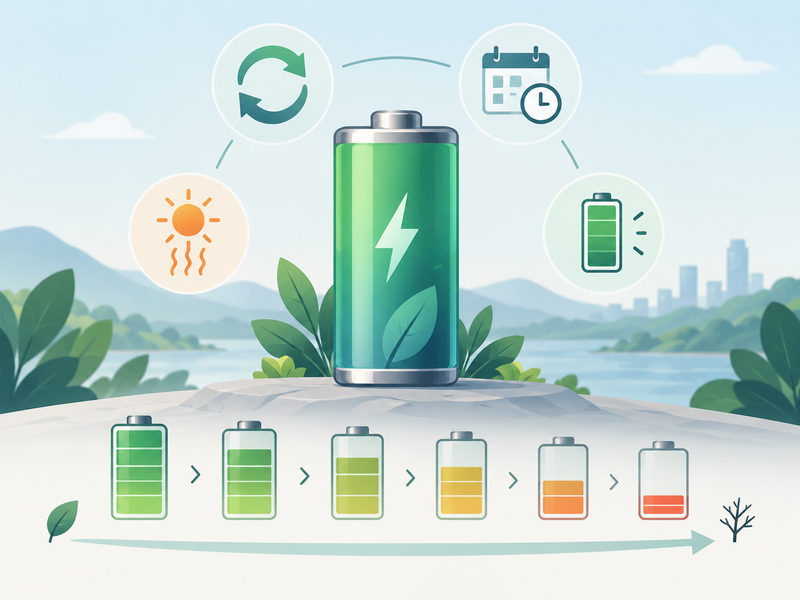
A battery rarely loses capacity because of one single event. In most cases, degradation is gradual: chemical and physical changes accumulate while the battery is being used, charged, stored and exposed to different temperatures.
That is why an older battery may still charge to “100%” while storing less energy than it did when it was new. The state-of-charge display describes how full the battery is relative to its present usable range; it does not tell you that the original capacity is still available.
For the broader foundation behind mAh, Ah and Wh, see the complete battery capacity guide: https://medium.com/@volodymyrzh/battery-capacity-explained-mah-wh-amp-hours-decoded-1dc676be5a38
Battery Degradation Means the Battery Is Changing
Battery degradation is the gradual decline in a battery’s ability to store energy, deliver power or perform as efficiently as it did when new.
Capacity loss is one of the most visible signs. A battery originally rated at 100 Wh might eventually provide only 90 Wh, then 85 Wh, even when fully charged.
But capacity is only part of battery health. Internal resistance can increase, voltage behaviour can change and the battery may become less capable of supplying high loads.
This is why battery degradation is closely connected with state of health, or SoH. SoH is an estimate of the battery’s overall condition relative to when it was new:
https://digitalowl.fika.bar/what-is-battery-state-of-health-01M2YV5RRYGFSKJYQWQH8RWS0V
Cycle Aging Happens While the Battery Is Used
One major form of degradation is cycle aging.
Every charge and discharge moves ions through the battery and produces changes inside the electrodes and electrolyte. These processes are designed to be reversible, but they are never perfectly reversible indefinitely.
Over many cycles, small irreversible changes accumulate.
For lithium-ion batteries, these can include growth of interfacial layers, loss of active lithium, changes in electrode materials and increases in internal resistance. Other battery chemistries age through somewhat different mechanisms, so there is no single degradation model that applies equally to every battery.
How quickly cycle aging develops also depends on how the battery is used.
Deep discharge cycles can be more stressful than shallow cycles for many batteries. High charge or discharge rates can also increase stress under some operating conditions, especially when combined with unfavourable temperatures.
This is one reason a cycle count by itself does not fully describe battery condition.
Batteries Also Age While Sitting Still
A battery does not have to be cycling to lose capacity.
Calendar aging describes degradation that occurs simply with time. A battery stored for several years can therefore lose some of its original capacity even if it has completed relatively few charge cycles.
The rate is not fixed.
Storage temperature, state of charge, battery chemistry and cell design can all influence how quickly calendar aging proceeds. A battery stored under gentle conditions can therefore age differently from an otherwise identical battery stored under more stressful conditions.
This distinction is important because “low cycle count” does not automatically mean “almost new.”
Age and usage both matter.
Heat Usually Accelerates Aging
Temperature has a major influence on battery degradation.
Higher temperatures generally accelerate many of the chemical reactions that contribute to aging. A battery repeatedly exposed to excessive heat may therefore lose capacity faster than the same battery operated in a more moderate thermal environment.
Heat can come from several sources:
high ambient temperatures;
charging or discharging at high power;
poor cooling around a battery pack;
heat generated internally by electrical resistance;
prolonged storage in a hot location.
Cold temperatures create a different problem. A battery can temporarily deliver less energy or power when cold even without permanent capacity loss. Some charging conditions at very low temperatures can also create additional degradation risks for certain lithium-ion chemistries.
So a battery that performs poorly in the cold is not necessarily permanently degraded. Temperature-related performance loss and permanent aging are related but different concepts.
High State of Charge Can Add Stress
Keeping some battery types near their upper voltage limit for long periods can also accelerate aging.
This is particularly relevant to many lithium-ion systems. High state of charge generally means higher electrode potentials, which can increase the rate of unwanted side reactions.
That does not mean charging to 100% immediately damages a battery or that every device should always be stopped at an arbitrary percentage.
Battery chemistry, voltage limits, thermal management and the manufacturer’s control strategy all matter.
But two otherwise similar batteries can age differently if one spends most of its life at high state of charge and elevated temperature while the other spends more time under moderate conditions.
The combination of stressors is often more important than any one number.
Capacity Retention Shows the Result of Degradation
Capacity retention provides a convenient way to describe how much capacity remains compared with a reference value.
If a battery began with 100 Ah of measured capacity and later provides 90 Ah under comparable test conditions, its capacity retention is approximately 90%.
That does not automatically mean the battery has exactly 10% less useful life remaining. It simply describes the measured capacity relative to the reference point.
Capacity retention is explained in more detail here:
https://digitalowl.fika.bar/what-is-capacity-retention-01M2YVXR04YVB9906154JB79PB
This distinction matters because battery degradation is gradual rather than a simple switch from “healthy” to “failed.”
There Is No Universal Battery Aging Rate
Statements such as “a battery loses X% every year” should be treated cautiously.
Battery aging depends on chemistry, cell design, temperature, charge voltage, depth of discharge, current, storage conditions and usage pattern. Even two batteries of the same model can experience different degradation histories.
That is also why comparisons are more useful when they include measurement conditions rather than presenting a capacity number alone.
Battery health metrics can become particularly valuable when they are presented with clear methodology, reference conditions and visualised trends. This broader approach to turning battery-health measurements into useful energy data is covered here:
https://www.linkedin.com/pulse/battery-health-metrics-linkable-energy-data-volodymyr-zhyliaev-i3nif/
Degradation Is a Process, Not a Single Threshold
Battery capacity usually declines through a combination of time, cycling and operating stress.
Cycle aging reflects what happens as the battery repeatedly charges and discharges. Calendar aging continues even during storage. Heat can accelerate degradation, while long periods at high state of charge can add stress for some chemistries.
The exact balance is different for every battery system.
That is why one number — cycle count, age, state of charge or remaining capacity — cannot describe the entire condition of a battery on its own.
Understanding battery degradation means looking at the history behind the number.
And when explaining technical subjects like this, the way information is structured and communicated matters too. A separate guide on building a consistent tone of voice for technical and marketing content is available here:
https://volodymyrzh.medium.com/tone-of-voice-in-marketing-content-9f702ee8de3c
Comments
No comments yet. Be the first to comment!