What Is Capacity Retention?
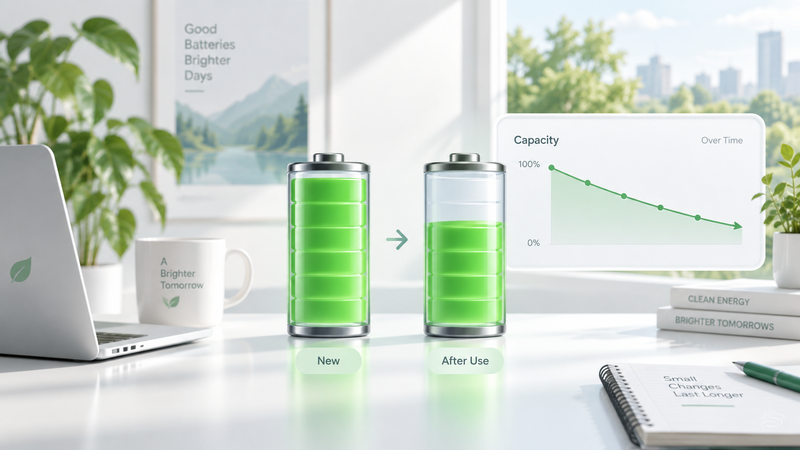
Battery capacity retention describes how much of a battery's original capacity remains after ageing, cycling or a defined period of use.
If a battery originally provides 1,000 Wh and later provides 850 Wh under comparable test conditions, its capacity retention is approximately 85%.
This sounds simple, but capacity-retention figures are often misunderstood. A specification such as “80% capacity after 3,000 cycles” does not mean the battery works normally for 2,999 cycles and suddenly loses 20% of its capacity on the next one. Battery degradation is normally gradual, and the 80% figure is a reference threshold used to describe how performance changes over time.
For the broader concepts behind battery capacity, mAh, Ah and Wh, see:
https://medium.com/@volodymyrzh/battery-capacity-explained-mah-wh-amp-hours-decoded-1dc676be5a38
Capacity Retention Compares Today With an Earlier Reference
The basic idea can be represented as:
Capacity retention = Current measured capacity ÷ Reference capacity × 100%
Imagine a battery that delivered 2,000 Wh when new. After extended use, a comparable capacity test shows 1,700 Wh.
1,700 ÷ 2,000 × 100% = 85%
Its capacity retention is therefore approximately 85%.
The word comparable is important. If the original capacity was measured under one set of conditions and the later capacity under very different conditions, the percentage may not represent ageing alone. Temperature, discharge rate, voltage limits and measurement methodology can all affect the result.
80% Retention Does Not Mean the Battery Has Failed
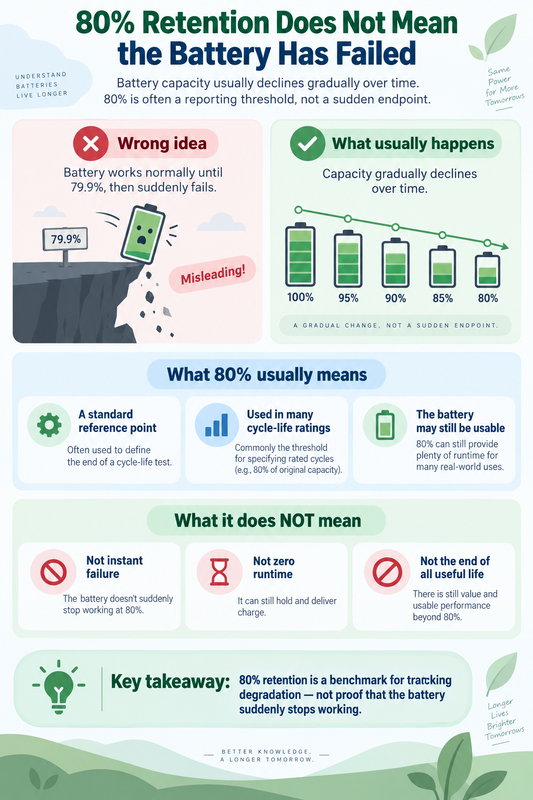
Cycle-life specifications often use a retention threshold such as 80%.
For example:
3,000 cycles to 80% capacity
This usually means that under the stated test conditions, the battery is expected to retain around 80% of the relevant reference capacity after approximately 3,000 cycles.
It does not automatically mean:
the battery fails at cycle 3,000;
capacity suddenly drops from 100% to 80%;
only 20% of battery life remains;
the battery becomes unusable at 80%.
Instead, capacity usually declines progressively. The manufacturer or test procedure simply uses 80% as a defined point for reporting cycle performance.
Battery cycle life and the importance of test conditions are explained in more detail here:
https://digitalowl.fika.bar/what-is-battery-cycle-life-01M2YNVWHAW1CQ4D7CFQ9DSEHH
Capacity Retention and State of Health Are Related but Not Identical
Capacity retention is often an important part of State of Health (SoH), but the two terms should not automatically be treated as synonyms.
Capacity retention answers a relatively specific question:
How much measurable capacity remains compared with the reference value?
State of Health is broader. Depending on the battery system, SoH may consider capacity together with other information such as internal resistance, voltage behaviour or diagnostic data.
For example, a battery may retain 88% of its original measured capacity while a battery-management system reports an SoH value calculated from several variables rather than capacity alone.
For the distinction:
https://digitalowl.fika.bar/what-is-battery-state-of-health-01M2YV5RRYGFSKJYQWQH8RWS0V
This is why a capacity-retention percentage should be described as exactly that rather than automatically relabelled as SoH.
Retention Depends on How Capacity Is Measured
A statement such as “the battery retains 90% capacity” becomes much more useful when the measurement conditions are known.
Important context can include:
battery chemistry;
reference capacity;
temperature;
depth of discharge;
charge and discharge rate;
cutoff voltage;
number of cycles;
test procedure;
measurement date.
Suppose Battery A is reported at 85% retention after 2,000 cycles and Battery B at 90%. Without knowing how those values were measured, it may be impossible to conclude that Battery B aged more slowly.
One result could come from shallow cycling at moderate temperature while the other came from deeper cycling or a different retention methodology.
For battery-health data to be useful as a comparison or research resource, the methodology needs to travel with the number. This broader approach to transparent battery-health data is discussed here:
https://www.linkedin.com/pulse/battery-health-metrics-linkable-energy-data-volodymyr-zhyliaev-i3nif/
Capacity Loss Changes Runtime
When a battery retains less capacity, it generally has less stored energy available for the same type of load.
Imagine a battery that originally delivered 1,000 Wh and now delivers 800 Wh under comparable conditions. If every other factor stayed equal, you would expect less runtime from the aged battery.
But real-world runtime does not depend on capacity alone. Load, inverter efficiency, standby consumption, AC/DC conversion and other assumptions also matter.
That is why a capacity-retention figure should not be converted directly into an exact runtime prediction without considering the rest of the system.
For a deeper explanation of why battery runtime estimates need explicit assumptions:
Capacity retention tells you how much the energy-storage capability has changed. It does not by itself tell you exactly how long every device will run.
Retention Usually Changes Gradually
Battery degradation is better imagined as a slope than as a cliff.
A simplified capacity history might look like this:
New battery: 100%
After some use: 96%
Later: 91%
Later still: 86%
Reference threshold: 80%
Real degradation may not follow a perfectly straight line, and the rate can change with operating conditions. Still, this model is much more useful than imagining a battery remaining at exactly 100% until a predefined cycle number.
The threshold used in a specification simply gives manufacturers and users a common reference point.
Why Different Batteries Retain Capacity Differently
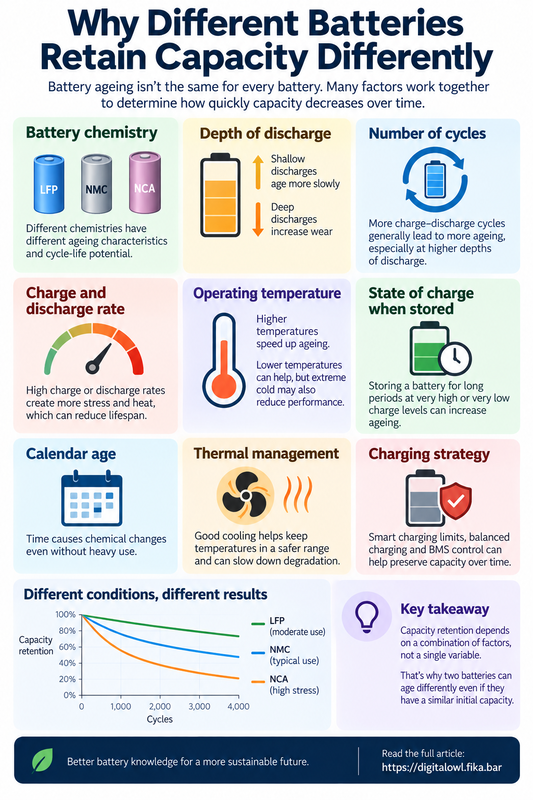
Capacity retention can be affected by many interacting factors. These include battery chemistry and cell design, but also how the battery is actually used.
Relevant factors can include:
number of cycles;
depth of discharge;
charge and discharge rate;
operating temperature;
time spent at high or low state of charge;
calendar age;
thermal management;
charging strategy.
This is why capacity retention should not be presented as a fixed universal decline such as “a battery loses X% every year.”
Different batteries and usage patterns can produce very different degradation curves.
Capacity Retention Is More Useful as a Trend
A single retention measurement can tell you something about the battery's present condition. A sequence of comparable measurements tells you much more.
For example:
100% → 97% → 93% → 89% → 85%
Now you can see not only the current capacity but the direction and approximate rate of change.
This is particularly useful for battery monitoring, research and long-term comparisons. The key requirement is consistency: the measurements should use sufficiently comparable conditions and definitions.
Without consistent methodology, a detailed-looking trend line can still be misleading.
The Main Idea
Capacity retention tells you how much of a battery's reference capacity remains after use and ageing.
A battery at 85% capacity retention has not necessarily reached 85% of its total lifetime, and an 80% retention threshold does not mean sudden failure. It is simply a defined benchmark for describing degradation.
To interpret a retention figure properly, look beyond the percentage. Ask what the original reference was, how the capacity was measured, under what conditions it was tested and when the measurement was taken.
That turns “80% remaining” from an isolated number into useful information about how battery performance is changing over time.
Comments
No comments yet. Be the first to comment!