Cell Voltage vs Pack Voltage
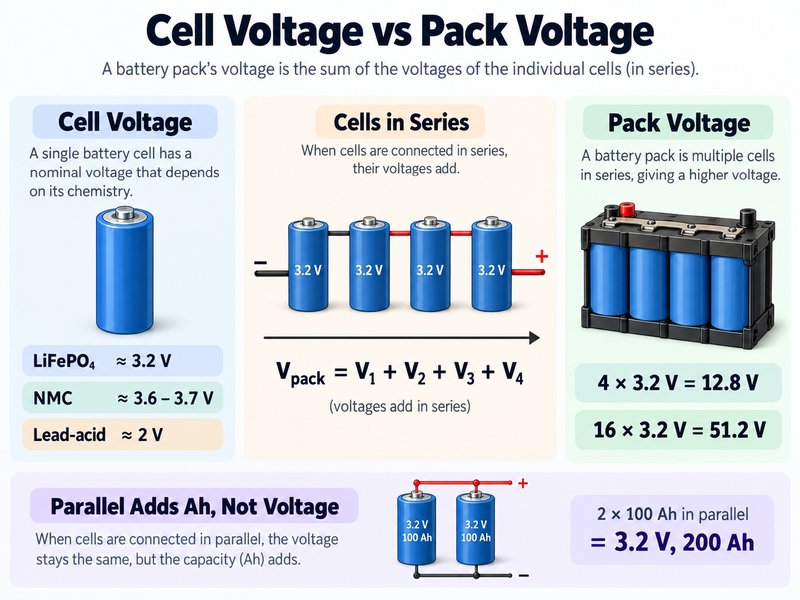
A battery pack may be labelled 12 V, 24 V, 48 V or another system voltage, but the individual cells inside it usually operate at much lower voltages.
The connection between those two numbers is straightforward:
cell voltage × number of cells in series = pack voltage
But battery labels can become confusing because cell chemistry, nominal voltage, state of charge and series configuration all affect the number you see.
Understanding the difference between cell voltage and pack voltage makes it much easier to read battery specifications correctly.
What Is Cell Voltage?
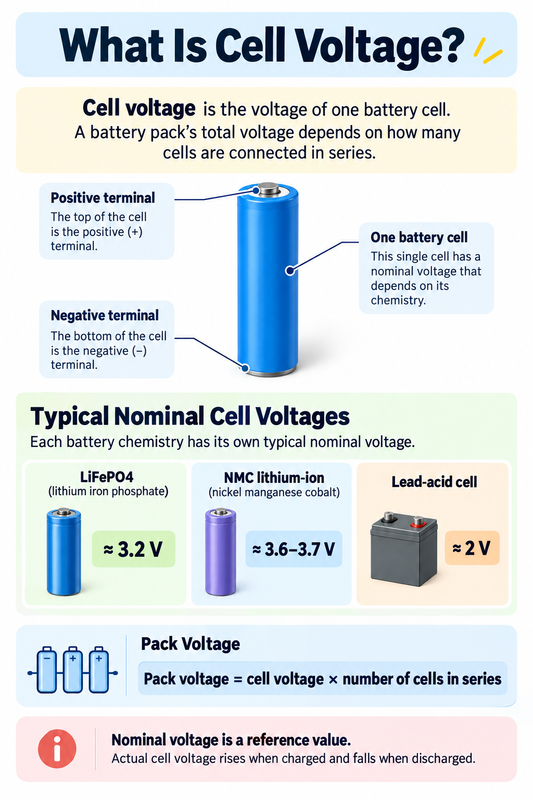
A battery cell is the basic electrochemical unit inside a battery.
Every cell chemistry operates within a characteristic voltage range. The exact voltage changes as the cell charges and discharges, so manufacturers usually provide a nominal voltage as a convenient reference point.
Typical examples include:
LiFePO4 cell: around 3.2 V nominal
NMC lithium-ion cell: commonly around 3.6–3.7 V nominal
Lead-acid cell: around 2 V nominal
These values are chemistry-specific approximations rather than universal voltages for every individual cell.
For a broader explanation of what battery voltage represents:
A cell's actual voltage can be higher when charged and lower when discharged.
That is why nominal voltage should not be confused with full-charge voltage.
What Is Pack Voltage?
A battery pack combines multiple cells into a larger electrical system.
When cells are connected in series, their voltages add together.
For example, imagine four LiFePO4 cells with a nominal voltage of about 3.2 V each:
3.2 V × 4 = 12.8 V nominal
The individual cells remain approximately 3.2 V nominal cells.
But together they form a pack with a nominal voltage of approximately 12.8 V.
The same principle can be extended:
4 × 3.2 V ≈ 12.8 V
8 × 3.2 V ≈ 25.6 V
16 × 3.2 V ≈ 51.2 V
These are common conceptual examples for LiFePO4 systems.
They help explain why products marketed within familiar 12 V, 24 V or 48 V system classes may have nominal pack voltages that are not exactly those round numbers.
Series Connections Build Pack Voltage
The relationship between cell and pack voltage comes primarily from the number of cells connected in series.
A configuration may be described with a number followed by S, meaning series.
For example:
4S = four cells or parallel cell groups connected in series
If each cell has a nominal voltage of 3.2 V:
4S × 3.2 V = 12.8 V nominal
If the same chemistry uses 16 cells in series:
16S × 3.2 V = 51.2 V nominal
This is the same series principle described in more detail here:
https://digitalowl.fika.bar/batteries-in-series-vs-parallel-01M3ADSFCS839DE87JYK879SPD
Series configuration changes pack voltage.
Parallel configuration serves a different purpose.
Parallel Cells Do Not Increase Pack Voltage
Suppose two identical cells are connected in parallel.
Their voltage remains approximately the same as the voltage of one cell. What increases is the available charge capacity in amp-hours.
Conceptually:
Series → voltage adds
Parallel → Ah adds
This means a battery pack can use both arrangements at the same time.
Multiple cells may first be connected in parallel to create a larger-capacity group, and several of those groups may then be connected in series to reach the required pack voltage.
A pack designation might therefore contain both an S and a P value.
The important point for voltage is that the series count determines the nominal pack voltage.
Chemistry Changes the Math
The same number of series-connected cells does not always produce the same pack voltage.
Consider a simplified comparison.
Four LiFePO4 cells at approximately 3.2 V nominal produce:
4 × 3.2 V = 12.8 V
Four NMC cells at approximately 3.6 V nominal would produce:
4 × 3.6 V = 14.4 V
The series count is identical.
The pack voltage is different because the cell chemistry has a different nominal cell voltage.
This is why a notation such as 4S does not fully describe a battery unless the chemistry or cell voltage is also known.
Nominal Pack Voltage Is Not a Fixed Voltage
A battery labelled 12.8 V does not remain at exactly 12.8 V throughout its entire discharge.
Pack voltage changes because the individual cell voltages change.
If every cell rises during charging, the total pack voltage rises.
If every cell falls during discharge, the total pack voltage falls.
The same multiplication principle still applies:
current cell voltage × series count = current pack voltage
For example, a 16S pack does not have one permanently fixed voltage. Its pack voltage follows the combined voltage of all 16 series positions.
This is also why chargers, inverters and battery-management systems work with voltage ranges, not only one nominal number.
Why “12 V Battery” Can Be Misleading
Battery products are often grouped into familiar system classes such as:
12 V
24 V
36 V
48 V
These labels are useful for identifying the general system family, but they should not always be interpreted as exact operating voltages.
A LiFePO4 product sold for a “12 V” application may have a nominal pack voltage around 12.8 V.
Another chemistry designed for a similar application may use a different cell arrangement and nominal voltage.
For accurate comparisons, check:
battery chemistry;
nominal cell voltage;
number of cells in series;
nominal pack voltage;
allowed operating-voltage range.
The round-number system label is only part of the specification.
Pack Voltage Does Not Tell You Total Energy
A higher-voltage battery pack does not automatically contain more energy.
Total stored energy still depends on both voltage and amp-hour capacity:
Wh = V × Ah
For example:
12 V × 200 Ah = 2,400 Wh
and:
24 V × 100 Ah = 2,400 Wh
The pack voltages are different, but the nominal stored energy is the same.
This is why cell configuration, pack voltage and battery capacity need to be treated as related but separate concepts.
A broader battery-capacity framework is available here:
https://medium.com/@volodymyrzh/battery-capacity-explained-mah-wh-amp-hours-decoded-1dc676be5a38
From Cell to Pack
The simplest way to think about the hierarchy is:
Cell → series group → battery pack → system voltage
The cell provides the chemistry-specific voltage.
Series connections combine those voltages.
The completed pack then presents a nominal voltage suitable for the wider battery system.
So when a specification says 48 V battery, the useful follow-up questions are:
What chemistry does it use?
What is the nominal cell voltage?
How many series positions are inside the pack?
Is 48 V a system-class label or the exact nominal pack voltage?
Once those questions are answered, battery-voltage specifications become much easier to interpret.
The key rule remains simple:
Cell voltage describes one electrochemical unit. Pack voltage is the combined voltage created by the cells connected in series.
Comments
No comments yet. Be the first to comment!