Charge Rate and Battery Lifespan
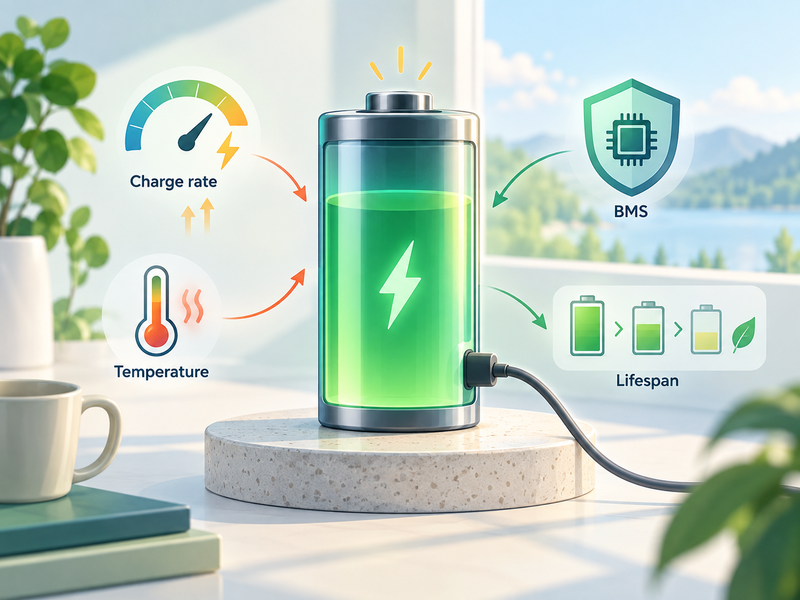
Fast charging is convenient, but does charging a battery faster also make it wear out faster?
Sometimes it can. A higher charge rate can increase heat and electrochemical stress, and under unfavourable conditions it may accelerate battery degradation.
But the relationship is not as simple as “fast charging damages batteries.”
Battery chemistry, temperature, state of charge, cell design, cooling and the battery management system all affect what happens. A charging rate that is aggressive for one battery may be completely normal for another.
For the broader foundation behind battery capacity, mAh, Ah and Wh, see:
https://medium.com/@volodymyrzh/battery-capacity-explained-mah-wh-amp-hours-decoded-1dc676be5a38
What Does Charge Rate Mean?
Charge rate describes how quickly energy is being put back into a battery.
One useful way to express it is C-rate.
A rate of approximately 1C means the charging current is numerically equal to the battery’s rated capacity in amp-hours.
For example, for a 100 Ah battery:
0.5C corresponds to about 50 A;
1C corresponds to about 100 A;
2C corresponds to about 200 A.
This is a simplified relationship, and real charging time is not simply the inverse of C-rate because charging systems usually change current as the battery approaches full charge.
For a more detailed explanation of C-rate:
https://digitalowl.fika.bar/what-is-c-rate-01M2NW656JMX8NS28G44TJW4MC
Why Higher Charge Rates Can Increase Stress
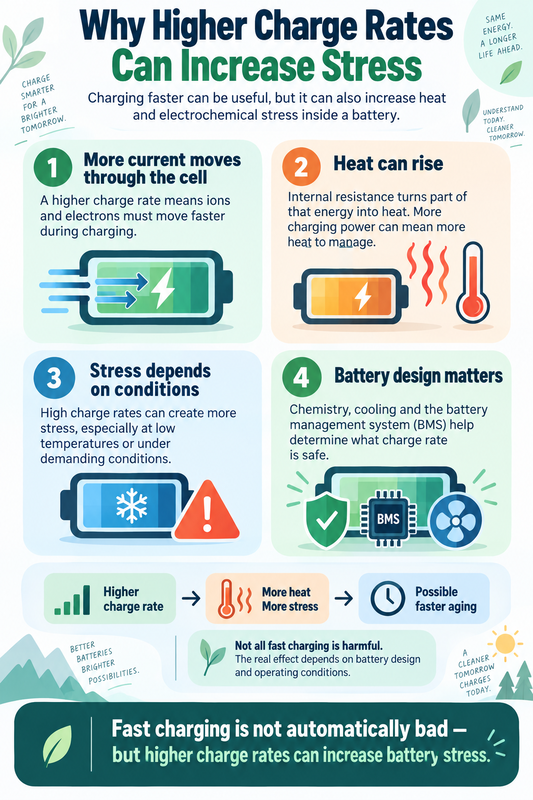
Charging a battery requires ions and electrons to move through the cell.
When charging current increases, those processes have to occur more quickly.
That can increase several forms of stress inside the battery. Internal resistance also means that some electrical energy is converted into heat.
Higher charging power can therefore increase the amount of heat that the battery and its cooling system need to manage.
The exact response depends strongly on battery design.
A cell specifically designed for high-power charging may tolerate rates that would be inappropriate for another cell with different electrodes, electrolyte or thermal characteristics.
This is why charge rate should always be interpreted relative to the battery being charged.
Heat Is Important, but It Is Not the Whole Story
Heat is one of the easiest effects of high charging power to observe.
Elevated battery temperature can accelerate many degradation reactions, especially when the battery spends substantial time under those conditions.
But temperature alone does not explain every fast-charging effect.
Inside lithium-ion cells, charging also depends on how quickly lithium ions can move through the electrolyte and enter the electrode materials.
Under certain combinations of high charging current, low temperature and cell state, the desired electrochemical reactions may not proceed quickly enough.
That can create additional degradation risks.
So “fast charging = more heat = shorter life” is useful as a rough starting point, but it is too simple to describe real batteries accurately.
Temperature Changes What Counts as a High Charge Rate
The same charging current can affect a battery differently at different temperatures.
At moderate temperatures, a battery may accept relatively high charging power without excessive stress.
At very low temperatures, the electrochemical processes inside many lithium-ion cells slow down. Charging aggressively under those conditions can be more problematic.
At very high temperatures, other degradation reactions can accelerate.
This means a charge rate cannot be evaluated in isolation.
Modern charging systems frequently monitor battery temperature and reduce charging power when conditions are outside the preferred range.
Charge Rate Often Changes During One Charging Session
When a charger is described as “fast,” it does not necessarily deliver its maximum power from empty to full.
Many lithium-ion charging systems use a charging profile in which relatively high current is possible during part of the session and then gradually reduced as the battery approaches its upper voltage limit.
This is one reason charging from, for example, a low state of charge to a moderate state of charge can be much faster than completing the final part to 100%.
The battery management system and charger are controlling the process rather than applying one constant maximum rate from beginning to end.
As a result, the headline charger power is not enough to describe the stress experienced by the battery.
The Battery Management System Matters
Modern battery packs usually contain a battery management system, or BMS.
Among other functions, the BMS can monitor voltage, current and temperature and prevent operation outside defined limits.
During charging, it may reduce power when:
cell temperature is too high or too low;
individual cell voltages approach their limits;
the battery reaches a high state of charge;
the pack cannot safely accept the requested current.
Thermal-management systems can also remove heat from the pack.
This is why using a manufacturer-supported fast charger is very different from simply forcing excessive current into an unprotected battery.
The charging system, battery and BMS are designed to operate together.
Faster Charging Does Not Have One Universal Cycle-Life Penalty
It is tempting to look for a rule such as:
“Fast charging reduces battery life by X%.”
There is no universal percentage that applies to every battery.
The result depends on factors including:
battery chemistry;
cell construction;
charge rate;
temperature;
state-of-charge range;
cooling;
charging protocol;
depth of discharge;
battery management strategy.
Even two batteries using the same broad chemistry can behave differently because their cells and charging systems were designed for different performance targets.
Cycle-life claims therefore need to be read together with their test conditions.
For more on how cycle-life ratings should be interpreted:
https://digitalowl.fika.bar/what-is-battery-cycle-life-01M2YNVWHAW1CQ4D7CFQ9DSEHH
Slow Charging Is Not Automatically the Best Choice
If lower charging rates can reduce some forms of stress, it may seem logical that the slowest possible charging rate must always be best.
In practice, battery use involves trade-offs.
A battery exists to provide useful energy. Charging speed may be important in an electric vehicle, power tool, portable power station or energy-storage system.
Modern batteries are therefore often designed around a practical operating window that balances charging time, power, temperature and longevity.
Using an appropriate manufacturer-supported charging rate can be more useful than trying to minimise charging current at all costs.
The objective is not necessarily to charge as slowly as possible.
It is to charge within the conditions the battery system was designed to handle.
Charge Rate Is One Part of Battery Lifespan
Charging speed can influence battery aging, but it is only one part of a much larger picture.
A high charge rate may increase heat and electrochemical stress. Yet chemistry, temperature, state of charge, cooling and battery-management controls determine how significant that stress becomes.
That is why two batteries exposed to the same nominal C-rate may not experience the same degradation.
Instead of asking:
“Is fast charging bad for batteries?”
a better question is:
“Is this charging rate appropriate for this battery, at this temperature and state of charge, using the charging system it was designed for?”
That question reflects how modern battery systems actually work.
Comments
No comments yet. Be the first to comment!