What Is Battery State of Health?
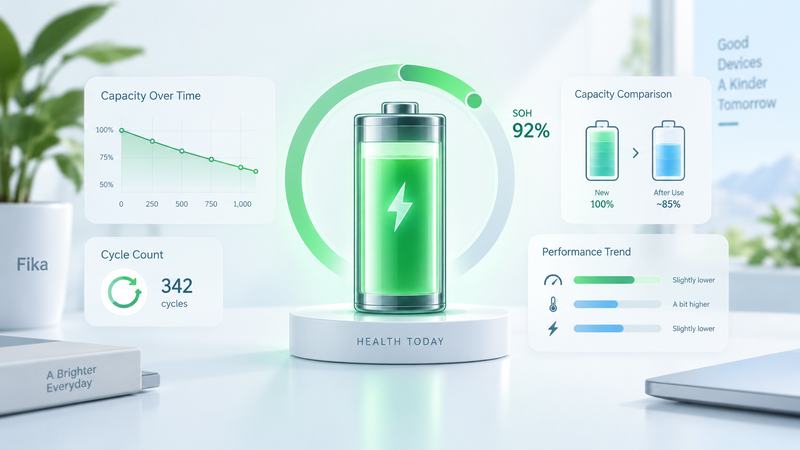
Battery State of Health, usually shortened to SoH, is an estimate of how a battery's present condition compares with its condition when it was new.
A new battery is generally treated as being close to 100% SoH. As the battery ages, repeated cycling, time, temperature and operating conditions can reduce its ability to perform as originally specified. SoH attempts to describe that change in a compact way, but it is important to understand that there is no single universal SoH measurement used by every battery system.
For the broader framework behind battery capacity and the units used to describe it, see:
https://medium.com/@volodymyrzh/battery-capacity-explained-mah-wh-amp-hours-decoded-1dc676be5a38
SoH Is a Health Estimate, Not a Charge Level
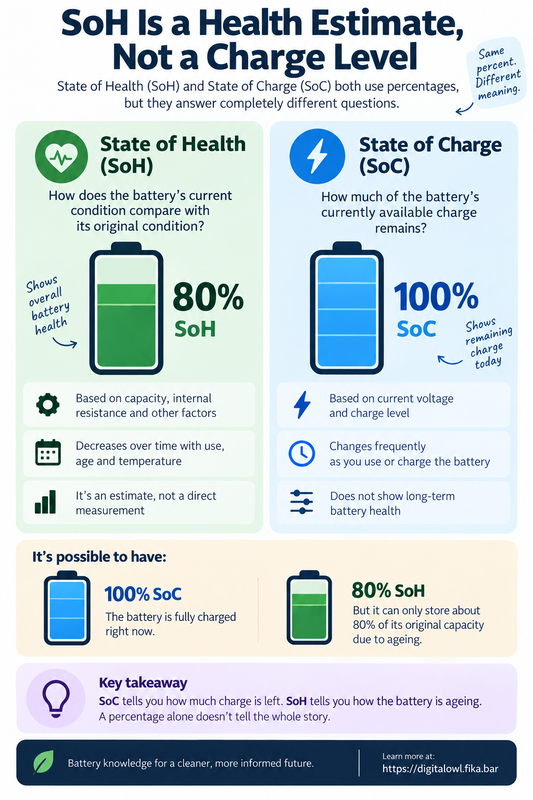
State of Health is easy to confuse with State of Charge (SoC) because both are often displayed as percentages. They answer completely different questions.
SoC asks: How much of the battery's currently available charge remains?
SoH asks: How does the battery's current condition compare with its original condition?
A battery can therefore be at 100% SoC while having only 80% SoH. It may be fully charged according to its present usable range, but that range may be smaller than it was when the battery was new.
This distinction matters whenever battery percentages are used in dashboards, apps or specification comparisons. A percentage alone does not tell you what is actually being measured.
Capacity Is One Common Way to Estimate SoH

One intuitive way to describe battery health is to compare current measurable capacity with an original reference capacity.
A simplified example is:
SoH = Current capacity ÷ Original capacity × 100%
Suppose a battery originally delivered 1,000 Wh under defined test conditions but now delivers 850 Wh under comparable conditions:
850 ÷ 1,000 × 100% = 85%
In that simplified capacity-based interpretation, its SoH would be about 85%.
However, real battery-management systems may use more complicated models. Some incorporate internal resistance, voltage behaviour, charge throughput, temperature history or other diagnostic information. This is why SoH figures produced by different devices should not automatically be treated as perfectly comparable.
SoH and Cycle Life Are Connected
Battery cycle-life ratings usually describe how many cycles a battery can complete before reaching a specified capacity-retention threshold.
For example, a manufacturer might specify a certain number of cycles until the battery retains 80% of its original capacity under stated test conditions. That does not mean the battery suddenly fails at that point. It means the battery has reached a defined degradation benchmark.
A more detailed explanation of cycle life is here:
https://digitalowl.fika.bar/what-is-battery-cycle-life-01M2YNVWHAW1CQ4D7CFQ9DSEHH
Cycle count can therefore contribute to our understanding of battery health, but it is not the same thing as SoH. Two batteries with the same number of cycles can be in different condition if they experienced different temperatures, depths of discharge, charge rates or storage conditions.
Battery Age Does Not Translate Directly Into SoH
A three-year-old battery does not automatically have a particular State of Health.
One battery might be cycled deeply every day. Another might spend most of its life lightly used. One may operate in a temperature-controlled environment while another regularly experiences high temperatures.
Battery ageing is influenced by both cycle ageing and calendar ageing, so elapsed time alone is not enough to determine remaining health.
The same principle applies to runtime. A battery with degraded capacity may run the same device for less time than it did when new, but runtime also depends on load and system losses.
For the difference between stored capacity and actual runtime, see:
Why SoH Is Usually an Estimate
Battery capacity cannot always be measured continuously during normal operation. A complete capacity test may require charging and discharging the battery under controlled conditions, which is impractical for many systems.
Instead, a BMS or other diagnostic system may estimate health from available information. Depending on the battery and system, that information can include voltage, current, temperature, charge throughput and observed capacity.
Algorithms can then compare current behaviour with a model of how the battery behaved when new.
This means a displayed SoH value may contain uncertainty. Different algorithms may also produce somewhat different results for the same physical battery.
So when interpreting SoH, it helps to ask:
What does the system define as 100%?
Is SoH based mainly on capacity or several metrics?
Was the value measured or estimated?
Under what conditions was the reference capacity established?
Has the battery recently been recalibrated or fully tested?
These questions are often more useful than treating one percentage as an absolute measurement.
SoH Data Becomes More Useful When the Method Is Visible
Battery-health metrics can also become useful research data when their definitions and methodology are documented.
A dataset containing SoH values is far more useful if it also states the battery type, measurement method, reference capacity, temperature, cycle count and verification date. Without that context, a chart comparing “92% vs 86% SoH” may look precise while comparing values calculated in completely different ways.
This is why battery-health information can work as a linkable energy-data asset when the methodology is transparent:
https://www.linkedin.com/pulse/battery-health-metrics-linkable-energy-data-volodymyr-zhyliaev-i3nif/
The principle applies far beyond SEO or publishing. Transparent methodology also makes technical comparisons more meaningful.
What Does a Lower SoH Mean in Practice?
A lower SoH usually indicates that some aspect of battery performance has declined relative to the original reference condition.
If the estimate is primarily capacity-based, lower SoH usually means the battery stores or delivers less energy than when it was new. That can translate into shorter runtime for the same load.
Other changes may also accompany ageing, including increased internal resistance or reduced ability to deliver high power, depending on chemistry and battery design.
But an SoH percentage should not be interpreted as a universal prediction such as “85% SoH means 15% of the battery's life remains.” Battery degradation does not work that way.
SoH describes present condition relative to a reference. It does not provide a simple countdown to failure.
The Main Idea
State of Health describes how a battery's current condition compares with its original condition. Capacity retention is one common component, but real SoH estimates may also use other diagnostic information.
SoH should not be confused with State of Charge. A battery can be fully charged and still have lost part of its original capacity.
Most importantly, SoH is only meaningful when you know what the percentage represents and how it was determined. Treat it as a battery-health estimate with a methodology behind it, not as a universal standalone number.
That makes SoH much more useful for understanding degradation, comparing battery condition and following how performance changes over time.
Comments
No comments yet. Be the first to comment!