What Is an NMC Battery?
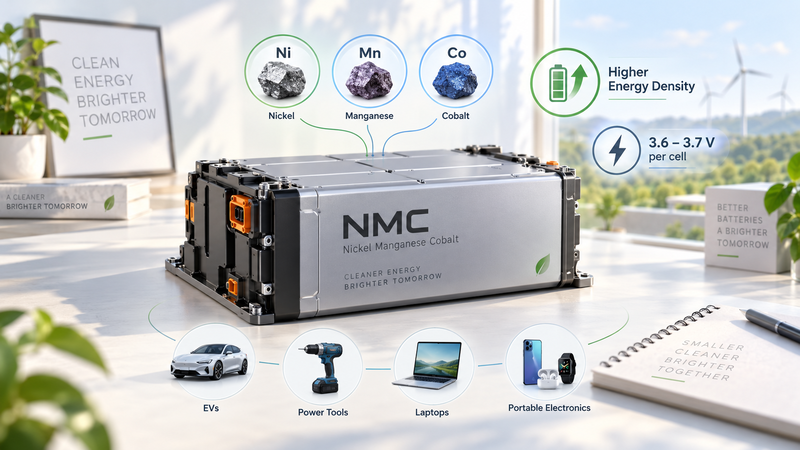
NMC is one of the most common families of lithium-ion battery chemistry. The abbreviation refers to the three main metals used in the cathode: nickel, manganese and cobalt.
NMC batteries are widely used where relatively high energy density matters, including electric vehicles, power tools and many portable electronic devices. But “NMC” does not describe one identical battery chemistry. Different NMC cells can use different proportions of nickel, manganese and cobalt and can be designed for different priorities.
That means chemistry is only the starting point. Cell design, pack construction, cooling, charging limits and battery-management controls also shape real-world performance.
For the broader foundation behind battery capacity, mAh, Ah and Wh, see: https://medium.com/@volodymyrzh/battery-capacity-explained-mah-wh-amp-hours-decoded-1dc676be5a38
What Does NMC Mean?
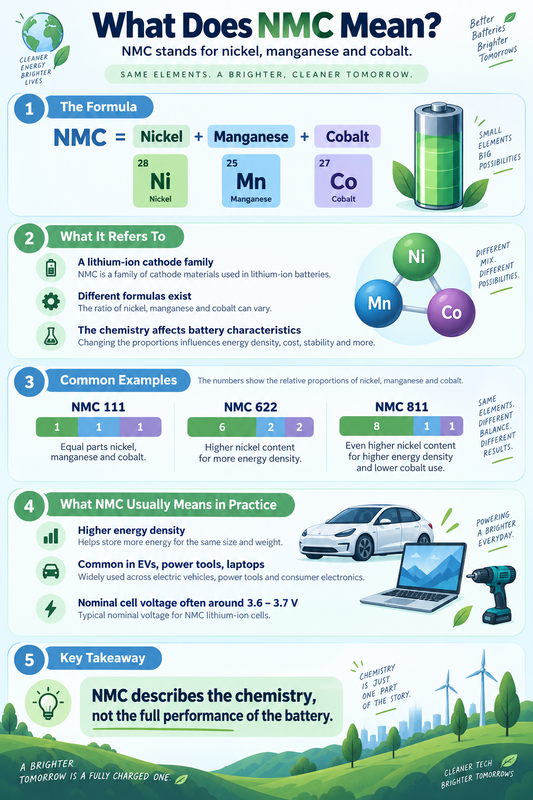
NMC stands for nickel manganese cobalt.
These materials are used in the cathode of the lithium-ion cell. During charging and discharging, lithium ions move between the cathode and anode while electrons travel through the external circuit.
The balance between nickel, manganese and cobalt can vary. You may therefore encounter names such as NMC 111, NMC 622 or NMC 811.
The numbers describe the approximate relative proportions of nickel, manganese and cobalt in the cathode formulation.
For example, NMC 811 contains a much larger proportion of nickel than older NMC formulations.
These variations matter because changing the material balance can influence energy density, stability, cost and other characteristics.
NMC Cells Usually Have a Higher Nominal Voltage Than LiFePO4
Many NMC cells have a nominal voltage around 3.6–3.7 V per cell.
For comparison, a typical LiFePO4 cell has a nominal voltage around 3.2 V.
Nominal voltage is a reference value rather than the exact voltage the cell maintains at all times. Actual voltage changes with state of charge, load, temperature and cell design.
The higher cell voltage can influence how many cells are required to build a battery pack with a particular nominal voltage.
But voltage alone does not tell you which chemistry is more suitable for an application.
Energy Density Is One of NMC's Main Advantages
One of the major reasons NMC is used so widely is energy density.
Compared with LiFePO4, NMC batteries can generally store more energy for a given mass or volume.
That matters significantly in applications where weight and space are limited.
An electric vehicle, for example, needs to carry a large amount of energy without making the battery pack excessively heavy. A smartphone manufacturer wants as much runtime as possible from a small battery. Power tools also benefit from compact packs capable of storing useful amounts of energy.
Higher energy density can therefore provide a practical advantage even when another chemistry might offer benefits in other areas.
Different NMC Formulations Have Different Priorities
It is misleading to treat every NMC battery as identical.
The relative amounts of nickel, manganese and cobalt can be adjusted to change the characteristics of the cathode.
Broadly speaking, increasing nickel content can help increase energy density, while manganese and cobalt contribute other useful material properties.
But these relationships involve trade-offs rather than simple improvements.
Battery manufacturers also modify electrode structures, electrolytes, additives and cell designs, so two cells described as NMC can still behave quite differently.
This is why the chemistry name alone should not be used to predict exact cycle life, charging speed or thermal behaviour.
Cycle Life Depends on More Than Chemistry
NMC batteries can provide substantial cycle life, but there is no single cycle-life number that represents all NMC cells.
A claim such as “2,000 cycles” needs additional information.
You should check:
depth of discharge;
charge and discharge rate;
operating temperature;
voltage limits;
capacity-retention threshold;
test methodology.
A cell repeatedly charged to aggressive voltage limits or exposed to high temperatures may age differently from the same chemistry operated under more moderate conditions.
That is why battery cycle-life specifications should always be read together with their test conditions:
https://digitalowl.fika.bar/what-is-battery-cycle-life-01M2YNVWHAW1CQ4D7CFQ9DSEHH
Thermal Management Matters
Energy density is useful, but packing more energy into a small space also makes battery-system design important.
NMC battery packs commonly rely on a battery management system and, in demanding applications, active thermal management.
The system may monitor:
cell voltage;
current;
temperature;
state of charge;
differences between cells.
In an electric vehicle, cooling systems can help keep the pack within an appropriate temperature range during driving and charging.
This does not mean NMC batteries are inherently unsafe. Nor does it mean that chemistry alone determines battery safety.
Cell quality, manufacturing, pack design, mechanical protection, charging controls, cooling and the BMS all contribute to the behaviour of the complete battery system.
NMC Batteries Still Degrade Over Time
Like other rechargeable batteries, NMC cells gradually change as they age.
Repeated cycling can contribute to cycle aging, while calendar aging continues as time passes even when the battery is not being heavily used.
Temperature, high state of charge, charging conditions and other stresses can influence the rate of degradation.
The result can include lower usable capacity and increased internal resistance.
A broader explanation of these mechanisms is available here: https://digitalowl.fika.bar/why-batteries-lose-capacity-over-time-01M2Z5S6B6REX9ZM18HDCS7SGV
This is important because the original chemistry does not guarantee that the battery will retain its original performance indefinitely.
Where Are NMC Batteries Used?
NMC is common in applications where energy density, weight and power capability are important.
Typical examples include:
electric vehicles;
e-bikes and other electric mobility systems;
power tools;
laptops;
portable electronics;
some stationary energy-storage systems.
Different applications can use different NMC formulations and pack designs.
A cell optimised for an electric vehicle may prioritise different characteristics from one designed for a small consumer device.
NMC vs LiFePO4 Is a Trade-Off, Not a Simple Ranking
NMC is often compared with LiFePO4 because both are major lithium-ion chemistries.
In general, NMC tends to offer higher energy density, which can reduce battery size and weight for a given amount of stored energy.
LiFePO4 often attracts attention for long cycle-life potential and thermal stability.
But these are broad tendencies rather than guaranteed results for every battery.
A well-designed NMC pack can outperform a poorly designed LiFePO4 pack in many practical measures, and vice versa.
The relevant question is not simply which chemistry is “better.”
It is which combination of energy density, lifespan, power, weight, size, operating conditions and cost fits the application.
NMC Is a Chemistry, Not a Complete Specification
Seeing “NMC” on a specification tells you what broad cathode family the battery uses. It does not tell you its complete performance.
You still need to examine capacity, nominal voltage, power limits, charging rate, cycle-life conditions, temperature limits and BMS behaviour.
NMC batteries are popular because they can provide a strong combination of energy density, power capability and practical packaging.
But the exact result depends on much more than the three letters on the chemistry label.
Understanding NMC therefore begins with the chemistry — and ends with the complete battery system.
Comments
No comments yet. Be the first to comment!