What Is Battery Cell Balancing?
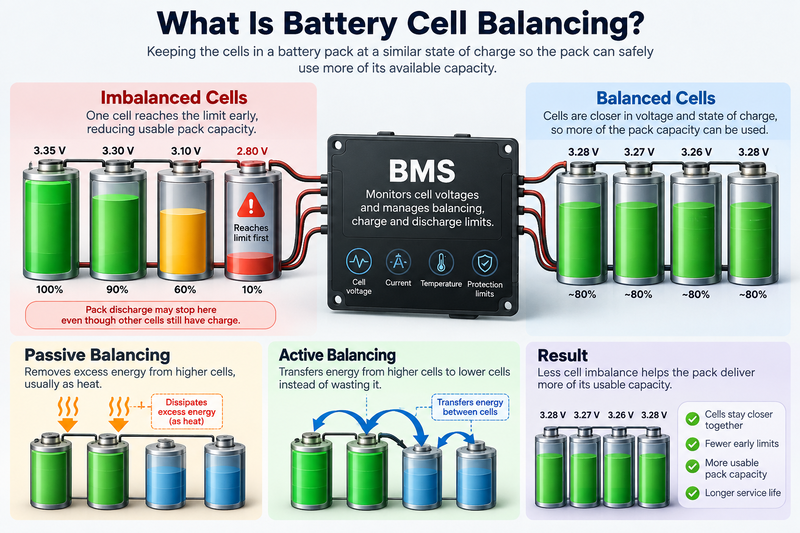
A battery pack can contain many individual cells, but those cells do not always behave identically.
Small differences in capacity, internal resistance, temperature and aging can cause some cells to reach their voltage limits before others. Over time, those differences can grow.
Battery cell balancing is the process of reducing these differences so the cells in a battery pack remain closer to the same state of charge.
Balancing matters because the performance of a series-connected battery pack can be limited by its weakest or most extreme cell.
Why Cells Become Imbalanced
Even cells manufactured to the same specification are not perfectly identical.
Small differences can appear in:
actual cell capacity;
internal resistance;
self-discharge rate;
temperature;
aging rate;
charging and discharging behaviour.
Those differences may initially be very small.
But a battery pack can complete hundreds or thousands of charge-discharge cycles. If one cell consistently charges slightly faster or discharges slightly differently from the others, its state of charge can gradually drift away from the rest of the pack.
The result is cell imbalance.
Series-Connected Cells Make Imbalance Important
Cell balancing is especially relevant in battery packs containing cells or cell groups connected in series.
In a series arrangement, cell voltages add together to create pack voltage.
For example, four cells at approximately 3.2 V nominal can create a pack around:
4 × 3.2 V = 12.8 V
The basic relationship between series and parallel battery architecture is explained here:
https://digitalowl.fika.bar/batteries-in-series-vs-parallel-01M3ADSFCS839DE87JYK879SPD
The important point is that the cells share the same series current, but their individual voltages and states of charge can still differ.
One cell may therefore reach its upper or lower voltage limit before the rest.
One Cell Can Limit the Whole Battery Pack
Imagine a simplified four-cell pack.
Three cells still have substantial charge remaining, but one cell reaches the system's lower voltage limit first.
The battery-management system may need to stop discharge to protect that cell.
The pack therefore stops supplying energy even though the other cells still contain usable charge.
From the user's perspective, the battery appears to have less usable capacity.
A similar problem can occur during charging.
If one cell reaches its upper voltage limit before the others, charging may need to stop even though the remaining cells are not yet equally full.
This is why cell imbalance can reduce the amount of the battery's nominal capacity that can be practically accessed.
Cell Balancing and the BMS
Cell balancing is commonly associated with the battery management system, or BMS.
A BMS can monitor individual cell or cell-group voltages and keep the complete pack within defined operating limits.
A broader explanation of the BMS is available here:
https://digitalowl.fika.bar/what-does-a-battery-management-system-do-01M2VNAVCRSBTWHF3T6SPZMX9P
Depending on the battery design, balancing may be one of several BMS-related functions alongside monitoring:
cell voltage;
pack voltage;
current;
temperature;
charge limits;
discharge limits.
Balancing should therefore be understood as one part of battery-pack management rather than the entire purpose of the BMS.
What Is Passive Cell Balancing?
Passive balancing reduces the charge of cells that are at a higher state of charge than the others.
Conceptually, excess energy from the higher cells is dissipated, commonly as heat, so the lower cells can catch up during the balancing process.
The basic idea is:
higher cell → remove a small amount of excess energy → bring cells closer together
Passive balancing is relatively straightforward and is widely used in battery-management designs.
Its main limitation is that the excess energy is not moved to another cell.
It is dissipated.
That means passive balancing is normally a gradual correction mechanism rather than a way to redistribute large amounts of battery energy.
What Is Active Cell Balancing?
Active balancing takes a different approach.
Instead of simply dissipating excess energy from higher cells, an active balancing system can transfer energy between cells or cell groups.
Conceptually:
higher-energy cell → energy transfer → lower-energy cell
This can reduce energy waste and may allow larger balancing currents, depending on system design.
However, active balancing generally requires more complex electronics.
So passive and active balancing represent different engineering approaches:
Passive balancing: simpler; excess energy is dissipated.
Active balancing: more complex; energy is redistributed.
Neither term by itself tells you how effective a particular battery's balancing system will be.
Balanced Does Not Mean Identical
Cell balancing does not make every cell physically identical.
An older or degraded cell may still have:
lower capacity;
higher internal resistance;
different self-discharge behaviour;
different temperature response.
Balancing can reduce differences in state of charge or cell voltage, but it cannot reverse underlying cell degradation.
This distinction matters.
If one cell has permanently lost significant capacity, repeatedly bringing its voltage into alignment with the others does not restore the missing capacity.
Balancing manages differences.
It does not recreate lost battery health.
Why Cell Balancing Can Affect Usable Capacity
Battery capacity is usually discussed in Ah or Wh, but the usable energy available from a complete pack also depends on operating limits.
A battery pack may contain substantial nominal energy while still being constrained by one cell reaching its voltage boundary early.
That creates an important sequence:
cell imbalance → one cell reaches limit early → BMS restricts charge or discharge → less pack energy becomes usable
Cell balancing attempts to reduce this problem by keeping the cells closer together.
For a broader explanation of battery capacity and how Ah, voltage and Wh relate:
https://medium.com/@volodymyrzh/battery-capacity-explained-mah-wh-amp-hours-decoded-1dc676be5a38
Balancing Becomes More Important as Packs Become More Complex
A single cell has no other cell inside the same pack to balance against.
Once cells are combined into larger series-connected packs, cell-to-cell differences become more important.
Larger battery packs may contain many series positions, and each position contributes to the overall pack voltage.
The basic architecture can therefore be thought of as:
individual cells → series/parallel arrangement → cell monitoring → balancing → usable pack
The more the pack depends on many individual cells operating within a narrow voltage range, the more important cell-level monitoring becomes.
Cell Balancing Is Not the Same as Charging
Balancing and charging are related but different processes.
Charging adds energy to the battery.
Balancing manages differences between cells.
A pack can therefore be charging while the battery-management system is also monitoring or balancing individual cells.
Likewise, a battery's charger and its BMS perform different roles even though they interact as part of the same system.
The Key Idea
Battery cell balancing exists because a multi-cell battery pack is only as usable as the cells operating within its allowed limits.
Small cell differences can accumulate over time.
If one cell reaches a high or low voltage limit before the rest, the BMS may restrict the whole pack even though other cells still have room to charge or energy left to deliver.
Balancing reduces those differences.
The simplest summary is:
Cell imbalance: cells drift to different states.
Passive balancing: removes excess energy from higher cells.
Active balancing: redistributes energy between cells.
BMS: monitors cells and manages pack operating limits.
Result: better cell alignment can help preserve access to the battery pack's usable capacity.
Cell balancing does not increase the battery's rated capacity.
It helps the pack make better use of the capacity its cells can actually provide.
Comments
No comments yet. Be the first to comment!