What Is a LiFePO4 Battery?
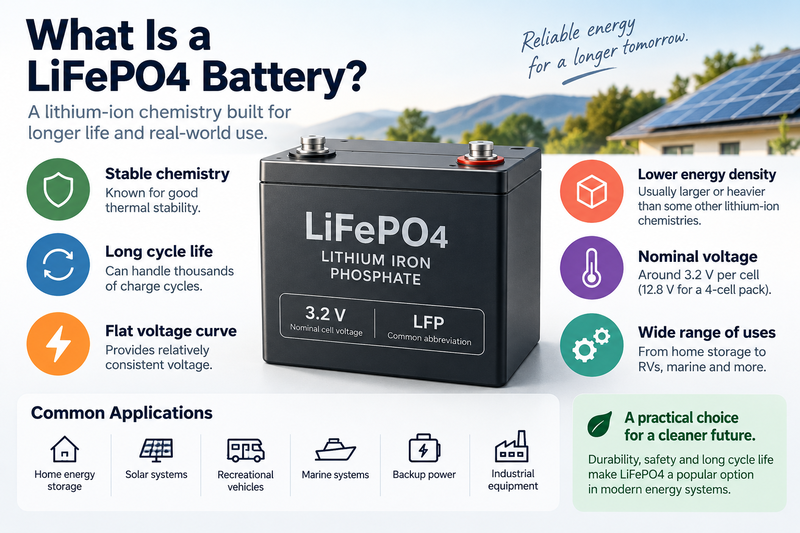
LiFePO4 is one of the most widely used lithium-ion battery chemistries for applications where long cycle life, predictable performance and durability are important. The abbreviation stands for lithium iron phosphate.
Like other lithium-ion batteries, LiFePO4 cells move lithium ions between positive and negative electrodes during charging and discharging. What makes the chemistry different is the material used in the positive electrode. That choice affects voltage, energy density, thermal behaviour, cycle life and the way a battery pack is designed.
LiFePO4 is therefore not simply another name for a lithium battery. It is a particular branch of the broader lithium-ion family.
For the wider foundation behind battery capacity, mAh, Ah and Wh, see: https://medium.com/@volodymyrzh/battery-capacity-explained-mah-wh-amp-hours-decoded-1dc676be5a38
What Does LiFePO4 Mean?
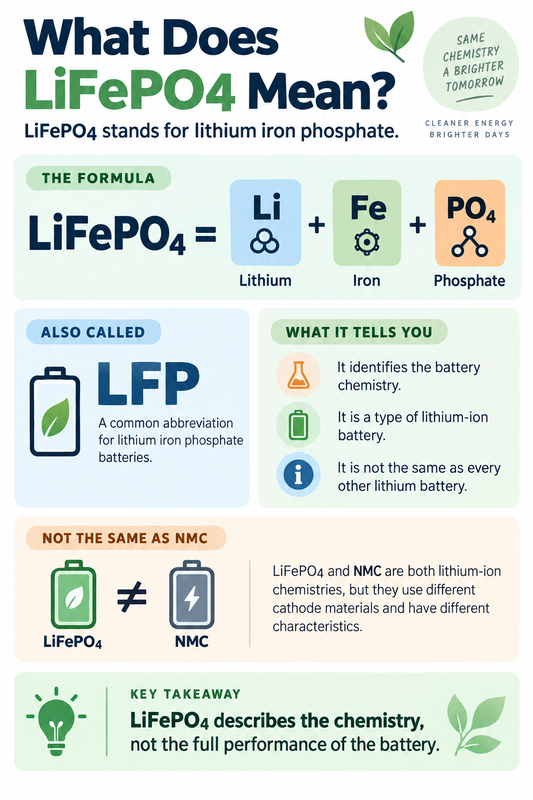
The chemical formula LiFePO4 represents lithium iron phosphate. In a LiFePO4 cell, lithium iron phosphate is used as the cathode material.
The chemistry is often abbreviated as LFP, so when a specification refers to an LFP battery, it usually means a lithium iron phosphate battery.
The chemistry should not be confused with other common lithium-ion families such as NMC, which uses nickel, manganese and cobalt in the cathode. Both are lithium-ion technologies, but their characteristics and common applications can differ substantially.
LiFePO4 Has a Lower Cell Voltage Than Some Other Lithium-Ion Chemistries
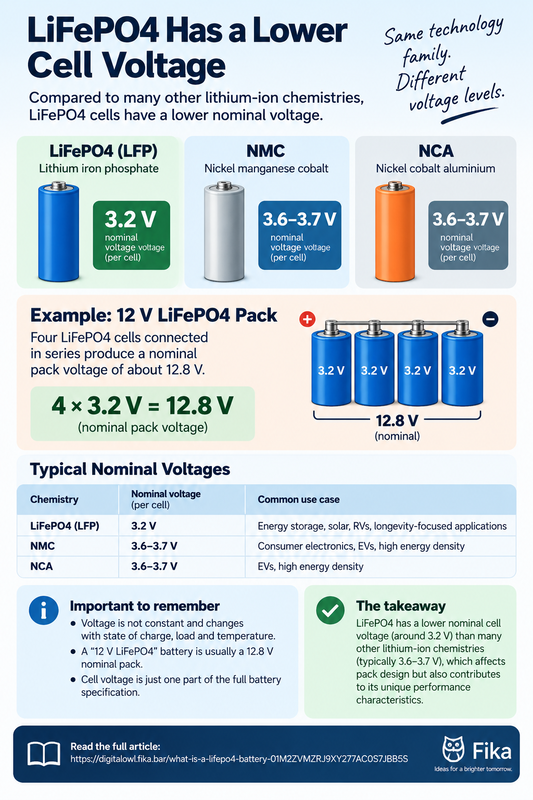
A typical LiFePO4 cell has a nominal voltage of around 3.2 V. That is lower than the nominal voltage of many NMC-type lithium-ion cells, which are commonly around 3.6–3.7 V per cell.
This matters when building a battery pack. For example, four LiFePO4 cells connected in series produce a nominal pack voltage of roughly:
4 × 3.2 V = 12.8 V
That is why many batteries marketed as “12 V LiFePO4” are actually 12.8 V nominal packs.
The voltage is not constant throughout discharge, however. As with other batteries, actual cell voltage changes with state of charge, load, temperature and operating conditions.
The Voltage Curve Is Relatively Flat
One characteristic of LiFePO4 is its relatively flat discharge-voltage profile through much of its usable capacity. The voltage can remain fairly stable while the battery moves through a large portion of its state-of-charge range.
That can be useful for equipment that benefits from relatively consistent voltage, but it also creates a measurement challenge. Because voltage changes relatively little through the middle of the discharge curve, estimating state of charge from voltage alone can be less straightforward than people expect.
A battery management system may therefore use current tracking, voltage measurements and other information to estimate remaining charge.
LiFePO4 Is Known for Long Cycle Life
Cycle life is one of the main reasons LiFePO4 is widely used in energy-storage applications. Under appropriate operating conditions, LiFePO4 batteries can often complete a large number of charge-discharge cycles before their usable capacity falls to a specified threshold.
But a statement such as “This battery lasts 6,000 cycles” still needs context. Cycle-life results depend on test conditions, including depth of discharge, temperature, charge rate, discharge rate, voltage limits and capacity-retention threshold.
That is why two LiFePO4 batteries advertised with different cycle counts cannot be compared fairly without checking how those figures were measured.
A detailed explanation of cycle-life ratings is available here: https://digitalowl.fika.bar/what-is-battery-cycle-life-01M2YNVWHAW1CQ4D7CFQ9DSEHH
Depth of Discharge Still Matters
LiFePO4 is often associated with deep cycling, but that does not mean depth of discharge has no effect on degradation. Repeatedly using a larger share of the battery’s available capacity generally creates a different aging profile from repeatedly using a smaller share.
A battery might therefore achieve a larger number of cycles under shallower cycling than under repeated very deep cycling. The important point is not that one specific DoD is universally correct. The relationship depends on the cell, battery design and test conditions.
This is why cycle-life claims should always be read together with the depth of discharge used during testing: https://digitalowl.fika.bar/depth-of-discharge-and-cycle-life-01M2ZF6QA0YD5DF1YD0H73DEQ0
Thermal Stability Is an Important Characteristic
LiFePO4 is generally valued for its comparatively stable cathode chemistry. This is one reason it is frequently selected for stationary storage, portable power stations, recreational vehicles and other applications where durability and thermal behaviour matter.
However, this should not be simplified into the statement that LiFePO4 batteries are “completely safe.” Any battery can become hazardous if it is damaged, manufactured poorly, charged outside its limits, short-circuited or used without appropriate protection.
Pack design, cell quality, the battery management system, mechanical protection, wiring, chargers and thermal conditions all matter. Chemistry can influence risk, but the safety of a complete battery system depends on much more than chemistry alone.
The Trade-Off Is Energy Density
LiFePO4 also has trade-offs. One of the most important is energy density.
Compared with some other lithium-ion chemistries, particularly NMC, LiFePO4 generally stores less energy for the same cell mass or volume. That means a LiFePO4 battery may need to be larger or heavier to store the same amount of energy.
Whether that matters depends on the application. For a smartphone or other device where every gram and cubic centimetre matter, higher energy density can be extremely valuable. For stationary solar storage or a portable power system, longer cycle life and durability may be more important than minimising size.
There is no universally superior chemistry. The better choice depends on what the battery is expected to do.
Where LiFePO4 Batteries Are Commonly Used
LiFePO4 appears in many applications where repeated cycling or long service life is important, including:
home energy storage;
solar battery systems;
portable power stations;
recreational vehicles;
marine electrical systems;
backup power;
industrial equipment;
some electric vehicles.
The same chemistry can still behave differently across these applications because cell design, pack architecture and battery-management systems vary. A large stationary battery and a compact high-power battery can both use LiFePO4 cells while being optimised for very different operating conditions.
LiFePO4 Is a Chemistry, Not a Complete Performance Specification
Seeing “LiFePO4” on a battery tells you something important about its chemistry. It does not tell you everything about the battery.
You still need to check:
Capacity — how much charge or energy can it store?
Voltage — what is the nominal pack voltage?
Continuous power — how much load can it support?
Charge rate — how quickly can it safely recharge?
Cycle-life conditions — at what DoD and capacity-retention threshold was the rating measured?
Temperature limits — under what conditions can it charge and discharge?
BMS limits — what protections and operating restrictions are built into the pack?
Two batteries using the same LiFePO4 chemistry can therefore have very different specifications and real-world performance.
The Main Idea
LiFePO4 is a lithium-ion chemistry based on lithium iron phosphate. Its most notable characteristics include a relatively low nominal cell voltage, a flat discharge profile, strong cycle-life potential and comparatively stable thermal behaviour.
Its main trade-off is that it generally provides lower energy density than some other lithium-ion chemistries. That makes LiFePO4 particularly attractive when longevity, repeated cycling and durability matter more than achieving the highest possible energy per kilogram or litre.
But chemistry is only the starting point. To understand a real battery, you still need to examine the complete pack: capacity, voltage, power limits, cycle-life conditions, temperature limits and the battery management system.
Comments
No comments yet. Be the first to comment!