Digitalowl
- Home
- Why Beginners Should Build Small Projects Before Learning Everything
- What to Power First During a 72-Hour Blackout
Recent posts
-
What Is a LiFePO4 Battery?
LiFePO4 is one of the most widely used lithium-ion battery chemistries for applications where long cycle life, predictable performance and durability are important. The abbreviation stands for lithium iron phosphate. Like other lithium-ion batteries, LiFePO4 cells move lithium ions between positive and negative electrodes during charging and discharging. What makes the chemistry different is the m…

- batteries
- electricity
- +2
-
Battery Health & Lifespan Topic Map: What to Read Next
Battery lifespan is rarely controlled by one number. Cycle count matters. Temperature matters. Depth of discharge matters. Charge rate matters. Time matters even when the battery is sitting unused. And the battery management system influences how much of that stress the cells are actually allowed to experience. That makes battery health difficult to understand through isolated specifications. This…

- batteries
- blackout
- +3
-
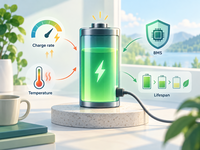
Charge Rate and Battery Lifespan
Fast charging is convenient, but does charging a battery faster also make it wear out faster? Sometimes it can. A higher charge rate can increase heat and electrochemical stress, and under unfavourable conditions it may accelerate battery degradation. But the relationship is not as simple as “fast charging damages batteries.” Battery chemistry, temperature, state of charge, cell design, cooling an…
- batteries
- electricity
- +2
-
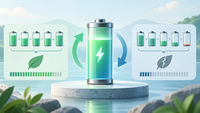
Depth of Discharge and Cycle Life
How deeply a battery is discharged can influence how quickly it ages. This relationship is often simplified into advice such as “never discharge a battery below 20%” or “use only 80% of its capacity.” Those rules can sometimes be useful as practical guidelines, but they are not universal laws. Battery chemistry, cell design, temperature, charge rate, discharge rate and the manufacturer’s operating…
- batteries
- electricity
- +4
-
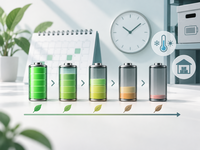
What Is Calendar Aging?
A battery can lose capacity even when it is barely being used. That may sound surprising because battery wear is often associated with charging and discharging. But cycling is only one part of battery degradation. Chemical reactions continue inside many batteries while they sit in storage, remain installed in a device or spend long periods at a particular state of charge. This time-dependent degra…
- batteries
- blackout
- +3
-
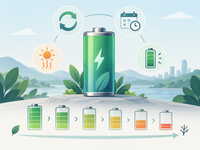
Why Batteries Lose Capacity Over Time
A battery rarely loses capacity because of one single event. In most cases, degradation is gradual: chemical and physical changes accumulate while the battery is being used, charged, stored and exposed to different temperatures. That is why an older battery may still charge to “100%” while storing less energy than it did when it was new. The state-of-charge display describes how full the battery i…
- batteries
- blackout
- +3
-
What Is Capacity Retention?
Battery capacity retention describes how much of a battery's original capacity remains after ageing, cycling or a defined period of use. If a battery originally provides 1,000 Wh and later provides 850 Wh under comparable test conditions, its capacity retention is approximately 85%. This sounds simple, but capacity-retention figures are often misunderstood. A specification such as “80% capacity af…

- batteries
- electricity
- +3
-
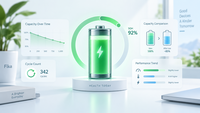
What Is Battery State of Health?
Battery State of Health, usually shortened to SoH, is an estimate of how a battery's present condition compares with its condition when it was new. A new battery is generally treated as being close to 100% SoH. As the battery ages, repeated cycling, time, temperature and operating conditions can reduce its ability to perform as originally specified. SoH attempts to describe that change in a compac…
- batteries
- electricity
- +2
-
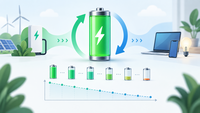
What Is Battery Cycle Life?
Battery cycle life tells you roughly how many charge-and-discharge cycles a battery can complete before its ability to store energy falls to a specified level. It is one of the most useful battery longevity specifications, but it is also easy to misunderstand. A battery rated for 2,000 cycles does not normally work perfectly for cycle 1,999 and suddenly fail at cycle 2,000. Capacity usually declin…
- batteries
- electricity
- +2
-
What Does a Battery Management System Do?
A battery management system, or BMS, is the electronic control system that monitors and helps protect a rechargeable battery pack. It does not create extra battery capacity, and it cannot make every unsafe situation harmless. Instead, a BMS watches important operating conditions and can take action when the battery approaches limits defined by the pack design. This makes it one of the key systems …

- batteries
- blackout
- +2
-
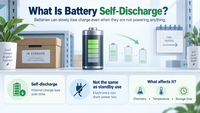
What Is Battery Self-Discharge?
A battery can lose charge even when nothing appears to be using it. Leave a charged battery unused for weeks or months, then check it again, and its state of charge may be lower. Part of that loss can come from electronics connected to the battery, but another part can occur inside the cells themselves. That internal loss is called self-discharge. Self-discharge is the gradual loss of stored charg…
- batteries
- blackout
- +4
-
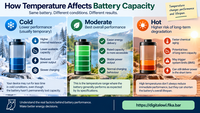
How Temperature Affects Battery Capacity
A battery can show the same capacity rating on its label and behave very differently on a cold winter morning, at normal room temperature and after spending hours in excessive heat. That does not necessarily mean its rated capacity has suddenly changed. Temperature affects how easily the battery can deliver and accept energy, how much of its stored energy is practically accessible under the curren…
- electricity
- portable-power-stations
-
Power, Runtime and Load: How Battery Capacity Meets Real Appliances
Battery capacity tells you how much energy a battery can store. It does not, by itself, tell you whether the battery can start a refrigerator, run a pump, support several devices at once or deliver the runtime you expect. Those questions sit at the intersection of energy, power and load behaviour. A battery rated at 2,000 Wh may contain plenty of energy for a particular task, but the system still …

- blackout
- electricity
- +2
-
What Is the Peukert Effect?
The Peukert effect describes how a battery can deliver less effective capacity when it is discharged at a higher rate. In simple terms, drawing energy faster can reduce how long some batteries are able to sustain the load compared with what a straightforward capacity calculation would suggest. The effect is particularly important for lead-acid batteries and should not be treated as a universal rul…

- blackout
- electricity
- +1
-
How High Loads Affect Usable Battery Capacity
A battery may have a fixed capacity rating, but that does not mean every watt-hour on the label will be equally easy to use under every load. As power demand rises, current usually rises too, increasing electrical losses inside the battery and the rest of the system. Voltage may fall more noticeably under load, heat generation can increase, and protective limits may be reached sooner. That does no…

- blackout
- electricity
- +2
-
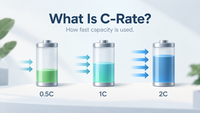
What Is C-Rate?
C-rate is a way to describe how quickly a battery is being charged or discharged relative to its rated capacity. It makes current easier to compare across batteries of different sizes because the rate is expressed as a proportion of the battery's own capacity rather than only as amps. A C-rate does not tell you how much energy a battery stores. It tells you how aggressively that stored capacity is…
- blackout
- electricity
- +2
-
Standby Power Consumption
A battery can lose useful runtime even when the device you care about appears to be doing almost nothing. Displays, control electronics, network connections, chargers and inverters may continue consuming small amounts of power in the background. This is standby power consumption: electrical power used while equipment remains ready to operate rather than performing its main task at full load. A few…

- blackout
- electricity
- +2
-
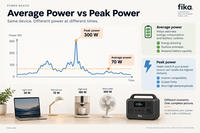
Average Power vs Peak Power
A device does not always consume the same amount of power every second it operates. Its power draw may rise, fall, cycle between different levels or briefly jump much higher than normal. That is why two different figures are useful when analysing a load: average power and peak power. Average power helps estimate how much energy a device uses over time. Peak power helps determine whether a battery …
- blackout
- electricity
- +3