Digitalowl
- Home
- Why Beginners Should Build Small Projects Before Learning Everything
- What to Power First During a 72-Hour Blackout
Recent posts
-
What Are Solar Input Limits?
Adding more solar panels seems like the obvious way to charge a battery faster. Sometimes it works. Sometimes it does almost nothing. The difference often comes down to solar input limits — the electrical boundaries that determine how much solar power a battery system, charge controller or portable power station can actually accept. These limits are usually defined by three numbers: maximum input …

- batteries
- electricity
- +3
-
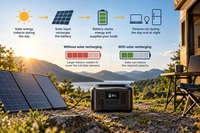
How Solar Recharging Changes Battery Capacity Needs
Battery sizing is often treated as a simple question: how much energy will your devices consume before the battery can be charged again? Solar changes that calculation. If a battery can receive meaningful energy during the same period in which loads are running, it does not necessarily need to store the entire day’s energy demand in advance. Part of that demand can be supplied by energy collected …
- batteries
- electricity
- +3
-
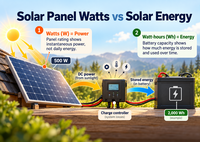
Solar Panel Watts vs Solar Energy
A solar panel rated at 400 W does not produce 400 watt-hours of energy every hour from sunrise to sunset. The number printed on the panel describes power. The energy the panel produces over time is measured in watt-hours (Wh) or kilowatt-hours (kWh). The basic distinction is: Solar panel watts = instantaneous power Solar energy = power produced over time Understanding that difference is essential …
- batteries
- electricity
- +2
-
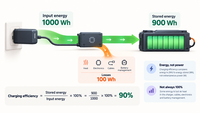
What Is Charging Efficiency?
Charging efficiency describes how much of the energy supplied to a battery system actually becomes stored battery energy. If a charger draws 1,000 Wh from a power source but the battery gains only 900 Wh, the missing energy has not disappeared. Part of it has been consumed or converted into heat by the charger, battery, cables, electronics and other components. The basic relationship is: Charging…
- batteries
- blackout
- +2
-
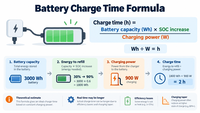
Battery Charge Time Formula
Battery charge time looks easy to calculate. If you know how much energy the battery needs and how much charging power is available, the theoretical formula is: Charging time (hours) = Energy required (Wh) ÷ Charging power (W) A 2,000 Wh battery charged at 500 W therefore appears to need: 2,000 Wh ÷ 500 W = 4 hours That is a useful starting point, but real charging usually takes longer because cha…
- batteries
- electricity
-
Charging Power vs Battery Capacity
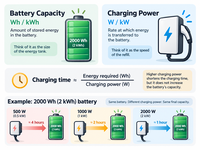
Charging power and battery capacity are often shown next to each other in specifications, but they describe completely different things. A battery might have 2,000 Wh of capacity and support 1,000 W charging. The first number tells you how much energy the battery can store. The second tells you how quickly energy can be supplied to the battery during charging. The simplest distinction is: Battery …
- batteries
- electricity
-
Battery Chemistry and Pack Architecture: How Capacity Is Built
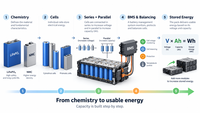
Battery capacity is often presented as a single number: 500 Wh, 2 kWh, 10 kWh. But that number is the result of several layers working together. The chemistry influences cell voltage, energy density, cycle behaviour and other characteristics. Cells are arranged into series and parallel groups. Those groups determine pack voltage and amp-hour capacity. A battery-management system monitors the cells…
- batteries
- electricity
- +1
-
What Is Expandable Battery Capacity?
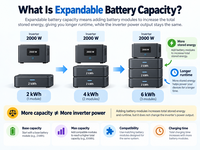
Expandable battery capacity means that an energy-storage system can increase its total stored energy by adding compatible battery modules. A system might begin with one battery and later support one or more expansion batteries. The result is usually more watt-hours or kilowatt-hours of stored energy and therefore potentially longer runtime. But there is an important limitation: Adding battery capa…
- blackout
- electricity
- +2
-
What Is Battery Cell Balancing?
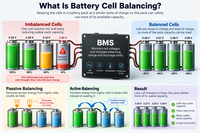
A battery pack can contain many individual cells, but those cells do not always behave identically. Small differences in capacity, internal resistance, temperature and aging can cause some cells to reach their voltage limits before others. Over time, those differences can grow. Battery cell balancing is the process of reducing these differences so the cells in a battery pack remain closer to the s…
- batteries
- electricity
- +1
-
12V vs 24V vs 48V Battery Banks
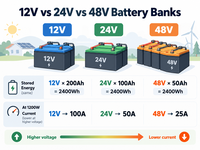
Battery banks are commonly described as 12V, 24V or 48V systems, but a higher voltage does not automatically mean a battery stores more energy. Voltage is only one part of the specification. The same amount of stored energy can be arranged as a lower-voltage bank with more amp-hours or a higher-voltage bank with fewer amp-hours. The major practical difference appears when the system needs to deliv…
- batteries
- blackout
- +3
-
Batteries in Series vs Parallel
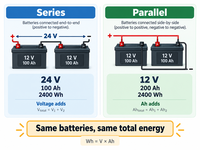
Connecting batteries in series or parallel changes how the battery bank behaves electrically. The simplest distinction is: Series increases voltage while amp-hours stay the same. Parallel increases amp-hours while voltage stays the same. But there is an important third number: watt-hours. When identical batteries are combined, both series and parallel arrangements can produce the same total sto…
- batteries
- blackout
- +3
-
Energy Density vs Battery Capacity
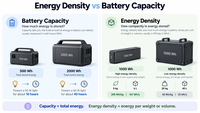
Battery capacity and energy density are closely related concepts, but they answer different questions. Battery capacity tells you how much energy a battery stores. Energy density tells you how much energy is stored relative to its weight or volume. That distinction matters when comparing batteries for portable power stations, electric vehicles, home storage, electronics and other applications wher…
- batteries
- blackout
- +3
-
Lithium-Ion vs Lead-Acid Batteries
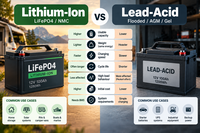
Lithium-ion and lead-acid batteries can both store electrical energy, but the same capacity label does not mean they will behave the same way in real use. The differences become especially important when comparing usable energy, weight, charging behaviour, cycle life and performance under higher loads. There is also an important terminology point: lithium-ion is not one single chemistry. LiFePO4 a…
- batteries
- blackout
- +3
-
LiFePO4 vs NMC
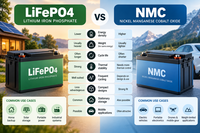
LiFePO4 and NMC are two common lithium-ion battery chemistries, but they are optimized around different priorities. One tends to emphasize long cycle life and thermal stability, while the other can offer higher energy density when size and weight matter. That does not make either chemistry universally better. The useful question is: Which trade-offs matter most for the application? Before comparin…
- batteries
- electricity
- +1
-
What Is an NMC Battery?
NMC is one of the most common families of lithium-ion battery chemistry. The abbreviation refers to the three main metals used in the cathode: nickel, manganese and cobalt. NMC batteries are widely used where relatively high energy density matters, including electric vehicles, power tools and many portable electronic devices. But “NMC” does not describe one identical battery chemistry. Different N…

- batteries
- blackout
- +2
-
What Is a LiFePO4 Battery?
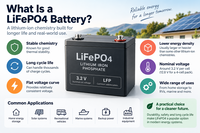
LiFePO4 is one of the most widely used lithium-ion battery chemistries for applications where long cycle life, predictable performance and durability are important. The abbreviation stands for lithium iron phosphate. Like other lithium-ion batteries, LiFePO4 cells move lithium ions between positive and negative electrodes during charging and discharging. What makes the chemistry different is the m…
- batteries
- electricity
- +2
-
Battery Health & Lifespan Topic Map: What to Read Next
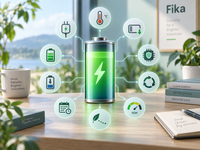
Battery lifespan is rarely controlled by one number. Cycle count matters. Temperature matters. Depth of discharge matters. Charge rate matters. Time matters even when the battery is sitting unused. And the battery management system influences how much of that stress the cells are actually allowed to experience. That makes battery health difficult to understand through isolated specifications. This…
- batteries
- blackout
- +3
-
Charge Rate and Battery Lifespan
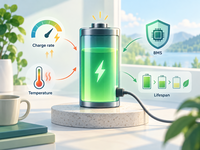
Fast charging is convenient, but does charging a battery faster also make it wear out faster? Sometimes it can. A higher charge rate can increase heat and electrochemical stress, and under unfavourable conditions it may accelerate battery degradation. But the relationship is not as simple as “fast charging damages batteries.” Battery chemistry, temperature, state of charge, cell design, cooling an…
- batteries
- electricity
- +2