Charging Power vs Battery Capacity
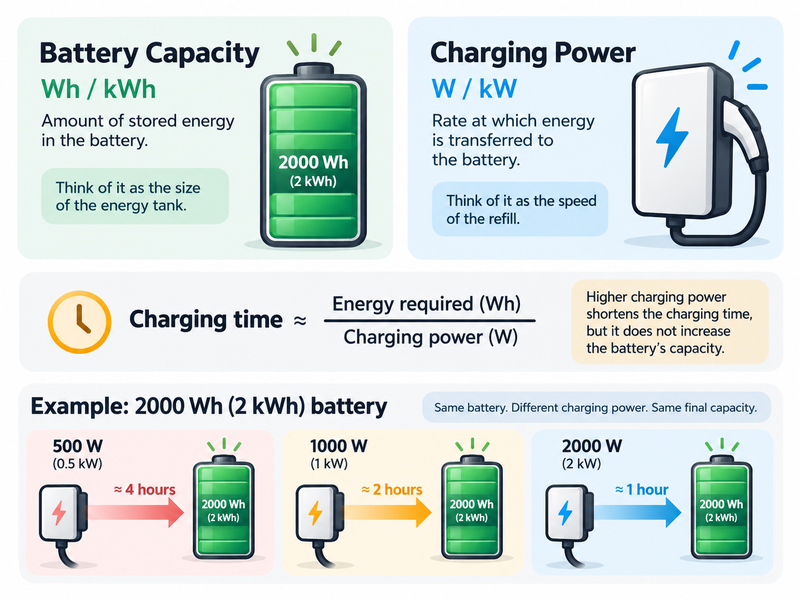
Charging power and battery capacity are often shown next to each other in specifications, but they describe completely different things.
A battery might have 2,000 Wh of capacity and support 1,000 W charging.
The first number tells you how much energy the battery can store.
The second tells you how quickly energy can be supplied to the battery during charging.
The simplest distinction is:
Battery capacity = Wh
Charging power = W
Understanding that difference makes charging-time estimates much easier.
Battery Capacity Describes Stored Energy
Battery capacity tells you how much energy the battery can hold.
For larger battery systems and portable power stations, this is commonly expressed in watt-hours (Wh) or kilowatt-hours (kWh).
For example:
500 Wh
1,000 Wh
2,000 Wh
5 kWh
A 2,000 Wh battery can theoretically store twice as much energy as a 1,000 Wh battery.
That does not tell you how quickly either battery can recharge.
For the broader relationship between Wh, Ah and battery capacity:
https://medium.com/@volodymyrzh/battery-capacity-explained-mah-wh-amp-hours-decoded-1dc676be5a38
Charging Power Describes the Rate of Energy Transfer
Charging power is measured in watts.
It describes how quickly energy is being transferred into the battery at a particular moment.
For example, a power station might accept:
200 W from a charger;
500 W from solar;
1,000 W from AC;
2,000 W from a high-power charging source.
A larger watt value generally means energy can be added more quickly.
But charging watts are not stored energy.
A charger rated at 1,000 W does not mean the battery contains 1,000 Wh.
Watts and watt-hours answer different questions:
W: How fast is energy moving?
Wh: How much energy is involved?
That distinction is explained in more detail here:
https://digitalowl.fika.bar/watts-vs-watt-hours-what-s-the-difference-01M2GNJJ68FM3605JW1JW54A99
A Simple Charging-Time Relationship
The basic theoretical relationship is:
Charging time ≈ battery energy ÷ charging power
Imagine a completely empty 2,000 Wh battery receiving a constant 500 W.
Ignoring losses and charging behaviour:
2,000 Wh ÷ 500 W = 4 hours
At 1,000 W:
2,000 Wh ÷ 1,000 W = 2 hours
At 2,000 W:
2,000 Wh ÷ 2,000 W = 1 hour
The battery capacity has not changed.
Only the rate at which energy is being supplied has changed.
Real charging time is usually longer than this simple calculation because charging is not perfectly efficient and charging power may not remain constant throughout the process.
Bigger Batteries Need More Energy to Refill
Now keep charging power constant and change battery capacity.
At a theoretical 500 W charging rate:
500 Wh ÷ 500 W = 1 hour
1,000 Wh ÷ 500 W = 2 hours
2,000 Wh ÷ 500 W = 4 hours
4,000 Wh ÷ 500 W = 8 hours
This shows why a larger battery can take longer to charge even when both products use the same charger.
The larger battery simply requires more energy to be replenished.
So when a manufacturer increases battery capacity without increasing charging power, charging time can increase substantially.
The Same Battery Can Support Different Charging Rates
A battery may support several charging sources.
For example, one system could accept:
300 W solar input;
500 W vehicle charging;
1,500 W AC charging.
The battery capacity is still the same.
What changes is the energy-transfer rate.
If the battery stores 2,000 Wh, AC charging may replenish it much faster than a smaller solar input.
This is one reason charging specifications should not be reduced to a single “charge time” number.
The result depends on the actual source and the available charging power.
Maximum Charging Power Is Not Always Actual Charging Power
A specification might say:
Maximum charging input: 1,500 W
That does not necessarily mean the battery receives exactly 1,500 W during the entire charging session.
Actual charging power may vary because of:
battery state of charge;
battery temperature;
charger limits;
available solar power;
BMS limits;
charging taper near high state of charge;
simultaneous system loads.
The maximum input figure therefore describes a capability or limit, not necessarily a constant charging rate.
This distinction will become especially important in the next article on the battery charge time formula.
Charging From 50% Is Different From Charging From 0%
The battery's total capacity is not always the amount of energy that needs to be replenished.
Consider a 2,000 Wh battery at 50% state of charge.
Very approximately, the missing nominal energy is:
2,000 Wh × 50% = 1,000 Wh
At a theoretical constant 500 W:
1,000 Wh ÷ 500 W = 2 hours
So a useful charge-time calculation needs to consider not only total battery capacity but also how much capacity actually needs to be refilled.
This is similar to runtime calculations: the battery's rated capacity provides the energy pool, but the practical result depends on how much of that pool is being used.
For more on capacity versus runtime:
More Charging Power Does Not Mean More Battery Capacity
Consider two versions of the same 2,000 Wh battery.
System A
Capacity: 2,000 Wh
Maximum charging power: 500 W
System B
Capacity: 2,000 Wh
Maximum charging power: 1,500 W
Both store the same nominal amount of energy.
System B can potentially replenish that energy much faster.
But it does not provide three times the battery capacity.
This is the same type of mistake as confusing inverter watts with battery watt-hours.
Power changes rate. Capacity changes amount.
Expandable Batteries Make the Difference Even More Important
Suppose an expandable system begins at 2 kWh and later grows to 6 kWh.
If its charging capability stays approximately the same, the larger battery bank contains three times as much energy to replenish.
That can increase charging time significantly.
This is why battery expansion should be evaluated together with charging capability.
More stored energy is useful for longer runtime, but eventually that energy must be replaced.
How to Compare Charging Specifications
When comparing battery systems, separate the specifications into different questions:
Battery capacity — Wh or kWh: How much energy can be stored?
Charging power — W or kW: How quickly can energy enter the battery?
Current state of charge: How much energy needs to be replaced?
Maximum input: What charging power can the system accept?
Actual source power: How much power is available from the charger or solar array?
Charging efficiency: How much input energy ultimately becomes stored energy?
Charging curve: Does the power remain constant or taper?
This gives a much more useful picture than simply comparing advertised recharge times.
The Key Difference
Charging power and battery capacity describe two different dimensions of the charging process.
Capacity tells you how large the energy container is.
Charging power tells you how quickly that container can be refilled.
A larger battery usually requires more energy to recharge.
A more powerful charging source can reduce the time needed to deliver that energy.
The core relationship is:
energy required ÷ charging power ≈ theoretical charging time
But the real result also depends on efficiency, charging limits, state of charge and the charging curve.
So when reading a specification such as:
2,000 Wh battery + 1,000 W charging
read it as two separate pieces of information:
2,000 Wh = how much energy the battery can store
1,000 W = how quickly energy can be supplied during charging
Keeping those numbers separate is the foundation for understanding battery charge time, charging efficiency and solar recharging.
Comments
No comments yet. Be the first to comment!