Solar Panel Watts vs Solar Energy
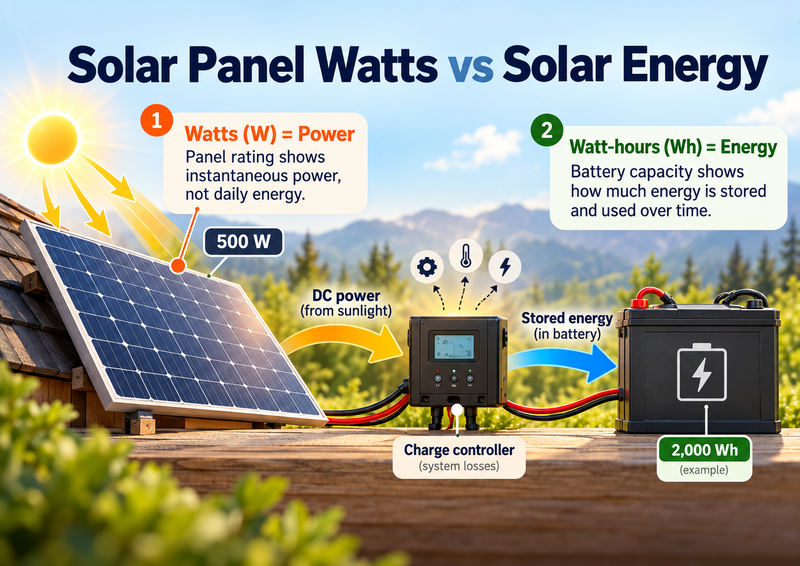
A solar panel rated at 400 W does not produce 400 watt-hours of energy every hour from sunrise to sunset.
The number printed on the panel describes power. The energy the panel produces over time is measured in watt-hours (Wh) or kilowatt-hours (kWh).
The basic distinction is:
Solar panel watts = instantaneous power
Solar energy = power produced over time
Understanding that difference is essential when estimating how much solar generation is needed to recharge a battery.
Solar Panel Watts Describe Power
A solar panel might be rated at:
100 W;
200 W;
400 W;
500 W.
That watt rating describes the panel's power capability under defined test conditions.
It does not mean the panel continuously produces its rated wattage whenever daylight exists.
A 400 W panel might produce close to its rated output under favourable conditions, substantially less under weaker sunlight, or almost nothing when heavily shaded.
The relationship between watts and watt-hours is explained here:
https://digitalowl.fika.bar/watts-vs-watt-hours-what-s-the-difference-01M2GNJJ68FM3605JW1JW54A99
Solar Energy Is Measured Over Time
Energy production depends on both power and time.
The basic relationship is:
Energy (Wh) = Power (W) × Time (h)
If a solar system actually delivered a constant 400 W for one hour:
400 W × 1 h = 400 Wh
For three hours:
400 W × 3 h = 1,200 Wh
or:
1.2 kWh
But real solar output changes continuously during the day, so actual energy production is normally the result of many different power levels accumulated over time.
For a dedicated explanation of watt-hours:
https://digitalowl.fika.bar/what-is-a-watt-hour-wh-explained-simply-01M2GM471S7BVV7BQ4R37DEEAP
A 400 W Panel Is Not a 400 Wh Panel
This is one of the easiest solar specifications to misread.
400 W tells you the panel's rated power.
It does not tell you the total energy produced during a day.
Imagine two days with the same 400 W panel.
On one day, strong sunlight allows high output for several hours.
On another, clouds and poor conditions keep output much lower.
The panel rating remains:
400 W
But the daily energy production could be very different.
So:
panel wattage stays the same → daily Wh changes
Solar Output Changes Throughout the Day
Solar panels do not normally produce one flat level of power from morning to evening.
A simplified daily curve might look like:
morning: low output → midday: higher output → evening: low output
If you measured the panel every few minutes, you might see values such as:
80 W → 180 W → 310 W → 390 W → 350 W → 220 W → 90 W
The total energy for the day comes from accumulating all of those changing power levels over time.
That is why daily solar generation is usually more useful in Wh or kWh than in watts alone.
Rated Watts and Actual Watts Are Different
A panel's watt rating is a reference specification, not a prediction of continuous real-world output.
Actual power can be influenced by:
solar irradiance;
panel orientation;
panel angle;
shading;
cloud cover;
temperature;
dirt or snow;
wiring losses;
controller limits.
This means a 400 W panel should not automatically be entered into an energy calculation as though it delivers 400 W continuously for every daylight hour.
The rating tells you the panel's scale.
Conditions determine the actual output.
Daylight Hours Are Not Full-Power Hours
Suppose a location has 10 hours between sunrise and sunset.
It would be incorrect to automatically calculate:
400 W × 10 h = 4,000 Wh
because the panel is not normally operating at rated power throughout all 10 hours.
Early morning and late afternoon sunlight is weaker than strong midday sunlight. Clouds, panel orientation and seasonal conditions also affect the output curve.
This creates an important distinction:
daylight hours ≠ hours at rated solar power
The next article in this series will explain the useful concept of peak sun hours, which converts varying sunlight over a day into an equivalent number of full-power solar hours.
Why Peak Sun Hours Are Useful
Imagine the changing sunlight during a day produces the same total solar energy that would have been generated by operating at full rated power for four hours.
That day can be described conceptually as having approximately:
4 peak sun hours
For a 400 W panel:
400 W × 4 h = 1,600 Wh
or:
1.6 kWh
This is much more useful than multiplying panel wattage by total daylight time.
Peak sun hours will be covered separately in BC056.
Solar Panel Watts vs Battery Watt-Hours
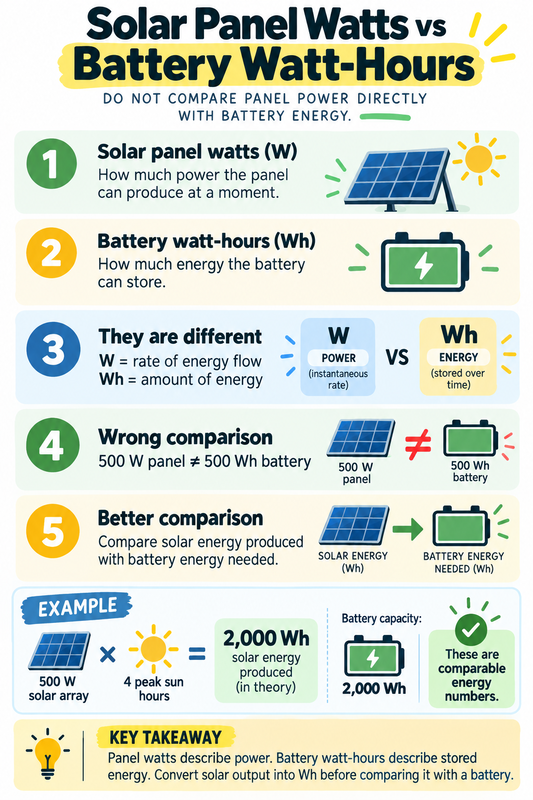
The distinction becomes especially important when charging batteries.
Suppose you have:
Battery capacity: 2,000 Wh
and:
Solar array rating: 500 W
A simple theoretical calculation might suggest:
2,000 Wh ÷ 500 W = 4 hours
But that means four hours at a continuous actual 500 W charging rate.
A 500 W solar array does not necessarily provide 500 W continuously.
Real recharge time depends on how much solar energy the array actually produces and how much of that energy reaches the battery.
Daily Solar Energy Is Often the More Useful Number
When evaluating whether solar can support a battery system, the useful question is often not:
How many watts of solar panels do I have?
It is:
How many watt-hours or kilowatt-hours can they produce during the relevant day?
For example:
500 W solar array
and:
2.0 kWh daily energy production
describe two different properties of the same system.
The 500 W value describes rated power.
The 2.0 kWh value describes energy produced over the measured or estimated period.
Battery charging depends ultimately on the second number.
Solar Array Size Adds Rated Power
Multiple panels can increase the total rated power of the array.
For example:
4 × 250 W panels = 1,000 W rated array
or:
1 kW of solar
That still does not mean the array generates 1 kWh every hour throughout the day.
If the system produced the equivalent of four full-power hours:
1,000 W × 4 h = 4,000 Wh
or:
4 kWh
Again:
kW describes power.
kWh describes energy.
System Losses Reduce Energy Reaching the Battery
Even the energy produced by the panels is not necessarily identical to the energy ultimately stored in the battery.
Losses may occur through:
wiring;
solar charge controllers;
DC conversion;
battery charging;
system electronics.
So the energy flow can be viewed as:
sunlight → panel output → controller → charging losses → stored battery energy
This connects solar production directly with charging efficiency.
The broader battery-capacity framework is available here:
https://medium.com/@volodymyrzh/battery-capacity-explained-mah-wh-amp-hours-decoded-1dc676be5a38
A Better Solar-to-Battery Calculation
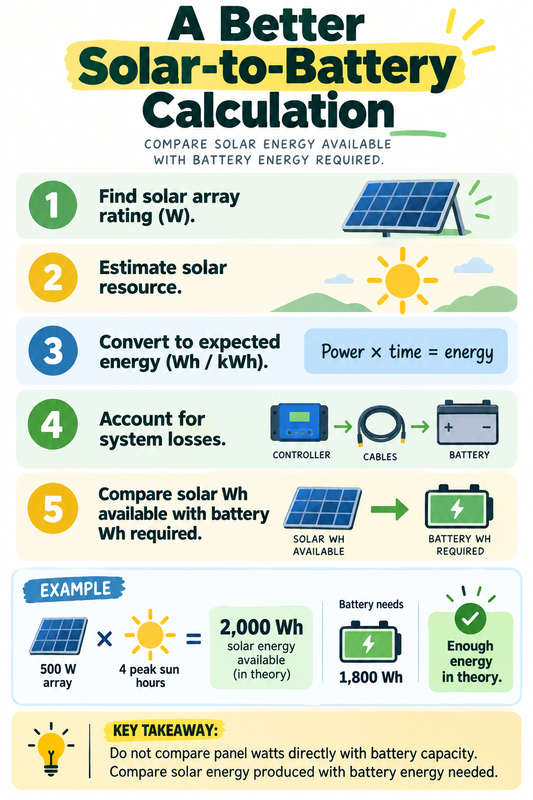
A useful estimation process is:
Find solar array rating in W.
Estimate the available solar resource.
Convert that into expected Wh or kWh production.
Account for relevant system losses.
Compare usable solar energy with the battery energy that needs to be replenished.
The important change is that both sides of the final comparison are energy values:
solar Wh available ↔ battery Wh required
That is much more meaningful than comparing panel watts directly with battery watt-hours.
The Key Difference
Solar panel watts and solar energy answer different questions.
Watts tell you how much power the panel or array can produce at a particular moment.
Watt-hours tell you how much energy was produced over time.
A useful mental model is:
Panel rating (W) × effective solar time = solar energy (Wh)
Real production then depends on sunlight, orientation, shading, temperature and system losses.
So when you see:
400 W solar panel
do not read it as:
400 Wh every hour all day.
Read it as:
a 400 W-rated energy source whose actual daily Wh depends on conditions and time.
That distinction is the foundation for understanding peak sun hours, solar charging time and solar array sizing.
Comments
No comments yet. Be the first to comment!