Battery Charge Time Formula
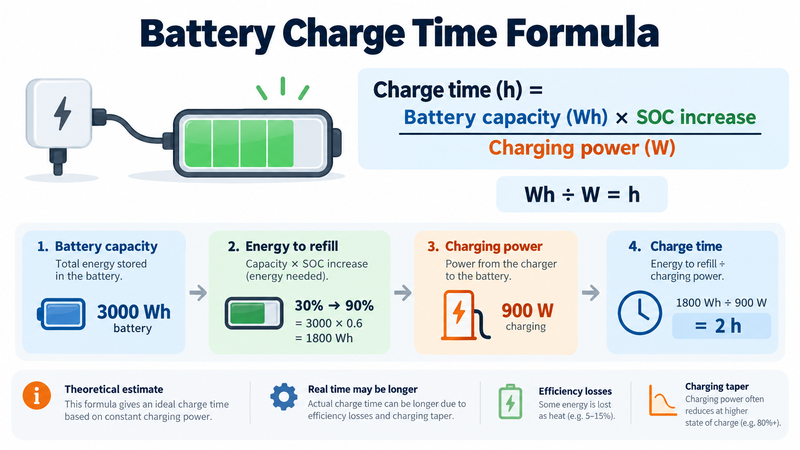
Battery charge time looks easy to calculate.
If you know how much energy the battery needs and how much charging power is available, the theoretical formula is:
Charging time (hours) = Energy required (Wh) ÷ Charging power (W)
A 2,000 Wh battery charged at 500 W therefore appears to need:
2,000 Wh ÷ 500 W = 4 hours
That is a useful starting point, but real charging usually takes longer because charging power is not always constant and not all input energy becomes stored battery energy.
Start With Watt-Hours and Watts
The formula only works when the units describe the correct quantities.
Watt-hours (Wh) describe energy.
Watts (W) describe power — the rate at which energy is transferred.
If a battery needs 1,000 Wh of energy and the charger supplies 500 W:
1,000 Wh ÷ 500 W = 2 hours
For a dedicated explanation of watt-hours:
https://digitalowl.fika.bar/what-is-a-watt-hour-wh-explained-simply-01M2GM471S7BVV7BQ4R37DEEAP
The distinction between charging power and battery capacity is explained here:
https://digitalowl.fika.bar/charging-power-vs-battery-capacity-01M3F78YY9ZSWJQV8EX0ZGEMP1
The Basic Battery Charge Time Formula
For a simplified full recharge:
Charge time = Battery capacity ÷ Charging power
For example:
500 Wh battery ÷ 250 W charger = 2 hours
1,000 Wh battery ÷ 500 W charger = 2 hours
2,000 Wh battery ÷ 500 W charger = 4 hours
2,000 Wh battery ÷ 1,000 W charger = 2 hours
These examples show the two variables clearly.
More battery energy increases the amount that needs to be replenished.
More charging power increases the rate at which that energy can be supplied.
Do Not Always Use the Full Battery Capacity
A battery does not usually start every charge at 0%.
If a 2,000 Wh battery is already at 40% state of charge, only approximately 60% of its nominal energy needs to be replenished.
The simplified calculation becomes:
Energy required = Battery capacity × Missing state of charge
For a 2,000 Wh battery charging from 40% to 100%:
2,000 Wh × 60% = 1,200 Wh
At 600 W:
1,200 Wh ÷ 600 W = 2 hours theoretical
This is more useful than dividing the full 2,000 Wh by charging power.
Charging From 20% to 80%
The same method works when the target is not 100%.
Suppose a 1,500 Wh battery charges from 20% to 80%.
The state-of-charge increase is:
80% − 20% = 60%
The nominal energy that must be added is therefore:
1,500 Wh × 0.60 = 900 Wh
At a constant 450 W:
900 Wh ÷ 450 W = 2 hours
Again, this is a theoretical result before charging losses and taper are included.
A More Useful Formula
The simplified formula can therefore be written as:
Charge time ≈ Battery capacity × SOC increase ÷ Charging power
Where SOC increase is written as a decimal.
For example:
battery capacity: 2,000 Wh;
starting SOC: 25%;
target SOC: 85%;
SOC increase: 60%;
charging power: 800 W.
Then:
2,000 Wh × 0.60 = 1,200 Wh
and:
1,200 Wh ÷ 800 W = 1.5 hours
The theoretical result is approximately 1 hour 30 minutes.
Why the Real Charge Time Is Usually Longer
The formula above assumes every watt supplied by the charger becomes stored battery energy.
Real systems have losses.
Some energy can be consumed by:
charging electronics;
voltage conversion;
battery-management systems;
cables and internal resistance;
cooling or heating;
other system components.
This means the source may need to deliver more energy than the battery ultimately stores.
A later article in this series will examine charging efficiency directly.
For charge-time estimation, the important lesson is simple:
the theoretical result is usually the minimum-style estimate, not a guaranteed real charging time.
Charging Power May Not Stay Constant
Another limitation is that a battery may not accept maximum charging power throughout the entire session.
Imagine a system advertised with a maximum input of 1,000 W.
It may reach approximately 1,000 W during part of the charge, then reduce input power as the battery approaches a higher state of charge.
This reduction is often called charging taper.
As a result:
2,000 Wh ÷ 1,000 W = 2 hours
does not automatically mean the battery will reach 100% in exactly two hours.
The 1,000 W figure may be a maximum rather than an average over the complete charge.
Maximum Charging Power vs Average Charging Power
This distinction matters when comparing products.
Consider two 2,000 Wh batteries.
Battery A advertises 1,200 W maximum input.
Battery B advertises 1,000 W maximum input.
It may appear obvious that Battery A must always charge 20% faster.
But real charge time depends on the complete charging curve.
If Battery A maintains 1,200 W only briefly while Battery B stays close to 1,000 W for longer, the difference in full charging time may be smaller than the headline numbers suggest.
Maximum power describes a limit.
Average charging power over the session is more directly connected to actual charging time.
Solar Charging Uses the Same Formula — With a Complication
The basic relationship also works for solar charging:
Energy required ÷ charging power = theoretical charging time
But solar input is rarely constant.
A “400 W solar array” does not necessarily supply 400 W continuously.
Actual output depends on factors such as:
sunlight intensity;
cloud cover;
panel angle;
temperature;
shading;
solar-controller limits;
time of day.
So:
2,000 Wh ÷ 400 W = 5 hours
means approximately five hours at a continuous 400 W input.
It does not automatically mean five ordinary clock hours outdoors.
Later nodes in this wave will separate solar panel watts, solar energy in Wh, and peak sun hours.
Expandable Capacity Changes Charge Time Too
Suppose a battery system originally stores 2 kWh and later expands to 6 kWh.
At the same 1,000 W charging power:
2,000 Wh ÷ 1,000 W = 2 hours theoretical
but:
6,000 Wh ÷ 1,000 W = 6 hours theoretical
Expansion has tripled the energy that may need to be replenished.
Unless charging capability also increases, the larger system can take substantially longer to recharge.
This is why capacity and charging power should always be evaluated together.
A Practical Charge-Time Workflow
For a useful estimate, follow this sequence:
Find battery capacity in Wh.
Find the starting SOC.
Choose the target SOC.
Calculate how many Wh need to be replaced.
Find the available charging power in W.
Divide required Wh by charging W.
Treat the result as theoretical.
Allow for charging efficiency and power taper.
This gives a much better estimate than simply trusting an advertised maximum charging wattage.
Example: 3,000 Wh Battery From 30% to 90%
Battery capacity:
3,000 Wh
SOC increase:
90% − 30% = 60%
Energy required:
3,000 Wh × 0.60 = 1,800 Wh
Charging power:
900 W
Theoretical charging time:
1,800 Wh ÷ 900 W = 2 hours
The real result may be somewhat longer depending on charging losses, temperature, BMS limits and whether the system maintains 900 W throughout the charging period.
The Key Formula
For a full theoretical recharge:
Charge time (h) = Battery capacity (Wh) ÷ Charging power (W)
For a partial recharge:
Charge time (h) = Battery capacity (Wh) × SOC increase ÷ Charging power (W)
These formulas provide the mathematical baseline.
Real battery charging then adds two major corrections:
charging efficiency + charging taper
That distinction is important because battery charge time should be estimated from energy and power — not treated as a fixed specification independent of conditions.
For the broader battery-capacity framework:
https://medium.com/@volodymyrzh/battery-capacity-explained-mah-wh-amp-hours-decoded-1dc676be5a38
Comments
No comments yet. Be the first to comment!