Digitalowl
- Home
- Why Beginners Should Build Small Projects Before Learning Everything
- What to Power First During a 72-Hour Blackout
Recent posts
-
UPS Runtime and Battery Capacity
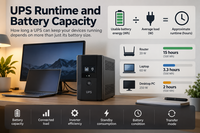
A UPS is designed to keep equipment running when grid power disappears, but its advertised battery size alone does not tell you how long connected devices will stay online. Runtime depends on battery capacity, connected load, inverter efficiency, standby consumption, battery condition and the way the UPS operates during an outage. A practical starting point is: usable battery energy ÷ average load…
- batteries
- electricity
- +2
-
Battery Capacity for Camping and RV Use
Battery sizing for camping or RV use is not really about choosing between a 1 kWh, 2 kWh or 4 kWh power station. The useful starting point is simpler: How much energy will you use during one day away from the grid? A weekend setup with LED lights, phones and a small fridge may need relatively little stored energy. Add laptops, cooking appliances, water pumps or air conditioning, and the requiremen…

- blackout
- electricity
- +4
-
How Much Battery Capacity Does a Sump Pump Need?
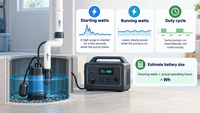
A sump pump is very different from a light, router or laptop when it comes to battery backup. It may remain idle for long periods, switch on only when water reaches a certain level, and then draw a relatively high amount of power for a short time. Its motor can also require a much larger burst of power at startup than during normal operation. That means sump-pump backup sizing depends on three sep…
- batteries
- electricity
- +2
-
How Much Battery Capacity Does a Refrigerator Need?
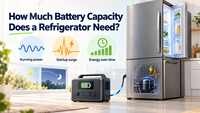
A refrigerator looks like a simple backup load. Check its wattage, multiply by the number of hours you want it to run, and choose a battery. In practice, refrigerators are more complicated because the compressor does not normally run continuously. A refrigerator may consume power for several minutes, stop after reaching the target temperature, and start again later. Each compressor start can also …
- batteries
- electricity
- +4
-
How Much Battery Capacity Do You Need for Home Backup?
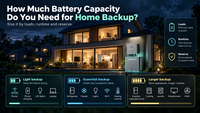
Home backup battery sizing sounds simple until you start listing everything you might want to keep running during an outage. A few lights and a router need very little energy. A refrigerator, freezer and laptop need more. Add a well pump, heating controls, medical equipment or several hours of higher-power appliances, and the required battery capacity can increase quickly. The useful question is n…
- blackout
- electricity
- +3
-
Portable Power Station Capacity Explained
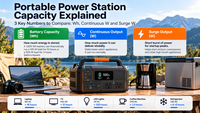
Portable power stations are often compared by one large number on the product page. Sometimes it is 500 Wh, 1,024 Wh or 2,048 Wh. That number matters, but it does not tell you everything the power station can do. To understand whether a portable power station fits a real use case, you need to separate three specifications: Battery capacity in Wh → Continuous output in W → Surge output in W Capacit…
- batteries
- electricity
- +4
-
How Solar Recharging Changes Battery Capacity Needs
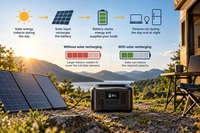
Battery sizing is often treated as a simple question: how much energy will your devices consume before the battery can be charged again? Solar changes that calculation. If a battery can receive meaningful energy during the same period in which loads are running, it does not necessarily need to store the entire day’s energy demand in advance. Part of that demand can be supplied by energy collected …
- batteries
- electricity
- +3
-
What Are Peak Sun Hours?
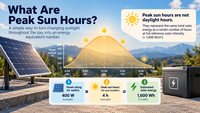
Peak sun hours are a way to convert changing sunlight throughout a day into a simple energy-equivalent number. They do not mean the number of hours between sunrise and sunset. Instead, one peak sun hour represents the same solar energy as receiving approximately full reference solar irradiance for one hour. This makes peak sun hours useful for estimating how much energy a solar panel or solar arra…
- batteries
- blackout
- +3
-
Solar Panel Watts vs Solar Energy
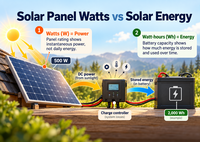
A solar panel rated at 400 W does not produce 400 watt-hours of energy every hour from sunrise to sunset. The number printed on the panel describes power. The energy the panel produces over time is measured in watt-hours (Wh) or kilowatt-hours (kWh). The basic distinction is: Solar panel watts = instantaneous power Solar energy = power produced over time Understanding that difference is essential …
- batteries
- electricity
- +2
-
What Is a LiFePO4 Battery?
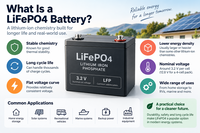
LiFePO4 is one of the most widely used lithium-ion battery chemistries for applications where long cycle life, predictable performance and durability are important. The abbreviation stands for lithium iron phosphate. Like other lithium-ion batteries, LiFePO4 cells move lithium ions between positive and negative electrodes during charging and discharging. What makes the chemistry different is the m…
- batteries
- electricity
- +2
-
Battery Health & Lifespan Topic Map: What to Read Next
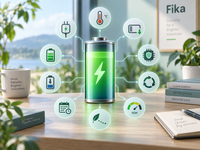
Battery lifespan is rarely controlled by one number. Cycle count matters. Temperature matters. Depth of discharge matters. Charge rate matters. Time matters even when the battery is sitting unused. And the battery management system influences how much of that stress the cells are actually allowed to experience. That makes battery health difficult to understand through isolated specifications. This…
- batteries
- blackout
- +3
-
Charge Rate and Battery Lifespan
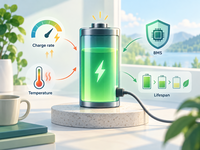
Fast charging is convenient, but does charging a battery faster also make it wear out faster? Sometimes it can. A higher charge rate can increase heat and electrochemical stress, and under unfavourable conditions it may accelerate battery degradation. But the relationship is not as simple as “fast charging damages batteries.” Battery chemistry, temperature, state of charge, cell design, cooling an…
- batteries
- electricity
- +2
-
Depth of Discharge and Cycle Life
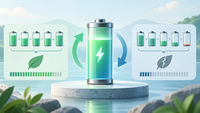
How deeply a battery is discharged can influence how quickly it ages. This relationship is often simplified into advice such as “never discharge a battery below 20%” or “use only 80% of its capacity.” Those rules can sometimes be useful as practical guidelines, but they are not universal laws. Battery chemistry, cell design, temperature, charge rate, discharge rate and the manufacturer’s operating…
- batteries
- electricity
- +4
-
What Is Capacity Retention?
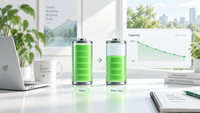
Battery capacity retention describes how much of a battery's original capacity remains after ageing, cycling or a defined period of use. If a battery originally provides 1,000 Wh and later provides 850 Wh under comparable test conditions, its capacity retention is approximately 85%. This sounds simple, but capacity-retention figures are often misunderstood. A specification such as “80% capacity af…
- batteries
- electricity
- +3
-
What Is Battery State of Health?
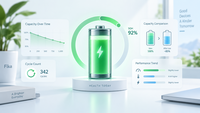
Battery State of Health, usually shortened to SoH, is an estimate of how a battery's present condition compares with its condition when it was new. A new battery is generally treated as being close to 100% SoH. As the battery ages, repeated cycling, time, temperature and operating conditions can reduce its ability to perform as originally specified. SoH attempts to describe that change in a compac…
- batteries
- electricity
- +2
-
What Is Battery Cycle Life?
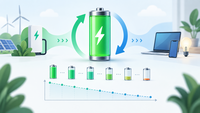
Battery cycle life tells you roughly how many charge-and-discharge cycles a battery can complete before its ability to store energy falls to a specified level. It is one of the most useful battery longevity specifications, but it is also easy to misunderstand. A battery rated for 2,000 cycles does not normally work perfectly for cycle 1,999 and suddenly fail at cycle 2,000. Capacity usually declin…
- batteries
- electricity
- +2
-
What Is Battery Self-Discharge?
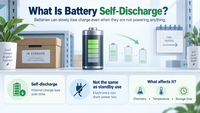
A battery can lose charge even when nothing appears to be using it. Leave a charged battery unused for weeks or months, then check it again, and its state of charge may be lower. Part of that loss can come from electronics connected to the battery, but another part can occur inside the cells themselves. That internal loss is called self-discharge. Self-discharge is the gradual loss of stored charg…
- batteries
- blackout
- +4
-
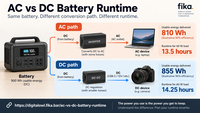
AC vs DC Battery Runtime
Two devices can require roughly the same useful power and still produce different battery runtimes depending on how that power reaches them. The difference often comes down to the power path. A battery stores energy as DC. If an appliance needs AC power, the system normally has to convert that DC energy through an inverter first. A compatible DC device may sometimes use battery energy more directl…
- electricity
- off-grid
- +1