Digitalowl
- Home
- Why Beginners Should Build Small Projects Before Learning Everything
- What to Power First During a 72-Hour Blackout
Recent posts
-
Battery Capacity for Multi-Day Outages
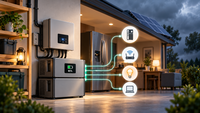
Sizing a battery for a few hours of backup is relatively simple. Multi-day outages are harder because energy use accumulates, weather can affect solar recharging, and essential loads may change from one day to the next. A useful starting point is: daily energy use × number of days = base storage requirement Then adjust for: solar or generator recharging; conversion losses; reserve capacity; exp…
- batteries
- blackout
- +3
-
Battery Capacity for Camping and RV Use
Battery sizing for camping or RV use is not really about choosing between a 1 kWh, 2 kWh or 4 kWh power station. The useful starting point is simpler: How much energy will you use during one day away from the grid? A weekend setup with LED lights, phones and a small fridge may need relatively little stored energy. Add laptops, cooking appliances, water pumps or air conditioning, and the requiremen…

- blackout
- electricity
- +4
-
How Much Battery Capacity Do You Need for Home Backup?
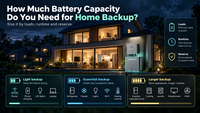
Home backup battery sizing sounds simple until you start listing everything you might want to keep running during an outage. A few lights and a router need very little energy. A refrigerator, freezer and laptop need more. Add a well pump, heating controls, medical equipment or several hours of higher-power appliances, and the required battery capacity can increase quickly. The useful question is n…
- blackout
- electricity
- +3
-
Generator and Battery Hybrid Charging
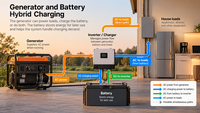
A generator does not have to power every appliance directly for the entire time it is running. In a hybrid backup system, it can instead become one part of a larger energy flow: supplying loads, charging a battery, or doing both depending on the capabilities of the system. This changes the role of the generator. Rather than acting as the only power source, it can replenish stored energy while the …
- batteries
- blackout
- +2
-
What Is Pass-Through Charging?
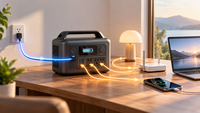
Pass-through charging is a feature that allows a battery system or portable power station to receive power while supplying power to connected devices at the same time. In simple terms, energy comes in from a charger, solar panel or another source while the system continues powering its loads. That sounds straightforward, but the actual energy flow can be more complex than simply “charging and disc…
- batteries
- blackout
- +3
-
What Are Peak Sun Hours?
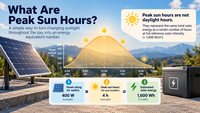
Peak sun hours are a way to convert changing sunlight throughout a day into a simple energy-equivalent number. They do not mean the number of hours between sunrise and sunset. Instead, one peak sun hour represents the same solar energy as receiving approximately full reference solar irradiance for one hour. This makes peak sun hours useful for estimating how much energy a solar panel or solar arra…
- batteries
- blackout
- +3
-
What Is Charging Efficiency?
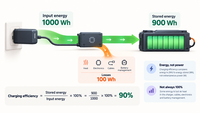
Charging efficiency describes how much of the energy supplied to a battery system actually becomes stored battery energy. If a charger draws 1,000 Wh from a power source but the battery gains only 900 Wh, the missing energy has not disappeared. Part of it has been consumed or converted into heat by the charger, battery, cables, electronics and other components. The basic relationship is: Charging…
- batteries
- blackout
- +2
-
What Is Expandable Battery Capacity?
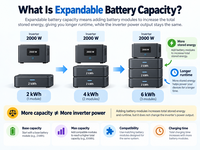
Expandable battery capacity means that an energy-storage system can increase its total stored energy by adding compatible battery modules. A system might begin with one battery and later support one or more expansion batteries. The result is usually more watt-hours or kilowatt-hours of stored energy and therefore potentially longer runtime. But there is an important limitation: Adding battery capa…
- blackout
- electricity
- +2
-
12V vs 24V vs 48V Battery Banks
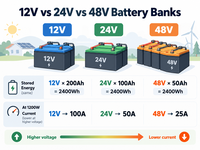
Battery banks are commonly described as 12V, 24V or 48V systems, but a higher voltage does not automatically mean a battery stores more energy. Voltage is only one part of the specification. The same amount of stored energy can be arranged as a lower-voltage bank with more amp-hours or a higher-voltage bank with fewer amp-hours. The major practical difference appears when the system needs to deliv…
- batteries
- blackout
- +3
-
Batteries in Series vs Parallel
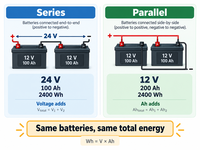
Connecting batteries in series or parallel changes how the battery bank behaves electrically. The simplest distinction is: Series increases voltage while amp-hours stay the same. Parallel increases amp-hours while voltage stays the same. But there is an important third number: watt-hours. When identical batteries are combined, both series and parallel arrangements can produce the same total sto…
- batteries
- blackout
- +3
-
Energy Density vs Battery Capacity
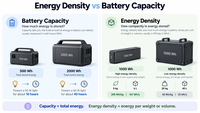
Battery capacity and energy density are closely related concepts, but they answer different questions. Battery capacity tells you how much energy a battery stores. Energy density tells you how much energy is stored relative to its weight or volume. That distinction matters when comparing batteries for portable power stations, electric vehicles, home storage, electronics and other applications wher…
- batteries
- blackout
- +3
-
Lithium-Ion vs Lead-Acid Batteries
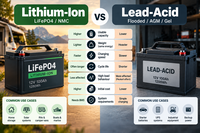
Lithium-ion and lead-acid batteries can both store electrical energy, but the same capacity label does not mean they will behave the same way in real use. The differences become especially important when comparing usable energy, weight, charging behaviour, cycle life and performance under higher loads. There is also an important terminology point: lithium-ion is not one single chemistry. LiFePO4 a…
- batteries
- blackout
- +3
-
What Is an NMC Battery?
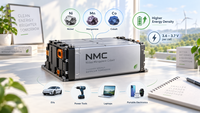
NMC is one of the most common families of lithium-ion battery chemistry. The abbreviation refers to the three main metals used in the cathode: nickel, manganese and cobalt. NMC batteries are widely used where relatively high energy density matters, including electric vehicles, power tools and many portable electronic devices. But “NMC” does not describe one identical battery chemistry. Different N…
- batteries
- blackout
- +2
-
Battery Health & Lifespan Topic Map: What to Read Next
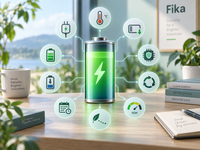
Battery lifespan is rarely controlled by one number. Cycle count matters. Temperature matters. Depth of discharge matters. Charge rate matters. Time matters even when the battery is sitting unused. And the battery management system influences how much of that stress the cells are actually allowed to experience. That makes battery health difficult to understand through isolated specifications. This…
- batteries
- blackout
- +3
-
What Is Calendar Aging?
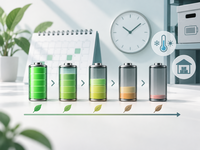
A battery can lose capacity even when it is barely being used. That may sound surprising because battery wear is often associated with charging and discharging. But cycling is only one part of battery degradation. Chemical reactions continue inside many batteries while they sit in storage, remain installed in a device or spend long periods at a particular state of charge. This time-dependent degra…
- batteries
- blackout
- +3
-
Why Batteries Lose Capacity Over Time
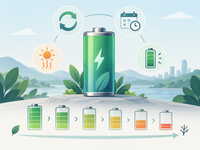
A battery rarely loses capacity because of one single event. In most cases, degradation is gradual: chemical and physical changes accumulate while the battery is being used, charged, stored and exposed to different temperatures. That is why an older battery may still charge to “100%” while storing less energy than it did when it was new. The state-of-charge display describes how full the battery i…
- batteries
- blackout
- +3
-
What Does a Battery Management System Do?
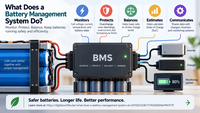
A battery management system, or BMS, is the electronic control system that monitors and helps protect a rechargeable battery pack. It does not create extra battery capacity, and it cannot make every unsafe situation harmless. Instead, a BMS watches important operating conditions and can take action when the battery approaches limits defined by the pack design. This makes it one of the key systems …
- batteries
- blackout
- +2
-
What Is Battery Self-Discharge?
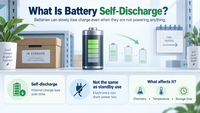
A battery can lose charge even when nothing appears to be using it. Leave a charged battery unused for weeks or months, then check it again, and its state of charge may be lower. Part of that loss can come from electronics connected to the battery, but another part can occur inside the cells themselves. That internal loss is called self-discharge. Self-discharge is the gradual loss of stored charg…
- batteries
- blackout
- +4