Digitalowl
- Home
- Why Beginners Should Build Small Projects Before Learning Everything
- What to Power First During a 72-Hour Blackout
Recent posts
-
What Is Continuous Power Output?
Continuous power output tells you how much electrical power a battery system, inverter or portable power station can supply steadily during normal operation. It is usually measured in watts (W) and answers a different question from battery capacity. A battery might store a large amount of energy but still be unable to run a high-power appliance if its inverter cannot continuously deliver enough wa…

- blackout
- electricity
- +3
-
How to Convert Wh to mAh: Formula and Examples
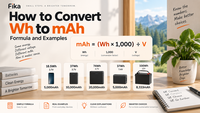
Battery capacity is sometimes listed in watt-hours (Wh) and sometimes in milliamp-hours (mAh). If you know the watt-hours and battery voltage, you can convert Wh into mAh with a simple formula. mAh = (Wh × 1,000) ÷ V The important detail is voltage. You cannot correctly convert Wh to mAh without knowing the voltage associated with the battery capacity. For a broader explanation of how Wh, mAh, Ah,…
- blackout
- electricity
- +4
-
Battery Capacity Reading Map: From mAh to Depth of Discharge
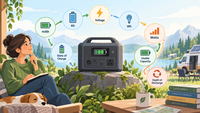
Battery specifications become much easier to understand once you stop treating every number on the label as a separate fact. mAh, Ah, voltage, Wh, watts, usable capacity, State of Charge, and Depth of Discharge all describe different parts of the same battery system. This page is a reading map rather than another complete battery-capacity guide. If you need the full explanation of how battery capa…
- electricity
- off-grid
- +2
-
What Is State of Charge? Battery SoC Explained Simply
When a phone, laptop, electric vehicle, or portable power station shows 65% battery remaining, that percentage represents its State of Charge, usually abbreviated as SoC. State of Charge is an estimate of how much usable charge or energy remains in a battery compared with its available fully charged state. In simple terms: 100% SoC = battery considered fully charged 50% SoC = roughly half of the a…

- electricity
- home
- +3
-
Rated Capacity vs Usable Capacity: What’s the Difference?
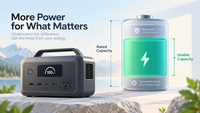
A battery may be advertised as 1,000Wh, but that does not necessarily mean a connected appliance will receive exactly 1,000Wh of usable electricity. The difference comes down to two related specifications: rated capacity and usable capacity. Rated capacity is the amount of energy used to describe the battery on its specification sheet. Usable capacity is the portion of that energy you can actually…
- electricity
- off-grid
- +2
-
Watts vs Watt-Hours: What’s the Difference?
Watts and watt-hours look similar, but they describe two different parts of an electrical system. Watts (W) measure power — how quickly energy is being used or delivered at a particular moment. Watt-hours (Wh) measure energy — how much electricity is stored or consumed over time. This distinction matters when choosing batteries and portable power stations because a system can have plenty of stored…

- blackout
- electricity
- +4
-
What Is a Watt-Hour? Wh Explained Simply
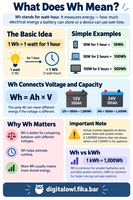
When comparing power banks, laptop batteries, portable power stations, or home-backup systems, one of the most useful specifications is Wh. Wh stands for watt-hour. It measures energy — how much electrical energy a battery can store or a device can consume over time. Unlike mAh or Ah, watt-hours take voltage into account. That makes Wh particularly useful when comparing batteries that operate at d…
- electricity
- home
- +2
-
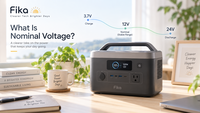
What Is Nominal Voltage? Battery Voltage Ratings Explained Simply
A battery labelled 3.7V, 12V, 24V, or 48V does not necessarily operate at exactly that voltage all the time. The number on the label is usually its nominal voltage — a standard reference value used to describe the battery system. Understanding nominal voltage is important because battery voltage changes as the battery charges, discharges, and supplies a load. It is also the voltage normally used w…
- blackout
- electricity
- +2
-
What Is Voltage? Battery Voltage Explained Simply
Voltage is one of the most important battery specifications, but it is often misunderstood. You may see batteries labelled 3.7V, 12V, 24V, or 48V, yet the number alone does not tell you how much energy the battery stores. Voltage describes electrical potential difference — essentially the electrical “push” that drives current through a circuit. For battery capacity, voltage matters because it conn…

- branding
- electricity
- +2
-
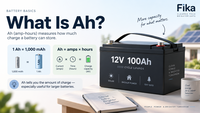
What Is Ah? Amp-Hours Explained Simply
If you compare car batteries, solar batteries, power stations, or other larger battery systems, you will often see capacity expressed in Ah. Ah stands for amp-hours. It measures electrical charge — not energy by itself. One amp-hour means a battery can theoretically deliver one amp of current for one hour. But voltage still matters, so two batteries with the same Ah rating can store very different…
- blackout
- electricity
- +3
-
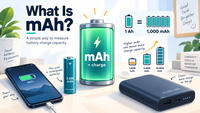
What Is mAh? Milliamp-Hours Explained Simply
If you have ever compared phones, power banks, rechargeable batteries, or portable electronics, you have probably seen a number followed by mAh. A phone might have a 5,000 mAh battery, while a power bank might advertise 10,000 or 20,000 mAh. But what does mAh actually measure? mAh stands for milliamp-hours. It is a measure of electrical charge, not a direct measure of stored energy. That distincti…
- electricity
- off-grid
-
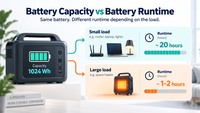
Battery Capacity vs Battery Runtime: What’s the Difference?
Battery capacity and battery runtime are closely connected, but they describe two different things. Capacity tells you how much energy a battery can store. Runtime tells you how long that stored energy can power a specific device. This distinction becomes especially important when choosing a power bank, portable power station, or home-backup battery. A larger battery usually provides longer runtim…
- blackout
- electricity
- +3
-
Why Portable Power Stations Are Becoming a Home Essential
A few years ago, portable power stations looked like a niche product for campers, van-life creators, and people who spent a lot of time outdoors. Today, they are becoming something much more ordinary: a practical backup tool for regular homes. The reason is simple. Modern life depends on electricity more than most people notice until the power goes out. A phone, laptop, Wi-Fi router, light, small …

- blackout
- off-grid
- +1
-
Why Small Structures Are Often Better for Off-Grid Living Than Big Houses
When people imagine off-grid living, they often picture a full cabin, a large rural house, or a custom-built retreat hidden somewhere in the woods. That vision can be beautiful, but it can also be expensive, slow, and difficult to manage. A big house creates big responsibilities, especially when you are trying to power, heat, repair, and maintain it without normal grid support. For many beginners,…

- blackout
- home
- +2
-
What Makes a Structure Worth Converting Into a Tiny Home?
Turning an old structure into a tiny home can feel like a shortcut. The walls are already there. The shape already exists. The place may already have character, history, and a sense of possibility. An old shed, trailer, barn, workshop, shipping container, railcar, or service vehicle can look like the beginning of a beautiful small home. But not every structure is worth converting. Some old structu…

- home
- off-grid
- +1