How to Convert Wh to mAh: Formula and Examples
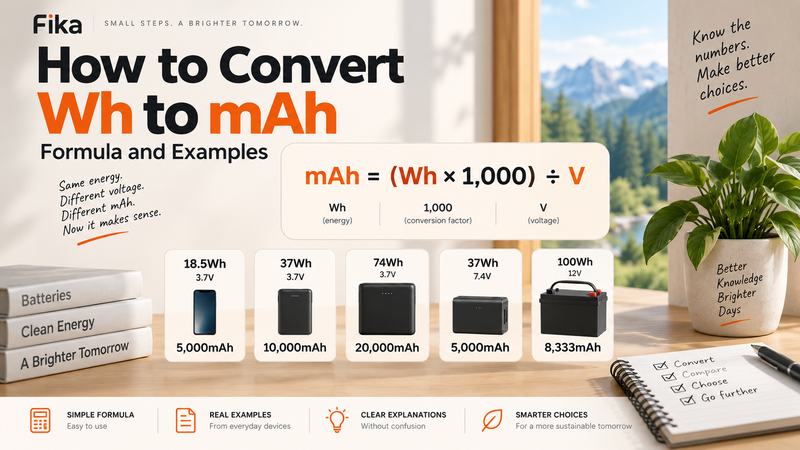
Battery capacity is sometimes listed in watt-hours (Wh) and sometimes in milliamp-hours (mAh). If you know the watt-hours and battery voltage, you can convert Wh into mAh with a simple formula.
mAh = (Wh × 1,000) ÷ V
The important detail is voltage. You cannot correctly convert Wh to mAh without knowing the voltage associated with the battery capacity.
For a broader explanation of how Wh, mAh, Ah, and voltage relate to battery capacity, see:
https://medium.com/@volodymyrzh/battery-capacity-explained-mah-wh-amp-hours-decoded-1dc676be5a38
The Wh to mAh Formula
Use this formula:
mAh = Wh × 1,000 ÷ V
where:
Wh = energy in watt-hours
V = battery voltage
mAh = capacity in milliamp-hours
The factor of 1,000 converts amp-hours into milliamp-hours because:
1 Ah = 1,000 mAh
Suppose a battery stores 37Wh of nominal energy and operates at 3.7V.
The calculation is:
37 × 1,000 ÷ 3.7 = 10,000mAh
So:
37Wh at 3.7V = 10,000mAh
Why Voltage Is Required
Wh measures energy, while mAh measures electrical charge.
Because they describe different electrical quantities, there is no universal conversion such as:
1Wh = a fixed number of mAh
The result depends on voltage.
For example, compare the same 37Wh of energy at two voltages.
At 3.7V:
37 × 1,000 ÷ 3.7 = 10,000mAh
At 7.4V:
37 × 1,000 ÷ 7.4 = 5,000mAh
Both batteries represent the same 37Wh of nominal energy, but one is rated at 10,000mAh while the other is rated at only 5,000mAh.
This is why mAh values cannot be meaningfully compared across different voltages without additional context.
For a focused explanation of what mAh represents:
https://digitalowl.fika.bar/what-is-mah-milliamp-hours-explained-simply-01M2GD3RKJD95V79BPHEW37S32
Which Voltage Should You Use?
Use the nominal voltage associated with the battery capacity rating.
Battery voltage changes during charging and discharging, so the momentary voltage measured with a meter is not normally the best value for a nominal capacity conversion.
For example, if a lithium-ion battery is specified as:
74Wh
3.7V nominal
then:
74 × 1,000 ÷ 3.7 = 20,000mAh
That means its nominal charge capacity is approximately 20,000mAh at 3.7V.
Using a different voltage changes the result.
Understanding the difference between the battery's voltage rating and its changing real-time voltage is therefore essential:
Wh to mAh Conversion Examples
Here are several common examples.
18.5Wh at 3.7V
18.5 × 1,000 ÷ 3.7 = 5,000mAh
Result: 5,000mAh
37Wh at 3.7V
37 × 1,000 ÷ 3.7 = 10,000mAh
Result: 10,000mAh
74Wh at 3.7V
74 × 1,000 ÷ 3.7 = 20,000mAh
Result: 20,000mAh
37Wh at 7.4V
37 × 1,000 ÷ 7.4 = 5,000mAh
Result: 5,000mAh
100Wh at 12V
100 × 1,000 ÷ 12 ≈ 8,333mAh
Result: approximately 8,333mAh
These examples show why a larger mAh figure does not automatically mean more stored energy. Voltage changes the relationship.
Why Wh Is Often Better for Comparing Different Batteries
If two batteries operate at different voltages, Wh provides a more direct energy comparison.
A 10,000mAh battery at 3.7V represents roughly 37Wh.
A 10,000mAh battery at 7.4V represents roughly 74Wh.
The mAh figures look identical, while the energy capacities are very different.
Wh removes much of this ambiguity because it already incorporates voltage into the energy figure.
For a deeper explanation of watt-hours:
https://digitalowl.fika.bar/what-is-a-watt-hour-wh-explained-simply-01M2GM471S7BVV7BQ4R37DEEAP
Does Converting Wh to mAh Tell You Usable Capacity?
Not necessarily.
The formula converts a stated energy capacity into an equivalent charge capacity at a specified voltage. It does not guarantee how much energy a connected device will actually receive.
Real-world usable capacity may be affected by:
battery-management reserves;
voltage conversion losses;
inverter losses;
temperature;
discharge rate;
battery age;
device cutoff limits.
So if a battery is rated at 74Wh and the calculation gives 20,000mAh at 3.7V, that does not mean every connected device can extract exactly 74Wh.
The conversion simply expresses the same nominal battery capacity in a different unit.
The Simple Rule
To convert watt-hours to milliamp-hours, use:
mAh = Wh × 1,000 ÷ V
For example:
37Wh at 3.7V = 10,000mAh
but:
37Wh at 7.4V = 5,000mAh
The amount of energy is the same. The mAh number changes because the voltage changes.
That is the key point to remember: you cannot convert Wh to mAh correctly without voltage.
Comments
No comments yet. Be the first to comment!