Battery Capacity Reading Map: From mAh to Depth of Discharge

Battery specifications become much easier to understand once you stop treating every number on the label as a separate fact. mAh, Ah, voltage, Wh, watts, usable capacity, State of Charge, and Depth of Discharge all describe different parts of the same battery system.
This page is a reading map rather than another complete battery-capacity guide. If you need the full explanation of how battery capacity works, start here:
https://medium.com/@volodymyrzh/battery-capacity-explained-mah-wh-amp-hours-decoded-1dc676be5a38
If you already know the basics and want to understand how the individual concepts fit together, follow the path below.
1. Start With Capacity vs Runtime
Before looking at units, separate two ideas that are often confused.
Battery capacity describes how much energy is available. Runtime describes how long that energy lasts under a particular load.
The same battery can run a small router for many hours but a high-power appliance for a much shorter period. This distinction becomes the foundation for nearly every battery-sizing calculation later.
Start with the relationship between stored energy, device load, and operating time:
2. Understand mAh Before Comparing Small Batteries
For phones, earbuds, cameras, and power banks, battery capacity is often shown in milliamp-hours (mAh).
mAh measures electrical charge rather than energy by itself. That means a larger mAh number is most useful when comparing batteries that operate at similar voltages.
This is also why a 20,000mAh power bank cannot automatically be compared with a completely different 20,000mAh battery system without knowing the voltage.
For the focused explanation:
https://digitalowl.fika.bar/what-is-mah-milliamp-hours-explained-simply-01M2GD3RKJD95V79BPHEW37S32
3. Move From mAh to Ah for Larger Batteries
Amp-hours (Ah) measure the same type of electrical charge as mAh, but at a more convenient scale for larger batteries.
The relationship is straightforward:
1 Ah = 1,000 mAh
That is why phones often use mAh while automotive, marine, RV, solar, and larger backup batteries commonly use Ah.
Ah is useful, but like mAh, it does not tell you stored energy unless voltage is also known.
For the full Ah explanation:
https://digitalowl.fika.bar/what-is-ah-amp-hours-explained-simply-01M2GGB34443JC68WVPZBGPX3K
4. Add Voltage to Understand Why Equal Ah Can Mean Different Energy
Voltage is the missing piece that explains why two batteries with identical Ah ratings can contain different amounts of energy.
For example, a 100Ah battery at 24V represents roughly twice the nominal energy of a 100Ah battery at 12V.
Voltage therefore helps connect charge capacity with energy capacity.
If the relationship between volts, current, and battery capacity is still unclear, read:
5. Know Why Nominal Voltage Is Used in Battery Specifications
A battery labelled 3.7V, 12V, or 48V does not necessarily remain at exactly that voltage throughout its charge cycle.
The number is usually a nominal voltage — a standardized reference used to describe the system and perform capacity calculations.
Actual voltage varies with state of charge, chemistry, temperature, and load. Understanding this prevents a common mistake: using the wrong voltage when converting Ah or mAh into Wh.
The dedicated guide is here:
6. Use Watt-Hours When You Need to Compare Stored Energy
Once charge capacity and voltage come together, the most useful cross-system energy unit is often watt-hours (Wh).
The basic relationship is:
Wh = Ah × V
Wh makes it possible to compare batteries that use different voltages on a common energy basis. It is especially useful for laptops, portable power stations, solar storage, and home-backup batteries.
For a focused explanation of what one watt-hour actually means:
https://digitalowl.fika.bar/what-is-a-watt-hour-wh-explained-simply-01M2GM471S7BVV7BQ4R37DEEAP
7. Separate Watts From Watt-Hours
The next important distinction is between power and energy.
Watts (W) describe how much power a device requires or a system can deliver at one moment.
Watt-hours (Wh) describe how much energy is stored or consumed over time.
A power station can therefore have a large Wh capacity but still be unable to run an appliance if its watt output is too low. The reverse is also possible: high output with a relatively small battery means powerful but short operation.
Read the comparison here:
https://digitalowl.fika.bar/watts-vs-watt-hours-what-s-the-difference-01M2GNJJ68FM3605JW1JW54A99
8. Do Not Assume Rated Capacity Equals Delivered Energy
A battery advertised as 1,000Wh does not necessarily deliver exactly 1,000Wh to an appliance.
Some energy can be unavailable or lost through the battery-management system, inverter, voltage conversion, standby consumption, temperature effects, and operating reserves.
This creates an important distinction between rated capacity and usable capacity.
Rated Wh remains valuable for comparison, but usable energy gives a more realistic basis for runtime planning.
The detailed explanation is here:
9. Use State of Charge to Understand What Remains
Once a battery is in use, State of Charge (SoC) describes its estimated remaining level.
A display showing 70% battery is essentially reporting an estimated 70% SoC.
But that percentage is not a direct measurement of remaining watt-hours. Battery systems estimate SoC using voltage, current flow, temperature, battery history, and other information.
That is why battery percentages can sometimes change unevenly or become less accurate as a battery ages.
For the full SoC guide:
10. Finish With Depth of Discharge
Depth of Discharge (DoD) looks at battery use from the opposite direction.
If SoC estimates how much capacity remains, DoD describes how much of the available capacity has already been used.
In simplified terms:
70% SoC ≈ 30% DoD
This relationship becomes particularly important when discussing battery cycling, operating windows, and long-term degradation.
To understand DoD without mixing it up with SoC or battery lifespan, continue here:
The Battery Capacity Learning Path
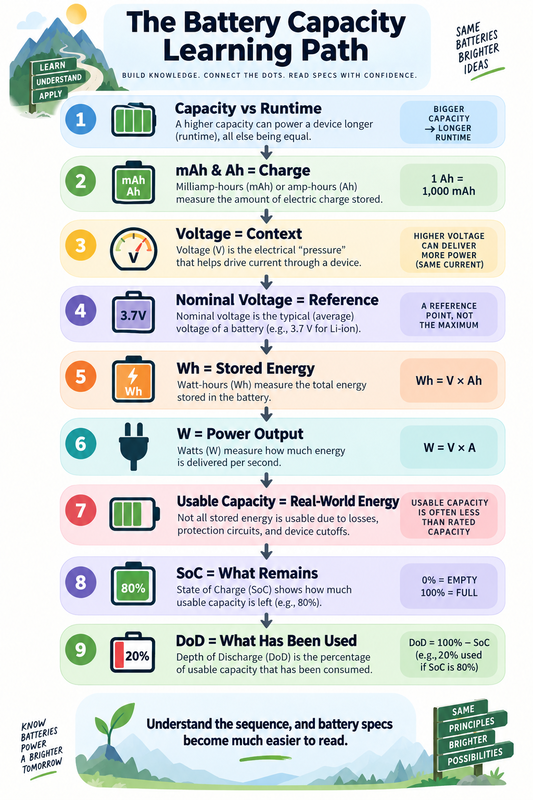
The concepts now connect in a logical sequence:
Capacity vs runtime
↓
mAh and Ah measure charge
↓
Voltage provides the electrical context
↓
Nominal voltage gives a standardized reference
↓
Wh expresses stored energy
↓
W separates power from energy
↓
Usable capacity brings the calculation closer to real-world performance
↓
SoC shows what remains
↓
DoD shows what has been used
You do not need to memorize every battery specification independently. Understanding how these concepts connect makes unfamiliar battery labels much easier to interpret — and provides the foundation for the next step: converting between mAh, Ah, Wh, and kWh and calculating how much battery capacity a device actually needs.
Comments
No comments yet. Be the first to comment!