What Is Voltage? Battery Voltage Explained Simply

Voltage is one of the most important battery specifications, but it is often misunderstood. You may see batteries labelled 3.7V, 12V, 24V, or 48V, yet the number alone does not tell you how much energy the battery stores.
Voltage describes electrical potential difference — essentially the electrical “push” that drives current through a circuit.
For battery capacity, voltage matters because it connects charge measurements such as amp-hours to actual stored energy.
For a broader explanation of battery capacity, mAh, Ah, and Wh, see:
https://medium.com/@volodymyrzh/battery-capacity-explained-mah-wh-amp-hours-decoded-1dc676be5a38
What Does Voltage Mean in a Battery?
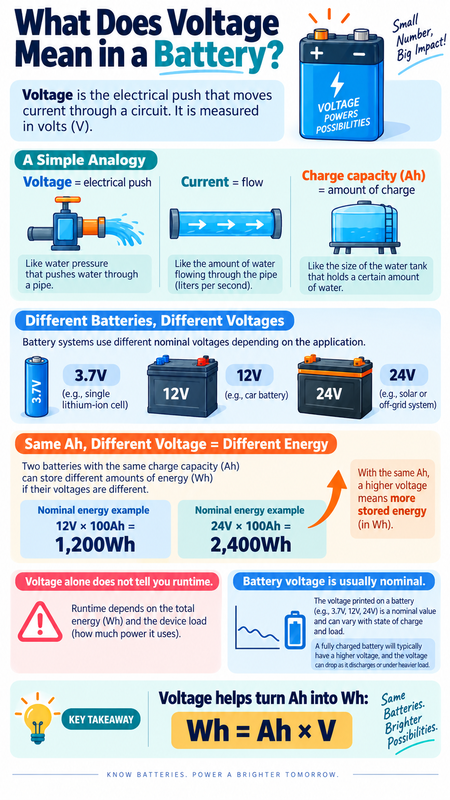
Voltage is measured in volts (V).
A simple way to think about it is as the pressure available to move electrical charge through a circuit. Higher voltage provides a greater electrical potential difference.
This analogy is not perfect, but it is useful:
Voltage is similar to pressure.
Current describes the flow of electrical charge.
Battery capacity describes how much charge or energy is available.
Voltage therefore describes something different from mAh, Ah, or Wh.
A battery labelled 12V 100Ah, for example, gives you two separate pieces of information:
12V — its nominal voltage
100Ah — its charge capacity
You need both values to estimate how much energy the battery stores.
Why Voltage Matters for Battery Capacity
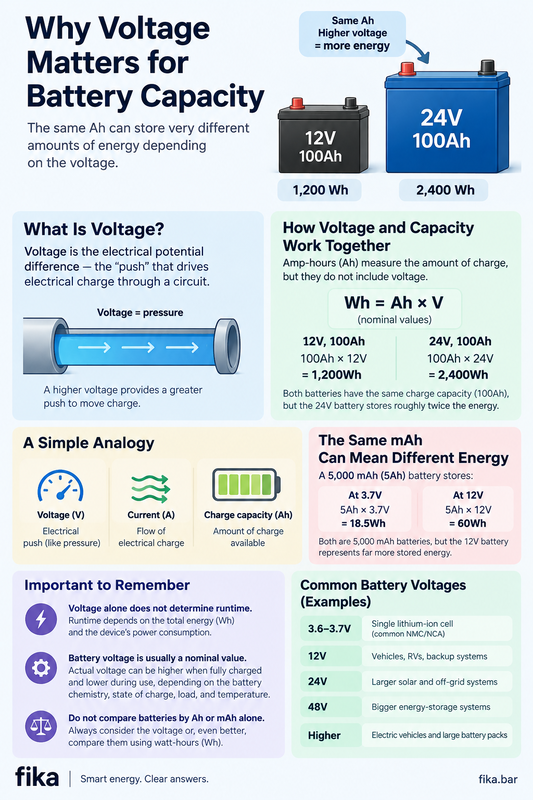
Amp-hours and milliamp-hours do not include voltage.
That is why two batteries with the same Ah rating can store very different amounts of energy.
Consider:
Battery A: 12V, 100Ah
Battery B: 24V, 100Ah
Both have the same charge capacity of 100Ah.
But their stored energy is different.
Using:
Wh = Ah × V
Battery A:
100Ah × 12V = 1,200Wh
Battery B:
100Ah × 24V = 2,400Wh
Doubling the voltage while keeping the same Ah rating roughly doubles the calculated energy capacity.
This is why comparing batteries only by Ah or mAh can be misleading.
The Same mAh Can Mean Different Energy
The same principle applies to smaller batteries.
Imagine two batteries rated at 5,000 mAh, or 5Ah.
At 3.7V:
5Ah × 3.7V = 18.5Wh
At 12V:
5Ah × 12V = 60Wh
Both are 5,000 mAh batteries, but the 12V battery represents far more stored energy.
Voltage is therefore the missing piece when converting charge capacity into watt-hours.
Voltage Does Not Tell You Runtime by Itself
A higher-voltage battery does not automatically mean longer runtime.
Runtime depends on the total energy available and how much power the connected device consumes.
For example, a battery system may operate at a higher voltage while using fewer amp-hours to provide the same amount of energy as a lower-voltage system.
That is why battery runtime is better estimated using watt-hours and device wattage, not voltage alone.
The relationship between stored capacity and operating time is explained in more detail here:
https://digitalowl.fika.bar/battery-capacity-vs-battery-runtime-what-s-the-difference-01M2GCG8KYW591PS3H17YBZZKY
Why Batteries Use Different Voltages
Different devices are designed around different electrical systems.
You commonly see:
around 3.6–3.7V nominal for individual lithium-ion cells;
12V-class systems in vehicles, RVs, and smaller backup systems;
24V or 48V systems in larger solar and energy-storage installations;
much higher voltages in electric vehicles and large battery packs.
Using higher system voltage can allow the same amount of power to be delivered with less current.
Because:
Power (W) = Voltage (V) × Current (A)
For example, supplying 1,200W theoretically requires:
100A at 12V
but only:
25A at 48V
Ignoring losses for simplicity, both provide the same power.
This is one reason larger energy-storage systems often use higher voltages.
Battery Voltage Is Not Completely Fixed
A battery described as “12V” does not necessarily measure exactly 12.0V at every moment.
Actual terminal voltage can vary with:
state of charge;
battery chemistry;
charging or discharging;
load;
temperature.
The voltage printed in a battery specification is usually a nominal value — a standardized reference used to describe the battery system.
This distinction becomes important when converting Ah or mAh to Wh. For capacity calculations, manufacturers generally base specifications on the battery’s stated nominal voltage rather than a momentary voltage reading.
Nominal voltage deserves its own explanation because it is not the same as maximum charging voltage or the voltage measured during use.
Voltage vs Capacity: Do Not Confuse Them
A battery with higher voltage is not automatically a larger battery.
For example:
12V × 100Ah = 1,200Wh
and:
24V × 50Ah = 1,200Wh
The first battery has twice the Ah capacity.
The second has twice the voltage.
Yet both represent approximately the same amount of stored energy.
That is why Wh is so useful for comparing batteries across different voltage systems.
The Simple Rule
Remember voltage this way:
Voltage tells you the electrical potential of the battery system.
It does not directly tell you how much energy is stored or how long the battery will run.
But voltage becomes essential when converting charge capacity into energy:
Wh = Ah × V
So when you see a battery advertised only in Ah or mAh, always look for its voltage before comparing it with another battery.
Voltage is the link that turns a charge-capacity number into a meaningful energy figure.
Comments
No comments yet. Be the first to comment!