Watts vs Watt-Hours: What’s the Difference?
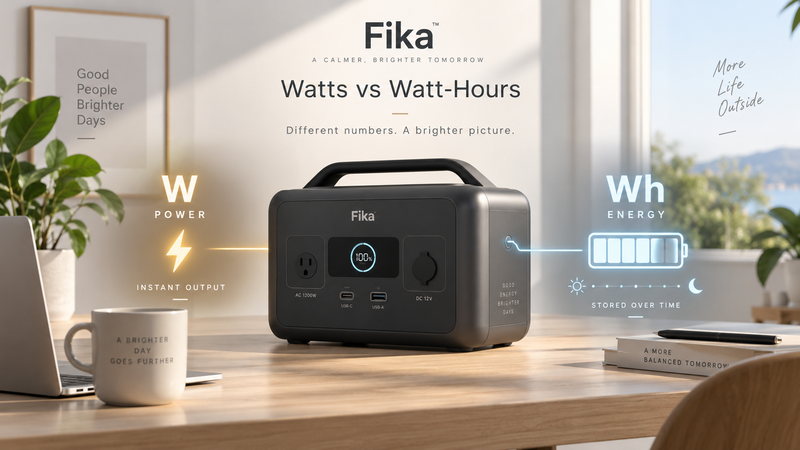
Watts and watt-hours look similar, but they describe two different parts of an electrical system.
Watts (W) measure power — how quickly energy is being used or delivered at a particular moment. Watt-hours (Wh) measure energy — how much electricity is stored or consumed over time.
This distinction matters when choosing batteries and portable power stations because a system can have plenty of stored energy but still lack enough output power to run a demanding appliance.
For the broader relationship between battery capacity, mAh, Ah, and Wh, see:
https://medium.com/@volodymyrzh/battery-capacity-explained-mah-wh-amp-hours-decoded-1dc676be5a38
What Do Watts Measure?
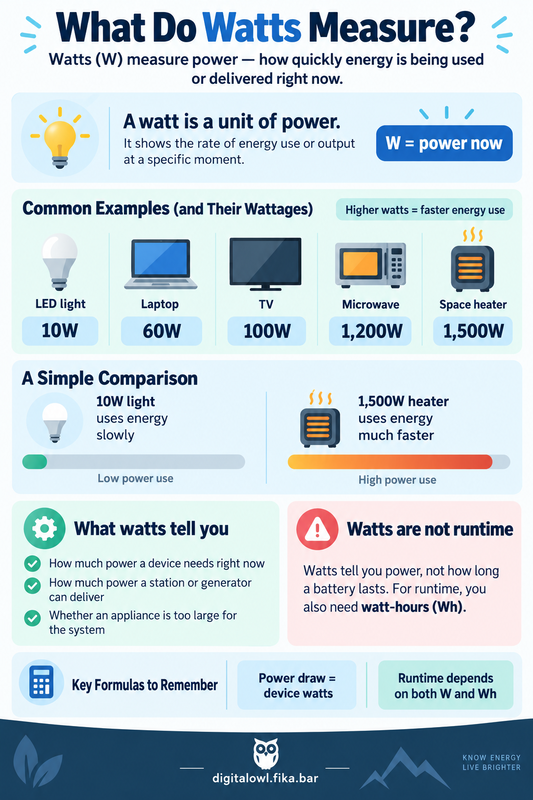
A watt measures power.
It tells you the rate at which a device consumes energy or a power source supplies it.
For example:
LED light: 10W
laptop: 60W
television: 100W
microwave: 1,200W
electric heater: 1,500W
A 1,500W heater is consuming energy much faster than a 10W light.
Watts therefore answer the question:
How much power does this device need right now?
For a portable power station, its continuous output rating in watts tells you how large a load it can support continuously.
What Do Watt-Hours Measure?
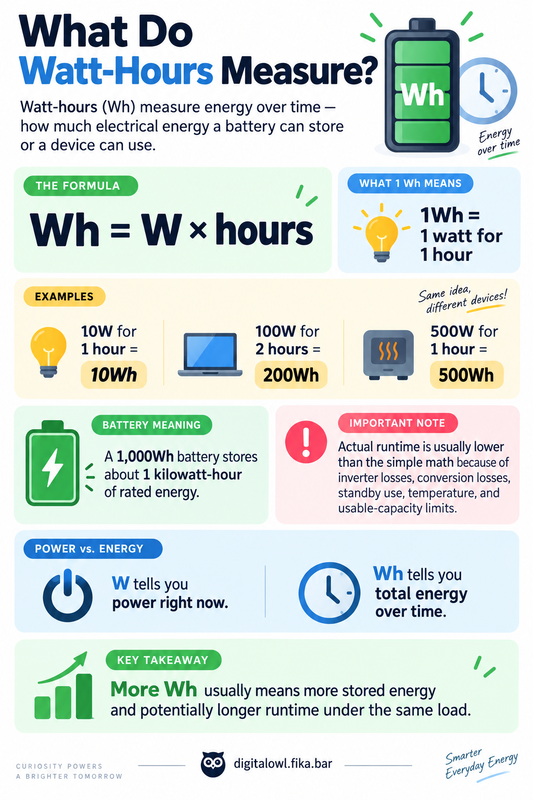
Watt-hours measure energy over time.
The basic relationship is:
Wh = W × hours
A 100W device operating for five hours consumes:
100W × 5 hours = 500Wh
A 500W device running for one hour also consumes:
500W × 1 hour = 500Wh
The power levels are very different, but the total energy consumption is the same.
If you want a deeper explanation of watt-hours as a battery-capacity unit, see:
https://digitalowl.fika.bar/what-is-a-watt-hour-wh-explained-simply-01M2GM471S7BVV7BQ4R37DEEAP
W Tells You What You Can Run
Suppose a portable power station has:
2,000Wh battery capacity
but only:
1,000W continuous output
The battery contains a substantial amount of energy, but the inverter can continuously deliver only 1,000W.
That means a 1,500W heater would exceed the system's continuous power rating, even though the battery theoretically contains enough energy to operate such a heater for more than an hour.
The problem is not battery capacity.
The problem is power output.
This is why looking only at Wh can lead to the wrong buying decision.
Wh Tells You How Long You Can Run It
Now imagine another power station with:
1,000Wh battery capacity
and:
2,000W continuous output
It may be powerful enough to operate a 1,500W appliance, but the battery will discharge quickly.
Ignoring losses for a simple example:
1,000Wh ÷ 1,500W ≈ 0.67 hours
That is only about 40 minutes of theoretical runtime.
So the system can handle the appliance's power requirement, but it cannot run it for very long.
This illustrates the core distinction:
W = whether the device can run
Wh = approximately how long it can run
A Simple Side-by-Side Example
Consider a 1,000Wh battery system.
If it powers a 50W device:
1,000Wh ÷ 50W = 20 hours
If it powers a 200W device:
1,000Wh ÷ 200W = 5 hours
If it powers a 1,000W device:
1,000Wh ÷ 1,000W = 1 hour
These are theoretical figures. Actual runtime will normally be lower because of conversion losses, system consumption, temperature, and usable-capacity limits.
But the relationship remains useful:
Higher watts consume the available watt-hours faster.
Why Battery Capacity and Output Must Be Checked Together
When evaluating a portable power station or backup battery, two questions should always be answered separately.
1. Does it have enough output?
Compare the appliance's wattage with the power station's continuous output rating.
If the appliance requires more power than the system can continuously deliver, having additional Wh will not solve the problem.
2. Does it have enough energy?
Once the system can handle the load, compare the battery's Wh capacity with the energy required for your desired runtime.
A rough starting point is:
Required Wh = Device Watts × Runtime Hours
For example, a 200W load operating for eight hours theoretically requires:
200W × 8 = 1,600Wh
You would normally want additional capacity to account for losses and reserve.
What About Starting or Surge Watts?
Some appliances briefly require more power when they start.
Refrigerators, pumps, air conditioners, and other motor-driven devices may have a startup demand significantly higher than their normal running wattage.
That introduces a third specification:
Surge watts
So for motor-driven loads, you should consider:
continuous watts — normal sustained output;
surge watts — short-term startup capability;
watt-hours — stored energy available for runtime.
A power station must satisfy all relevant limits.
The Simple Rule
The easiest way to remember the difference is:
Watts measure power.
Watt-hours measure energy.
Or, in practical battery terms:
W tells you what you can run.
Wh helps tell you how long you can run it.
A good battery system needs enough of both. High Wh with insufficient W may not start or operate your appliance, while high W with too little Wh may run it successfully but only for a short time.
That is why watts and watt-hours should always be checked together when sizing portable or backup power.
Comments
No comments yet. Be the first to comment!