Rated Capacity vs Usable Capacity: What’s the Difference?
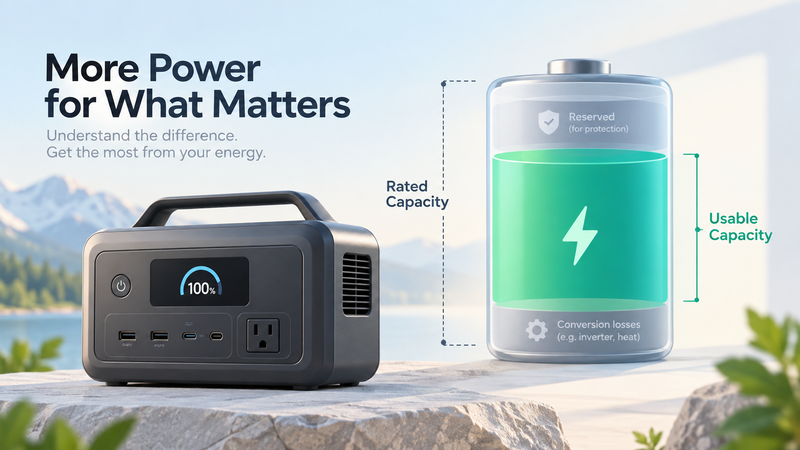
A battery may be advertised as 1,000Wh, but that does not necessarily mean a connected appliance will receive exactly 1,000Wh of usable electricity.
The difference comes down to two related specifications: rated capacity and usable capacity.
Rated capacity is the amount of energy used to describe the battery on its specification sheet. Usable capacity is the portion of that energy you can actually access under real operating conditions.
Understanding the difference makes battery runtime estimates much more realistic.
For the broader relationship between Wh, mAh, Ah, voltage, and battery capacity, see:
https://medium.com/@volodymyrzh/battery-capacity-explained-mah-wh-amp-hours-decoded-1dc676be5a38
What Is Rated Battery Capacity?
Rated capacity is the manufacturer's stated battery capacity under specified conditions.
For portable power stations, it is commonly expressed in watt-hours (Wh).
A unit advertised as:
1,000Wh
therefore has approximately 1,000 watt-hours of rated battery energy according to the manufacturer's measurement method.
Wh is particularly useful here because it represents energy rather than charge alone.
For a detailed explanation of the unit, see:
https://digitalowl.fika.bar/what-is-a-watt-hour-wh-explained-simply-01M2GM471S7BVV7BQ4R37DEEAP
The important point is that the rated number describes the battery itself. It does not guarantee that every watt-hour will appear at an AC outlet, USB port, or other output.
What Is Usable Capacity?
Usable capacity is the amount of stored energy that can actually be made available for use.
Several things can make it lower than the headline rating.
These include:
battery-management-system limits;
inverter losses;
DC-to-DC conversion losses;
standby consumption;
temperature;
discharge rate;
battery age;
system safety reserves.
The size of the difference varies by product and operating conditions.
There is no universal rule such as “every battery loses exactly 10%” or “85% is always usable.” Those numbers may be useful for rough planning in some cases, but they should not be treated as fixed characteristics of every battery system.
Why Battery Systems Keep Some Energy in Reserve
Rechargeable batteries should not always be charged or discharged to their absolute electrochemical limits.
A battery management system (BMS) helps protect the cells by controlling operating limits.
Depending on the design, the system may stop discharge before the cells reach a damaging low-voltage condition.
This can mean that some energy physically present in the battery is not exposed to the user as normal usable capacity.
That reserve is not necessarily wasted energy. It can help protect the cells and support battery longevity and safe operation.
The exact reserve depends on battery chemistry, firmware, product design, and manufacturer settings.
Conversion Losses Reduce Delivered Energy
A battery stores DC electricity, but many household appliances use AC power.
A portable power station therefore uses an inverter to convert battery DC into AC.
That process is not perfectly efficient.
Some energy becomes heat or is consumed by the power electronics themselves.
The same issue exists with other outputs. USB, 12V, and other ports may require voltage conversion, and each conversion stage can introduce some loss.
This means:
Battery energy stored → conversion → energy delivered to device
The amount available at the output can therefore be lower than the battery's rated Wh.
AC and DC Loads May Give Different Results
Because different outputs use different conversion paths, the same battery can provide different effective usable energy depending on how it is used.
For example, running an AC appliance through the inverter may involve more conversion overhead than powering an efficient DC device directly.
This does not mean DC is always dramatically more efficient. The actual difference depends on the electronics, voltage conversion required, load level, and product design.
It does mean that one fixed “usable Wh” number may not perfectly predict every possible use case.
Load Size Can Affect Usable Capacity
A battery powering a small, steady device operates under different conditions from the same battery supplying a very demanding appliance.
High discharge rates can increase internal losses and voltage drop.
As a result, a battery may deliver slightly different amounts of useful energy depending on the load.
This becomes especially relevant with:
electric heaters;
microwaves;
power tools;
pumps;
air conditioners;
other high-power appliances.
So two users with the same power station may not obtain identical runtimes even if they begin at the same state of charge.
Temperature Matters Too
Battery performance changes with temperature.
Cold conditions can temporarily reduce the amount of energy a battery can deliver effectively. High temperatures can increase degradation and affect long-term capacity.
This is another reason rated capacity should not be interpreted as a promise of identical output in every environment.
The specification provides a standardized reference.
Real-world usable energy reflects actual operating conditions.
A Simple Example
Imagine a portable power station rated at:
1,000Wh
You connect a 100W appliance.
The simple theoretical calculation is:
1,000Wh ÷ 100W = 10 hours
But the real system also consumes energy through its inverter, electronics, and other losses.
The actual runtime could therefore be shorter than 10 hours.
The correct conclusion is not to assume a specific percentage loss without product data.
Instead, treat:
10 hours as the theoretical maximum based on rated capacity
and use manufacturer testing or your own measured consumption for a better real-world estimate.
Rated Capacity vs Usable Capacity in One Sentence
The distinction is straightforward:
Rated capacity tells you how much energy the battery is specified to contain.
Usable capacity tells you how much of that energy can actually be delivered under the conditions in which you use it.
Both matter.
Rated Wh is excellent for comparing battery sizes, but realistic runtime planning should also account for conversion efficiency, protection limits, load, temperature, and operating conditions.
That is why a battery specification is the starting point for a runtime estimate — not the final answer.
Comments
No comments yet. Be the first to comment!