What Is mAh? Milliamp-Hours Explained Simply
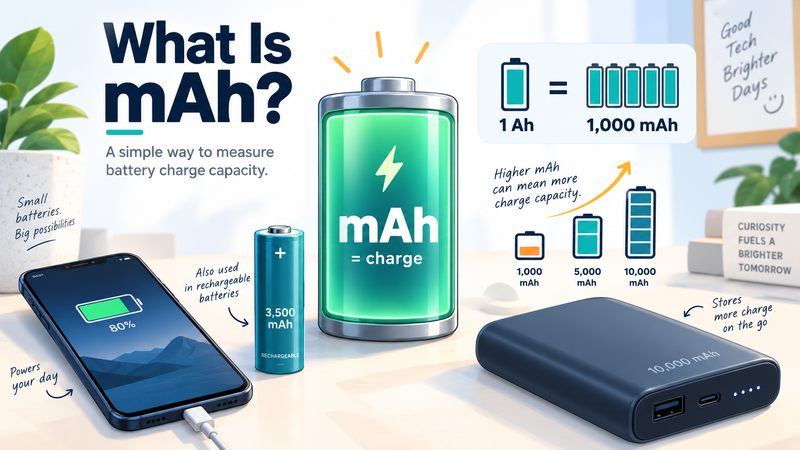
If you have ever compared phones, power banks, rechargeable batteries, or portable electronics, you have probably seen a number followed by mAh. A phone might have a 5,000 mAh battery, while a power bank might advertise 10,000 or 20,000 mAh.
But what does mAh actually measure?
mAh stands for milliamp-hours. It is a measure of electrical charge, not a direct measure of stored energy.
That distinction matters because a higher mAh number does not always mean a battery contains more energy or will run a device longer. Voltage and device power consumption also matter.
For the broader relationship between mAh, Ah, Wh, and battery energy, see:
https://medium.com/@volodymyrzh/battery-capacity-explained-mah-wh-amp-hours-decoded-1dc676be5a38
What Does mAh Mean?
The abbreviation breaks down into two parts:
mA = milliamps
h = hours
One amp equals 1,000 milliamps, so:
1 Ah = 1,000 mAh
In simplified terms, a 5,000 mAh battery represents 5 Ah of electrical charge capacity.
The unit describes how much charge a battery can deliver over time. For example, under idealized conditions, 5,000 mAh could represent:
5,000 mA for 1 hour;
1,000 mA for 5 hours;
500 mA for 10 hours.
Real batteries do not behave quite this perfectly because efficiency, temperature, discharge rate, electronics, and voltage changes affect the result. But the examples show what the unit represents.
mAh Measures Charge, Not Energy
This is the most important thing to understand about mAh.
Two batteries can have exactly the same mAh rating while storing very different amounts of energy.
Imagine two 3,000 mAh batteries:
Battery A operates at 3.7V
Battery B operates at 18V
Both contain 3 Ah of charge capacity, but their energy is different.
Battery A:
3 Ah × 3.7V = 11.1 Wh
Battery B:
3 Ah × 18V = 54 Wh
The second battery stores nearly five times as much energy despite having exactly the same mAh rating.
That is why mAh is most useful when comparing batteries that operate at the same or very similar nominal voltage.
When Is mAh Useful?
mAh works particularly well within one product category.
For example, suppose two smartphone batteries both operate at approximately the same nominal voltage:
Phone A: 4,000 mAh
Phone B: 5,000 mAh
The 5,000 mAh battery has roughly 25% more charge capacity, so it provides a useful indication that the second phone has a larger battery.
The same logic can work when comparing similar USB power banks whose internal cells use the same nominal voltage.
Problems start when mAh is used to compare unrelated battery systems.
A 10,000 mAh power bank cannot be meaningfully compared with a 10,000 mAh battery operating at a very different voltage without converting both to watt-hours.
Does More mAh Mean Longer Battery Runtime?
Not necessarily.
A higher mAh rating can contribute to longer runtime when other conditions are similar, but runtime also depends on how quickly a device consumes energy.
A phone with a larger display, faster processor, brighter screen, or more demanding applications may drain a larger battery faster than a more efficient device drains a smaller one.
The same principle becomes even more important with portable power stations.
Battery capacity and battery runtime are related, but they are not the same thing. A battery's capacity describes the available stored charge or energy, while runtime depends on the load connected to it.
A more detailed explanation is available here:
https://digitalowl.fika.bar/battery-capacity-vs-battery-runtime-what-s-the-difference-01M2GCG8KYW591PS3H17YBZZKY
So a battery specification cannot tell you runtime by itself. You also need to know what the device is doing with that available energy.
Why Power Banks Often Advertise mAh
mAh is familiar to consumers and produces visually large numbers.
For example:
20,000 mAh
looks much larger than:
74 Wh
Yet a 20,000 mAh battery rated at 3.7V contains approximately:
20 Ah × 3.7V = 74 Wh
Both specifications can describe the same underlying battery capacity from different perspectives.
For comparing similar power banks, mAh can still be useful. For comparing a power bank with a laptop battery or portable power station, Wh is much more informative because it accounts for voltage.
mAh vs Ah
There is no fundamental difference in what mAh and Ah measure.
They are simply different-sized units of electrical charge.
1 Ah = 1,000 mAh
So:
5,000 mAh = 5 Ah
10,000 mAh = 10 Ah
20,000 mAh = 20 Ah
Small consumer batteries are commonly expressed in mAh because the numbers are convenient. Larger batteries are more often specified in Ah.
Neither unit includes voltage by itself.
What Should You Check Besides mAh?
When evaluating a battery, do not stop at the headline mAh number.
Also look for:
nominal voltage;
watt-hour capacity;
device power consumption;
battery chemistry;
usable versus rated capacity;
charging and discharging limits.
For larger systems such as portable power stations, Wh is generally far more useful than mAh because it tells you how much energy the battery stores.
The Simple Rule
Remember mAh this way:
mAh tells you how much electrical charge a battery can hold.
It is useful for comparing similar batteries operating at similar voltages.
But mAh alone does not tell you total stored energy or exact runtime. Once voltage changes, watt-hours become the better comparison metric.
That small distinction prevents one of the most common mistakes people make when reading battery specifications.
Comments
No comments yet. Be the first to comment!