Why Small Structures Are Often Better for Off-Grid Living Than Big Houses
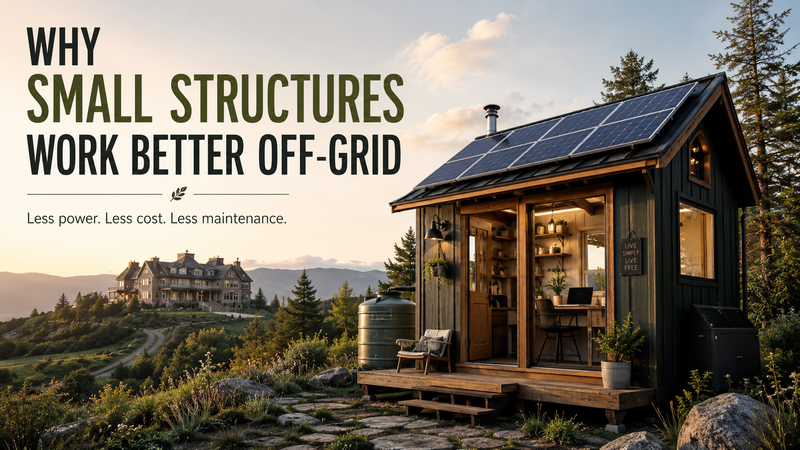
When people imagine off-grid living, they often picture a full cabin, a large rural house, or a custom-built retreat hidden somewhere in the woods. That vision can be beautiful, but it can also be expensive, slow, and difficult to manage. A big house creates big responsibilities, especially when you are trying to power, heat, repair, and maintain it without normal grid support.
For many beginners, a smaller structure is a smarter starting point.
A shed, small cabin, garage, trailer, workshop, tiny barn, or compact utility building may not look impressive at first. But for off-grid use, small spaces often have a major advantage: they are easier to control. They need less power, less heat, fewer materials, fewer repairs, and less money to become usable.
That does not mean a small structure is automatically perfect. It still needs to be dry, safe, legal, and practical. But if your goal is to start an off-grid retreat without turning it into a massive construction project, small is often better than big.
Big Houses Create Big Off-Grid Problems
A large house can be comfortable, but it also demands more from every system around it. More rooms mean more space to heat, more lights to power, more windows to seal, more roof area to maintain, more furniture to buy, and more places where something can fail.
On the grid, some of these problems are hidden. You flip a switch, run appliances, heat the whole house, and pay the bill later. Off-grid, every decision becomes more visible. If a space leaks heat, your heating system works harder. If you use too much electricity, your batteries drain faster. If the roof is large and old, repairs become more expensive.
A big off-grid house often needs:
a larger solar system;
more battery storage;
stronger heating and cooling;
more insulation;
more maintenance;
more tools and materials;
more time to clean and repair.
For a first off-grid project, that can become overwhelming. You may spend more time fixing the building than actually using it.
A small structure keeps the project closer to reality. Instead of trying to make an entire house work, you focus on one compact space and make it genuinely useful.
Small Spaces Need Less Power
Power is one of the most important parts of any off-grid setup. Even if you want a simple retreat, you still need energy for basic lighting, phone charging, a laptop, small tools, internet equipment, or maybe a compact fridge.
The larger the space, the easier it is to underestimate energy needs. A big house encourages more devices, more lights, more rooms, and more “normal home” habits. That can quickly push you toward a larger solar system and more expensive battery storage.
A small structure encourages discipline. You only power what you actually need.
For example, a compact off-grid retreat may only require:
several LED lights;
phone and laptop charging;
a small fan;
a router or satellite internet device;
occasional tool charging;
a small appliance used carefully.
That kind of setup is much easier to test with a portable power station or a modest solar panel system. You can learn your real usage before committing to permanent equipment.
This is one of the biggest advantages of starting small. You do not have to guess everything in advance. You can live with the space, observe your habits, and upgrade only when there is a clear reason.
They Are Easier to Heat and Cool
Heating and cooling are where small structures really show their value. A compact space warms up faster, loses less total heat, and can often be made comfortable with simpler solutions. In a big house, temperature control can become one of the biggest off-grid challenges.
A small retreat gives you more options. You may be able to improve comfort with basic insulation, draft sealing, curtains, rugs, ventilation, shade, and careful layout. You can focus your effort on the space you actually use instead of trying to control several empty rooms.
This matters especially for seasonal use. If you plan to visit on weekends or use the place as a part-time retreat, you probably do not need a full-size home. You need one reliable space that can become comfortable quickly.
A smaller structure can work well as:
a weekend sleeping cabin;
a remote work room;
a reading or writing retreat;
a fishing or hunting base;
a garden office;
a compact emergency shelter;
a seasonal tiny home.
In each case, the point is not to recreate a normal house. The point is to create a simple, manageable space that supports a specific use.
Repairs Stay More Manageable
Every old structure needs some work. The question is how much work and how expensive it becomes.
With a large building, repairs can spread quickly. A roof problem may cover a huge area. Drafty windows may appear in every room. Old flooring may need replacement across the whole house. Moisture problems may hide in multiple walls. Even simple improvements can become expensive because there is so much surface area.
With a small structure, repairs are usually easier to understand and control. The roof is smaller. The floor area is smaller. The number of windows and doors is lower. Insulation requires fewer materials. Interior improvements can be done in stages without taking over your entire budget.
A small structure makes it easier to ask practical questions:
Is the roof worth repairing?
Can the door be secured?
Can the floor handle normal use?
Can the walls be insulated?
Can water be kept out?
Can ventilation be improved?
Can the space become safe without major rebuilding?
If the answers are yes, the structure may be a good candidate. If the answers are no, it is easier to walk away before spending too much.
This is why small buildings are useful for beginners. They make the project less abstract. You can see the problems, estimate the work, and decide what matters first.
Small Structures Are Better for Testing Off-Grid Life
Off-grid living can sound romantic until you deal with the details. You have to think about energy, water, waste, heating, storage, weather, access, tools, safety, insects, humidity, mud, snow, poor signal, and unexpected repairs. It is better to discover those realities in a small, affordable project than in a large, expensive one.
A small structure gives you a testing ground. You can spend a weekend there and quickly learn what is missing. Maybe you need better ventilation. Maybe the solar panel location is wrong. Maybe the road is worse after rain. Maybe the space gets too hot in summer or too cold at night. Maybe you need more storage and less furniture.
These lessons are valuable because they help you avoid overbuilding. Instead of designing a perfect retreat in your imagination, you improve the place based on real use.
That is often the smartest path:
Make the space dry.
Make it secure.
Add basic power.
Improve lighting.
Test sleeping or working there.
Fix the most annoying problems.
Upgrade only after you know what you need.
This approach keeps the project practical. You do not need to solve every off-grid problem before you start. You only need to create a usable base and improve it over time.
Where Forgotten Structures Fit In
The best small off-grid space is not always a new tiny house. Sometimes it is a structure that already exists but has been ignored.
Old sheds, garages, trailers, barns, workshops, cabins, and utility buildings can sometimes become practical off-grid spaces if their basic condition is good enough. They may already have a roof, walls, doors, shade, a floor, and a useful location. That does not make them finished homes, but it does make them potential starting points.
The key is to look at them realistically. A forgotten structure is useful only if it can become dry, safe, and functional without costing more than a new build. But when the right structure is in the right place, it can save time and money.
For a deeper look at this idea, read this guide on forgotten structures that can become off-grid homes:
https://medium.com/@volodymyrzh/forgotten-structures-that-can-become-off-grid-homes-dc710891907d
This fits naturally with the small-structure approach. Instead of searching only for land or planning a new cabin from scratch, you start noticing what already exists and what could be adapted.
Visual Examples Help Before You Choose
Choosing between a small structure and a large one is easier when you think visually. A big house may look more comfortable at first, but it also carries more hidden costs. A small shed or cabin may look too simple, but it may be much easier to power, heat, repair, and use.
Visual examples help you compare the real trade-offs. You can see how a compact structure might hold a bed, a desk, a small power setup, shelves, tools, and basic lighting without becoming complicated. You can also see why oversized spaces often create more work than value in the early stages.
You can watch the related video here:
The goal is not to choose the smallest possible structure. The goal is to choose the smallest structure that can honestly support your needs.
What a Good Small Off-Grid Structure Should Have
A small structure does not need to be perfect, but it should have the right basic qualities. If it fails on the fundamentals, the project may become frustrating or unsafe.
A good candidate should have:
a roof that can be repaired or maintained;
walls that can keep out wind and rain;
a floor or base that is stable enough;
a door that can be secured;
enough ventilation;
space for basic furniture;
a reasonable place for solar or portable power;
safe access from a road, trail, or driveway;
no obvious major structural failure.
It also helps if the structure has a clear purpose. A small space works best when it is designed around one main use. It can be a sleeping cabin, a remote office, a weekend retreat, a tool base, or a backup shelter. Trying to make one tiny structure do everything at once can make it feel cramped and frustrating.
Clarity makes the project easier. When you know the main purpose, you know what to prioritize.
Small Does Not Mean Uncomfortable
One mistake people make is thinking small means primitive. That is not always true. A small off-grid structure can feel surprisingly comfortable if it is planned well.
Comfort often comes from simple details:
warm lighting;
a dry floor;
good airflow;
clean storage;
a comfortable chair or bed;
sealed drafts;
basic insulation;
useful shelves;
a small work surface;
less clutter.
A large unfinished building can feel cold and unpleasant. A small finished space can feel calm and efficient. The difference is not only size. It is whether the space has been improved with real use in mind.
For off-grid living, comfort should be practical. You want a space that is easy to arrive at, easy to use, easy to leave, and easy to maintain. Small structures are often better at that because they force you to focus on essentials.
Final Thought
Small structures are often better for off-grid living because they make the project more manageable. They need less power, less heat, fewer repairs, fewer materials, and less money to become useful. They also help you test off-grid life before committing to a bigger and more expensive setup.
A large house can be beautiful, but it can also become a heavy responsibility. A small shed, cabin, trailer, garage, workshop, or utility building can give you something more valuable at the beginning: a realistic starting point.
If you are new to off-grid projects, start with the smallest structure that can meet your real needs. Make it dry. Make it safe. Add basic power. Improve comfort slowly. Learn from the site before you spend too much.
In many cases, small is not a compromise. It is the smartest way to begin.
Comments
No comments yet. Be the first to comment!