What Is Ah? Amp-Hours Explained Simply
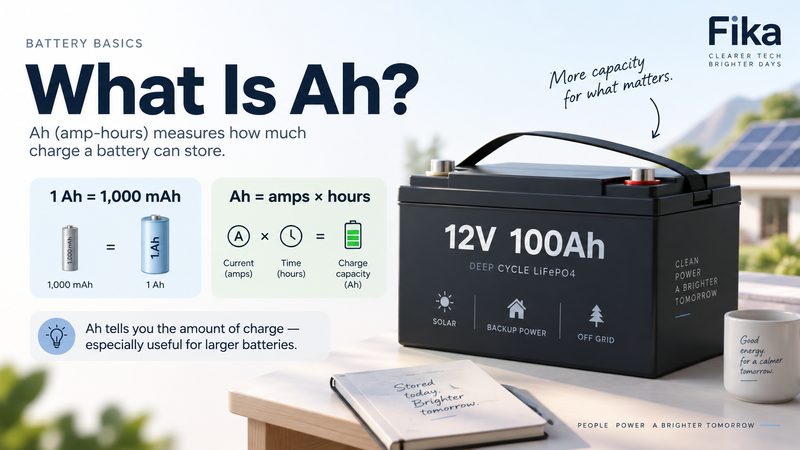
If you compare car batteries, solar batteries, power stations, or other larger battery systems, you will often see capacity expressed in Ah.
Ah stands for amp-hours. It measures electrical charge — not energy by itself.
One amp-hour means a battery can theoretically deliver one amp of current for one hour. But voltage still matters, so two batteries with the same Ah rating can store very different amounts of energy.
For the broader relationship between Ah, mAh, Wh, and battery capacity, see:
https://medium.com/@volodymyrzh/battery-capacity-explained-mah-wh-amp-hours-decoded-1dc676be5a38
What Does Ah Mean?
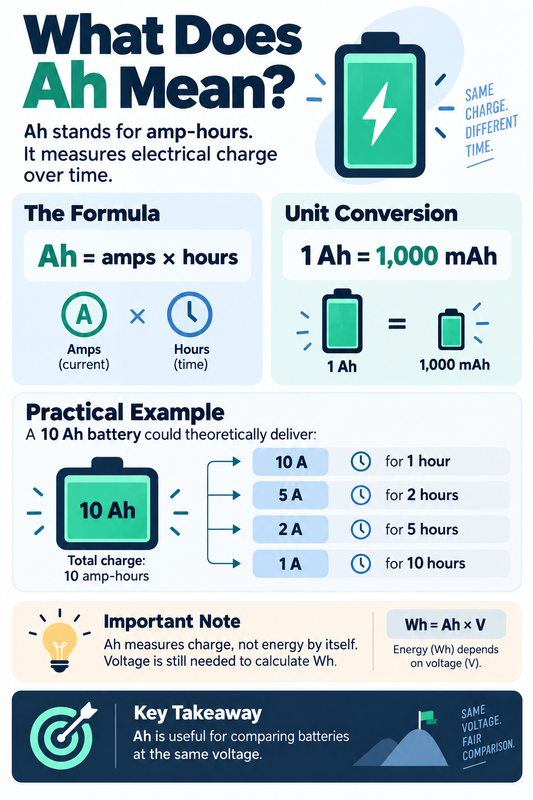
An amp-hour combines electrical current and time:
Ah = amps × hours
In simplified terms, a 10 Ah battery could theoretically provide:
10A for 1 hour;
5A for 2 hours;
2A for 5 hours;
1A for 10 hours.
These examples describe the same total amount of electrical charge.
Real-world batteries are less predictable because usable capacity can change with temperature, discharge rate, battery chemistry, age, and system losses. Still, the basic relationship makes Ah useful for understanding battery size.
Ah vs mAh
Ah and mAh measure the same thing: electrical charge.
The only difference is scale:
1 Ah = 1,000 mAh
Therefore:
2 Ah = 2,000 mAh
5 Ah = 5,000 mAh
20 Ah = 20,000 mAh
100 Ah = 100,000 mAh
Small consumer batteries are often described in mAh because the numbers are convenient for phones, cameras, earbuds, and power banks.
Larger battery systems usually use Ah.
For a more detailed explanation of milliamp-hours, see:
https://digitalowl.fika.bar/what-is-mah-milliamp-hours-explained-simply-01M2GD3RKJD95V79BPHEW37S32
Where Is Ah Commonly Used?
Amp-hours appear frequently on larger batteries, including:
automotive batteries;
RV and marine batteries;
deep-cycle batteries;
solar battery banks;
lead-acid batteries;
LiFePO₄ batteries;
backup-power systems.
For example, you may see a battery labelled:
12V 100Ah
The 100Ah describes charge capacity. The 12V describes nominal voltage.
Together, those specifications can be used to estimate stored energy.
Ah Does Not Measure Energy by Itself
This is the most important limitation of Ah.
Suppose you compare:
Battery A: 12V, 100Ah
and:
Battery B: 24V, 100Ah
Both are rated at 100Ah, but they do not store the same amount of energy.
Using:
Wh = Ah × V
Battery A stores approximately:
100Ah × 12V = 1,200Wh
Battery B stores approximately:
100Ah × 24V = 2,400Wh
The Ah rating is identical, but the 24V battery stores approximately twice as much energy.
That is why Ah alone should not be used to compare batteries operating at different voltages.
Does a Higher Ah Rating Mean Longer Runtime?
A higher Ah rating generally represents more charge capacity when you compare batteries operating at the same voltage.
For example:
12V 50Ah
versus:
12V 100Ah
The 100Ah battery contains roughly twice the charge capacity and, under similar conditions, can potentially provide substantially longer runtime.
But Ah still does not determine runtime by itself.
Runtime depends on:
battery voltage;
connected load;
usable capacity;
efficiency losses;
discharge rate;
temperature;
battery condition.
This is why battery capacity and battery runtime should be treated as separate concepts.
For a deeper explanation, see:
https://digitalowl.fika.bar/battery-capacity-vs-battery-runtime-what-s-the-difference-01M2GCG8KYW591PS3H17YBZZKY
Why Large Batteries Often Use Ah Instead of mAh
Technically, a 100Ah battery could be labelled:
100,000 mAh
But that would make the specification unnecessarily large and harder to read.
Ah is simply a more practical unit at larger scales.
The relationship is similar to using metres instead of millimetres when measuring a room. Both units describe the same type of quantity, but one is more convenient for the scale involved.
Ah vs Wh: Which Is More Useful?
Ah is useful when comparing similar batteries operating at the same nominal voltage.
For example, comparing two 12V LiFePO₄ batteries rated at 50Ah and 100Ah is straightforward.
But when voltages differ, Wh is usually the better comparison metric because it includes both charge capacity and voltage.
Remember:
Ah = charge capacity
Wh = stored energy
To move from Ah to Wh:
Wh = Ah × Voltage
So a complete battery specification is much more informative when it provides both voltage and Ah — or simply states the total Wh directly.
The Simple Rule
Remember amp-hours this way:
Ah tells you how much electrical charge a battery can deliver over time.
It is the same type of measurement as mAh, just expressed on a larger scale:
1 Ah = 1,000 mAh
Ah is useful for comparing batteries at the same voltage, but it should not be treated as a universal measure of stored energy.
If you want to compare batteries with different voltages, convert their capacity to watt-hours (Wh) first.
Comments
No comments yet. Be the first to comment!