What Is a Watt-Hour? Wh Explained Simply
When comparing power banks, laptop batteries, portable power stations, or home-backup systems, one of the most useful specifications is Wh.
Wh stands for watt-hour. It measures energy — how much electrical energy a battery can store or a device can consume over time.
Unlike mAh or Ah, watt-hours take voltage into account. That makes Wh particularly useful when comparing batteries that operate at different voltages.
For a broader explanation of battery capacity and the relationship between mAh, Ah, and Wh, see:
https://medium.com/@volodymyrzh/battery-capacity-explained-mah-wh-amp-hours-decoded-1dc676be5a38
What Does Wh Mean?
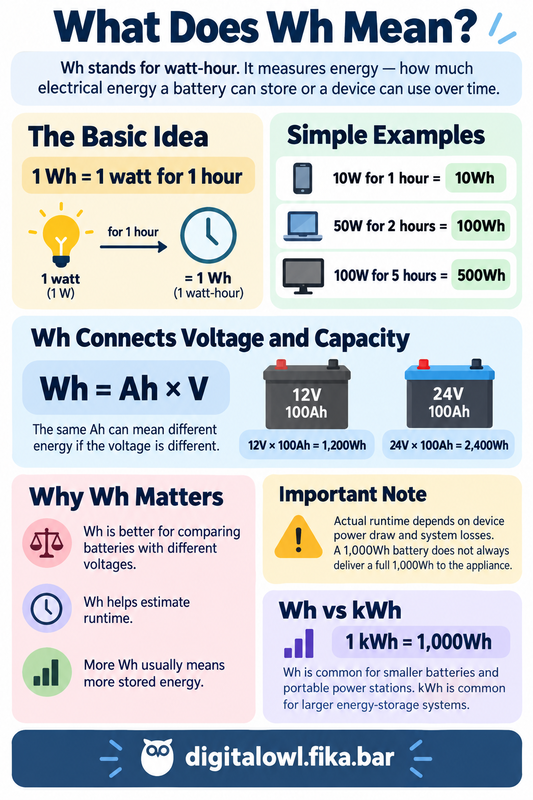
A watt-hour combines power and time.
In simple terms:
1 Wh = 1 watt used for 1 hour
So:
a 10W device running for 1 hour uses 10Wh;
a 10W device running for 5 hours uses 50Wh;
a 100W device running for 2 hours uses 200Wh.
The same unit can also describe how much energy a battery stores.
A battery rated at 500Wh contains roughly enough rated energy to supply 500 watts for one hour, 100 watts for five hours, or 50 watts for ten hours — before accounting for real-world losses and operating limits.
Wh therefore gives you a useful bridge between battery capacity and device runtime.
That relationship is explored in more detail here:
https://digitalowl.fika.bar/battery-capacity-vs-battery-runtime-what-s-the-difference-01M2GCG8KYW591PS3H17YBZZKY
Why Voltage Matters to Watt-Hours
Amp-hours measure charge, but they do not tell you total stored energy unless voltage is known.
The basic relationship is:
Wh = Ah × V
For example, consider a battery rated:
12V, 100Ah
Its nominal energy capacity is approximately:
12V × 100Ah = 1,200Wh
Now compare it with:
24V, 100Ah
That gives:
24V × 100Ah = 2,400Wh
Both batteries have the same Ah rating, but the second stores roughly twice as much nominal energy because its voltage is twice as high.
For more on why voltage changes battery-capacity calculations, see:
https://digitalowl.fika.bar/what-is-voltage-battery-voltage-explained-simply-01M2GH66XEB0MHMG3Z2Y7SNBEE
Why Wh Is Better for Comparing Different Batteries
Suppose two batteries are both rated at 10,000mAh.
Battery A operates at 3.7V:
10Ah × 3.7V = 37Wh
Battery B operates at 12V:
10Ah × 12V = 120Wh
Looking only at mAh would make them appear identical.
Looking at Wh immediately shows that they contain very different amounts of energy.
This is why Wh is usually the clearer metric for comparing:
laptop batteries;
large power banks;
portable power stations;
solar batteries;
backup batteries;
energy-storage systems.
What Does a 1,000Wh Battery Mean?
A battery rated at 1,000Wh has a nominal energy capacity of approximately one kilowatt-hour.
In theory, that could support:
100W for 10 hours
or:
500W for 2 hours
or:
1,000W for 1 hour
But these are theoretical examples.
Actual usable runtime is normally lower because of factors such as:
inverter losses;
voltage conversion;
battery-management-system consumption;
standby power;
temperature;
discharge limits.
So a 1,000Wh rating should be treated as a measure of rated stored energy, not a guarantee that exactly 1,000Wh will reach every connected appliance.
Wh vs kWh
Large battery systems often use kilowatt-hours (kWh) instead of Wh.
The conversion is simple:
1 kWh = 1,000Wh
Therefore:
500Wh = 0.5kWh
1,000Wh = 1kWh
5,000Wh = 5kWh
Portable power stations commonly use Wh because their capacities are usually measured in hundreds or a few thousand watt-hours.
Home batteries and larger energy-storage systems are more often described in kWh.
Does More Wh Always Mean a Better Battery?
Not necessarily.
More Wh means more rated stored energy, which generally allows longer runtime under the same load.
But capacity is only one specification.
A battery system must also provide enough power for the devices you want to connect. A large battery with a low-output inverter may have plenty of stored energy but still be unable to operate a high-power appliance.
Battery chemistry, usable capacity, charging speed, cycle life, weight, and expandability may also matter depending on the application.
The Simple Rule
Remember watt-hours this way:
Wh tells you how much energy a battery stores.
It incorporates both charge capacity and voltage, which makes it much more useful than Ah or mAh alone when comparing different battery systems.
The core formula is:
Wh = Ah × V
And when estimating runtime, Wh gives you the energy side of the calculation.
If you want to understand whether a battery can power a specific device, however, you also need to look at watts (W) — which is the next important distinction.
Comments
No comments yet. Be the first to comment!