Battery Capacity vs Battery Runtime: What’s the Difference?
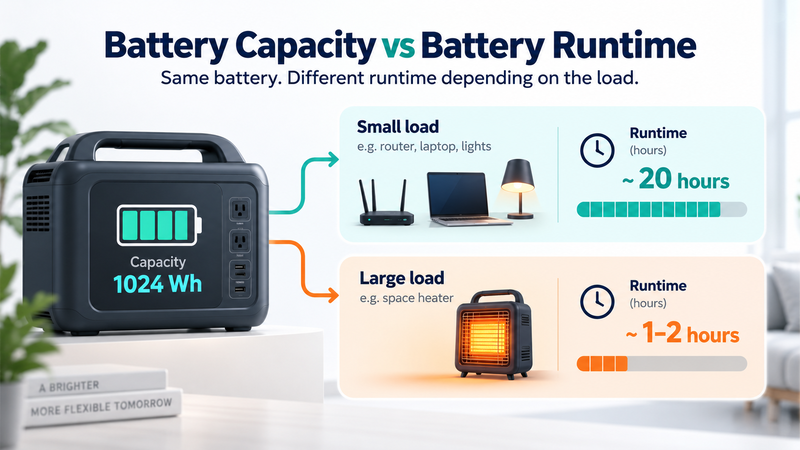
Battery capacity and battery runtime are closely connected, but they describe two different things. Capacity tells you how much energy a battery can store. Runtime tells you how long that stored energy can power a specific device.
This distinction becomes especially important when choosing a power bank, portable power station, or home-backup battery. A larger battery usually provides longer runtime, but capacity alone cannot tell you exactly how many hours a device will operate. For a broader explanation of battery capacity and the units used to measure it, see:
https://medium.com/@volodymyrzh/battery-capacity-explained-mah-wh-amp-hours-decoded-1dc676be5a38
Capacity Is Stored Energy; Runtime Is the Result
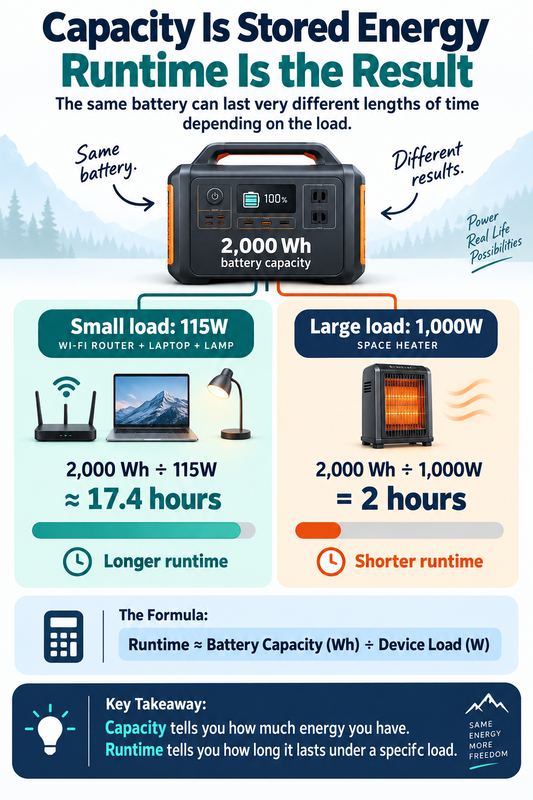
Think of battery capacity as the amount of energy available before you start using it. For larger battery systems, that energy is most usefully expressed in watt-hours (Wh).
Runtime appears only after you connect a load.
A 1,000 Wh battery does not have one fixed runtime. Its runtime depends on how quickly the connected equipment consumes that energy.
The basic relationship is:
Runtime ≈ Battery Capacity (Wh) ÷ Device Load (W)
If the same 1,000 Wh battery powers a 100W device, its theoretical runtime is:
1,000 Wh ÷ 100W = 10 hours
Connect a 500W appliance instead:
1,000 Wh ÷ 500W = 2 hours
The battery capacity has not changed. The load has.
That is the central difference between capacity and runtime.
Why the Same Battery Can Have Very Different Runtimes
Battery specifications sometimes create the impression that capacity alone determines how useful a battery will be. In practice, two people using the same power station can experience dramatically different runtimes.
Someone powering a router, laptop, and a few lights may use only 100–150W. Another person might connect a refrigerator, television, and other appliances that collectively draw several hundred watts.
Even if both start with the same battery capacity, their energy is being consumed at very different rates.
Runtime can also change while an appliance is operating. A refrigerator, for example, does not normally draw its rated running power continuously. Its compressor cycles on and off. Air conditioners, pumps, and other motor-driven equipment can behave in similar ways.
This is why real runtime should be based on actual or average consumption, not simply the highest wattage printed on an appliance label.
A Simple Capacity vs Runtime Example
Imagine two portable power stations, each with 2,000 Wh of battery capacity.
The first powers:
Wi-Fi router: 15W
Laptop: 60W
Lights: 40W
Combined load:
115W
The theoretical runtime is:
2,000 Wh ÷ 115W ≈ 17.4 hours
Now connect the same battery to a 1,000W appliance:
2,000 Wh ÷ 1,000W = 2 hours
In reality, both results would normally be somewhat lower because energy is lost through the inverter, voltage conversion, system electronics, and other processes.
The important point is that 2,000 Wh describes the available energy in both cases, while runtime changes according to the load.
Why Advertised Capacity Does Not Equal Exact Runtime
Even when you know both battery capacity and device wattage, the simple calculation gives only a starting estimate.
Real-world runtime can be reduced by:
inverter and conversion losses;
battery-management-system consumption;
standby power;
temperature;
battery age;
high discharge rates;
changing appliance loads;
safety reserves built into the battery system.
For example, a theoretical 10-hour result might become eight or nine hours under real operating conditions.
This does not mean the battery specification is necessarily inaccurate. It means some stored energy is consumed or lost before useful electricity reaches the connected device.
Capacity Also Does Not Tell You What the Battery Can Run
There is another important distinction: battery capacity is not the same as power output.
A system may contain 3,000 Wh of stored energy but have an inverter capable of delivering only 1,500W continuously. In that case, it cannot run a 2,000W appliance even though the battery contains enough energy to power such a load for more than an hour in theory.
When evaluating a battery system, check three separate specifications:
Capacity in Wh — how much energy is stored.
Continuous output in W — how much power can be delivered continuously.
Surge output in W — how much short-term power is available for appliance startup.
Capacity mainly determines how long equipment can operate. Output determines whether the equipment can operate at all.
Which Number Should You Use When Planning Backup Power?
Start with runtime, not battery size.
List the devices you actually need, estimate their combined wattage, and decide how many hours you want them to operate.
For example:
250W average load × 8 hours = 2,000 Wh
A battery rated at exactly 2,000 Wh would still leave little room for conversion losses or unexpected additional use, so a larger capacity would usually provide a more practical margin.
This approach is more reliable than simply buying the largest battery you can afford or assuming that a specific Wh rating automatically translates into a certain number of backup hours.
The Key Difference
The simplest way to remember the relationship is:
Battery capacity = how much energy you have.
Battery runtime = how long that energy lasts under a specific load.
A battery can therefore have a large capacity and still provide short runtime when powering demanding appliances. The same battery may run low-power electronics for many hours.
Once you separate these two concepts, comparing portable power stations and planning backup power becomes much easier.
Comments
No comments yet. Be the first to comment!